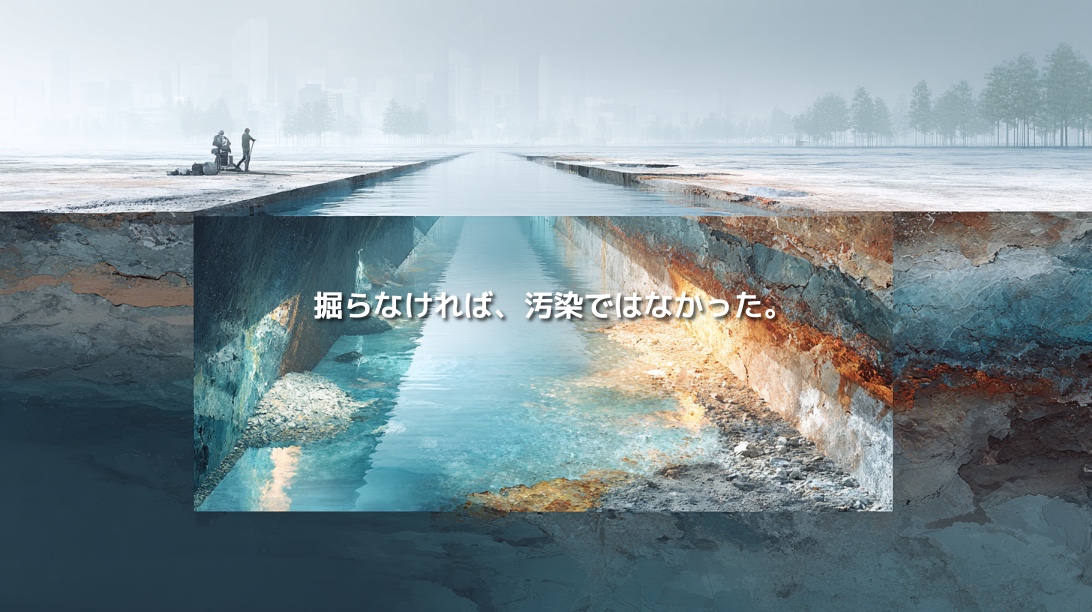
New tunnels continue to be excavated beneath our cities.
Railways, roads, underground shopping areas, water and sewer systems, and utility tunnels—we have expanded farther underground to avoid congestion at the surface and support the functions of modern cities.
Yet underground space is not simply empty land waiting to be used.
Geological formations created over thousands or tens of thousands of years may contain arsenic, lead, fluorine, selenium, boron, and other substances as natural components of rocks and soil.
They were not discharged by a factory or buried through illegal dumping. They were already present in the geology of the land.
When soil and rock are excavated for tunnels and underground structures, however, substances that had remained sealed underground are exposed to air and rainwater and transported elsewhere.
Materials that had been dormant within natural geological formations begin to move because of human development.
At that point, whose “pollution” do they become?
Soil Contamination Is Not Limited to Former Factory Sites
When people hear the term “soil contamination,” many imagine former industrial sites or chemical leaks.
Land contaminated by hazardous substances from past industrial activity certainly exists. However, some potentially harmful substances occur in soil independently of human activity because of the way the underlying geology was formed.
The Japanese archipelago was shaped by complex geological processes, including the subduction of tectonic plates, volcanic activity, and the uplift of marine sediments.
These processes distributed rocks and sediments containing various elements throughout the country.
Japan’s National Institute of Advanced Industrial Science and Technology, or AIST, has compiled data on the concentrations and leaching characteristics of heavy metals in natural rocks and sediments as “geogenic background information.”
In other words, even within Japan, the types and concentrations of elements found in soil vary according to local geology.
These differences cannot be identified simply by looking at the soil’s color or texture.
Geogenic heavy metals and metalloids may be present beneath forested mountains, under cities, or within sediments carried by rivers.
Something being natural does not necessarily mean that it is safe.
“Being Present” and “Leaching Out” Are Not the Same
The detection of heavy metals or metalloids in soil or rock does not automatically mean that human health is being harmed.
At least two separate questions must be considered when assessing soil contamination.
The first is how much of the substance is contained in the soil.
The second is how much of it can dissolve into water.
If an element is strongly bound to soil particles or minerals and remains largely immobile, opportunities for human or ecological exposure may be limited.
If it dissolves into rainwater or groundwater, however, it may be transported through the surrounding environment as the water moves.
Under Japan’s Soil Contamination Countermeasures Act, health risks are broadly considered through two principal exposure pathways: the direct ingestion of contaminated soil and the consumption of substances that have leached from soil into groundwater or other water sources.
Finding a substance above a regulatory standard is therefore not identical to confirming that actual health damage is occurring.
The questions that matter are not limited to whether the substance exists. We must also ask:
- In what chemical and physical form is it present?
- Can it dissolve into water?
- Is there a pathway through which it can reach groundwater or rivers?
- Is that water used for drinking?
- Is the soil exposed within places where people live?
The critical issue is the pathway connecting the substance to people and ecosystems.
This distinction is essential both to avoid underestimating genuine danger and to avoid creating unnecessary fear.
Excavation Changes the Environmental Conditions Underground
Soil and rock deep underground exist under conditions very different from those at the surface.
They have limited contact with air, while moisture, temperature, and oxidation-reduction conditions remain relatively stable.
Elements such as arsenic may be incorporated into minerals and remain part of a geological formation for extremely long periods.
Excavation changes those conditions.
Rocks are broken apart, increasing their exposed surface area. They come into contact with air. Rain falls on them at temporary storage sites. The balance of moisture and oxygen within the soil changes.
Minerals that were previously stable may oxidize, making the elements they contained more likely to dissolve into water.
In 2024, a research team from Tokyo University of Agriculture and Technology, AIST, and other institutions investigated the Yurakucho Formation beneath the Tokyo Lowland.
The researchers found that, at certain depths, arsenic leached from the soil at concentrations exceeding Japan’s soil-leaching standard.
Their research showed that the arsenic was concentrated in raspberry-shaped particles of pyrite known as framboidal pyrite.
When soil containing this pyrite is excavated and exposed to the atmosphere at the surface, oxidation may make the arsenic more likely to leach out.
While underground, the arsenic-bearing material had remained relatively stable as part of the geological formation.
Human excavation changed the environmental conditions surrounding it.
The problem is not that arsenic suddenly appears. The arsenic already existed.
The problem is that it can be transformed into a more mobile form.
The Ground Beneath Cities Has Its Own History
The Yurakucho Formation is a relatively young geological formation extending beneath Tokyo’s traditional low-lying districts and the coastal lowlands surrounding Tokyo Bay.
Sediments accumulated in areas once influenced by the sea and rivers, eventually forming the ground on which the modern city was built.
Roads, homes, and skyscrapers now stand at the surface.
Below them remain traces of the seas, rivers, wetlands, and sedimentary environments that existed before the city.
Urban development does not advance into an empty underground space.
It enters the previously invisible memory of the land.
When excavated soil containing geogenic heavy metals becomes an issue during tunnel construction, it is not necessarily because a particular company created a new hazardous substance.
The issue arises because geological formations created by natural processes over long periods come into contact with modern infrastructure development.
This does not fit easily into a simple structure of perpetrator and victim.
That is precisely why responsibility can be difficult to define.
Excavated Material Emerges as Construction-Generated Soil
Tunnel construction produces enormous quantities of soil and rock as excavation progresses.
Ordinary construction-generated soil may be reusable as embankment or land-development material at another project.
Soil containing geogenic heavy metals or metalloids above relevant standards, however, cannot simply be transported anywhere.
If the soil is exposed to rainwater at its destination, leachate may affect the surrounding soil or groundwater.
Even when the material is reused, project operators must assess its characteristics, the geology of the receiving site, groundwater movement, and how water is used in the surrounding area. Appropriate controls must then be designed.
In 2023, Japan’s Ministry of Land, Infrastructure, Transport and Tourism revised its technical manual for rocks and soils containing geogenic heavy metals encountered during construction.
The manual covers investigation, risk assessment, countermeasures, construction practices, and post-construction monitoring.
Available measures include:
- Impermeable barriers and containment systems that isolate soil from rainwater and groundwater
- Immobilization treatments that make heavy metals less soluble
- Adsorption layers that capture substances after they leach
- Drainage and water-treatment systems
- Monitoring of groundwater and leachate
There is no single solution that applies to every site.
The necessary controls depend on soil characteristics, the target substance, its concentration, the likelihood of oxidation, rainfall, topography, groundwater conditions, and the intended use of the land.
Containment is not the end of the responsibility. The structure must also be monitored to ensure that it continues to function over the long term.
The issue of construction-generated soil is therefore not limited to where the soil is transported.
It also concerns the condition in which the soil must be maintained after it arrives.
“Geogenic” Is Not a Disclaimer
The term “geogenic heavy metals” can create two common misunderstandings.
The first is that a naturally occurring substance must be safe.
Nature contains many substances that can harm human health. A natural origin may indicate that no illegal human activity created the substance, but it does not guarantee the absence of health or environmental effects.
The second misunderstanding is that all soil exceeding a regulatory standard should be excavated and removed.
Excavating soil and transporting it to a distant treatment facility also creates environmental impacts, including dump-truck traffic, carbon dioxide emissions, and the need to secure another receiving site.
Uniformly removing soil from places where exposure pathways have already been blocked may simply create a different set of burdens.
The appropriate response is neither to dismiss the issue because the substance is natural nor to remove everything simply because it has been detected.
What matters is determining who could be affected, through which pathway, and to what extent—and then managing the soil according to that risk.
Regulation Is Moving from Detecting Contamination to Managing Risk
Soil containing geogenic heavy metals may extend continuously across a broad geological formation.
If all of it is treated in the same way as localized contamination caused by industrial activity, the scale of investigation and remediation can become enormous. The movement and reuse of excavated soil also become more difficult.
Yet if regulations are relaxed too far, excavation could spread previously immobile substances to other locations.
Japan’s Ministry of the Environment has been reviewing the Soil Contamination Countermeasures Act.
Following an interim report issued in February 2026, authorities have been considering how areas containing geogenic heavy metals should be designated, with greater emphasis placed on managing soil when it is excavated and transported off-site.
The ministry’s Soil System Subcommittee also met in June 2026 to discuss methods for distinguishing geogenic contamination from anthropogenic contamination and the management of soil after removal.
This discussion does not seek to declare naturally contaminated soil “safe.”
Instead, it attempts to distinguish between a substance remaining within its original geological setting and that substance being excavated and transported elsewhere.
The focus is shifting toward actual health risks and preventing the spread of contaminants.
The objective is not to remove geology itself.
It is to prevent human activity from creating new pathways of exposure.
Was the Contamination Created by Nature or by People?
Arsenic existed underground because of natural geological processes.
But people excavate it, crush the surrounding rock, expose it to air and rain, and transport it to another location.
There is no simple answer to the question of who created the contamination.
Nature created the substance.
Human activity created the conditions that allowed it to move.
Responsibility does not mean accepting blame for arsenic existing underground.
It means investigating soil whose condition has been changed by excavation, communicating its characteristics, managing it in an appropriate location, and monitoring it for as long as necessary.
Construction projects appear to end when the completed structure opens.
The excavated soil, however, continues to be exposed to rain, interact with water, and affect the surrounding landscape long after construction is finished.
As cities expand farther underground, we must design not only what we build at the surface but also how we interact with the geological formations beneath us.
If we had not excavated it, it would not have become pollution.
More precisely, without excavation, the substance already present underground might never have emerged as something society needed to manage.
The arsenic beneath our cities is part of the land that nature created.
But from the moment we bring it to the surface, its future becomes a human responsibility.
Related Articles
- Where Do Cities Send Their Excavated Soil? The “Development Debt” Shifted to Mountains and Valleys
- Why Doesn’t Excavated Soil Circulate? The Barriers of Time, Distance, and Responsibility
Key Sources
- Ministry of Land, Infrastructure, Transport and Tourism: Manual for Managing Rocks and Soils Containing Geogenic Heavy Metals in Construction Projects, 2023 Edition
- AIST: Mechanism of Geogenic Arsenic Leaching from the Yurakucho Formation Beneath the Tokyo Lowland
- AIST: Publication of the Basic Surface Soil Assessment Map for Japan’s Chugoku Region
- Ministry of the Environment: Soil-Related Guidelines and Manuals
- Ministry of the Environment: Soil System Subcommittee