What It Means to Protect a Forest Before the Damage Becomes Visible
Environmental Challenges Across Japan’s 47 Prefectures | Part 2: Aomori
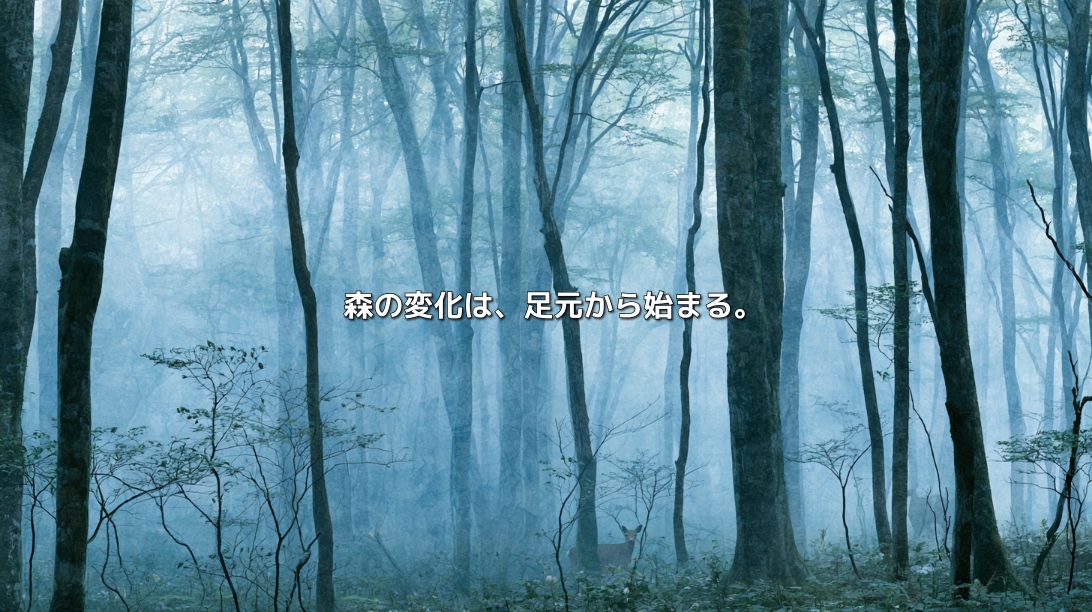
Shirakami-Sanchi brings to mind a vast forest of old beech trees—a landscape shaped by generations of growth, with relatively little human disturbance.
Straddling Aomori and Akita prefectures in northern Japan, this mountainous region was inscribed on the UNESCO World Heritage List in 1993.
But does recognition as a World Heritage site ensure that a forest will remain protected as it is?
Around Shirakami-Sanchi, records of sika deer are increasing. This does not mean that deer have already devastated its beech forests. The question is how to recognize changes around the forest before extensive damage becomes visible.
That question opens a deeper conversation about conservation in Aomori.
The Forest Is More Than Its Oldest Trees
Across Shirakami-Sanchi, mature beech trees stand above young saplings, dwarf bamboo, and other understory plants. Birds, insects, and mammals live among these layers.
A forest continues through the relationships between them—and through the growth of the trees that will eventually replace those standing today.
Beech trees do not produce the same quantity of nuts every year. Abundant harvests alternate with leaner years, changing the food available to wildlife. When an old tree falls, sunlight reaches the ground, creating opportunities for seedlings and forest-floor plants.
Even where the canopy appears unchanged, renewal continues beneath it.
To understand the forest’s health, we must look beyond the survival of its largest trees. We need to see what grows at their feet, whether young trees are developing, and how animals move through the landscape.
The Boundary That Deep Snow Has Helped Maintain
Shirakami-Sanchi is a land of heavy snow.
The Ministry of the Environment identifies deep snowfall as one of the conditions that have historically made the region difficult for sika deer and wild boar to inhabit.
Snow does more than shape the winter scenery. It influences which animals can survive the season, when plants begin to grow, and when meltwater reaches the rivers.
Shirakami’s beech forests have developed within these conditions.
However, finding deer nearby does not, by itself, establish that declining snowfall caused their arrival.
Animal movements, populations in neighboring areas, and winter conditions all need to be examined together. When a change seems readily connected to climate change, careful attention to cause and effect becomes especially important.
What the Records Around the Forest Reveal
A Ministry of the Environment survey for fiscal 2024 documented 269 sighting records, totaling 293 deer observations, in municipalities surrounding Shirakami-Sanchi.
These covered Ajigasawa, Nishimeya, and Fukaura in Aomori Prefecture, and Noshiro, Happo, and Fujisato in Akita Prefecture.
The figure of 293 is not an estimate of 293 distinct deer. The same animal may have been recorded at different times or locations.
The annual totals listed in the survey rose from 59 deer observations in fiscal 2021 to 229 in 2022, 241 in 2023, and 293 in 2024. However, monitoring effort and survey conditions can vary. These figures cannot be read directly as a rate of population growth.
They indicate that deer detections around the area have become more frequent and warrant continued monitoring.
Acoustic surveys in fiscal 2024 also detected a type of male call described as a “howl” at 15 of 17 monitoring sites. The report suggests that the types of calls recorded may indicate an early stage of deer encroachment. Missing recordings and equipment failures, however, mean that the acoustic results should be treated as provisional.
More detections, an established population, and actual vegetation damage are different findings. They need to be assessed separately.
How Deer Could Change the Forest
If deer establish themselves and reach high densities, browsing can alter understory vegetation and the growth of young trees.
Mature beeches may remain standing while the plants that would form the next generation disappear beneath them. The consequences may become apparent only decades later.
This is a potential pathway of change. It does not establish that such damage has already occurred widely across Shirakami-Sanchi.
In an April 2026 update, Ministry of the Environment field staff described the possibility of ecosystem impacts if deer become established deeper in the forest, while characterizing the situation as an early stage of encroachment.
Should action begin only once the damage is unmistakable?
Or should conservation begin earlier, by tracking where deer appear, where they survive winter, and whether vegetation is changing?
Shirakami confronts the difficulty of that second approach: responding while uncertainty remains.
Animals Do Not Stop at a World Heritage Boundary
The World Heritage area has boundaries drawn for its protection. Deer do not recognize those lines.
An animal may spend winter outside the protected area, then move into the forest as conditions change.
For this reason, the Ministry of the Environment, the Forestry Agency, and the prefectural governments of Aomori and Akita monitor both the heritage area and its surroundings, using cameras, field signs, and sound recordings.
Shirakami-Sanchi’s monitoring plan also encompasses weather, forest structure, forest-floor vegetation, animal distribution, and human use.
Protecting the forest requires information to move across boundaries too.
Observations from the mountain foothills, neighboring municipalities, and the other side of the prefectural border need to be brought together. Small signs become more meaningful when they can be read on the same map.
To Protect a Forest Is to Keep Watching It Change
World Heritage inscription recognized Shirakami-Sanchi’s value. It did not suspend the forest in time.
Trees grow and fall. New generations take root. Animals move. Snow and temperature conditions change.
Protecting an old-growth forest means maintaining the conditions that allow it to renew itself—and continuing to check whether those conditions are changing.
In the Hokkaido installment of this series, the visible landscape of drift ice offered a way to understand the seasonal processes supporting the sea.
Here in Aomori, the future of the forest asks us to look beneath the beech canopy.
Are small seedlings growing? Are different animals passing through? Is the next generation finding room to survive?
The next time we look at Shirakami’s trees, we should also look at the ground beneath them.
The forest’s future begins in places that are still quiet.
EDITOR’S NOTE — NEOTERRAIN
An old beech tree makes the passage of time visible. A small seedling asks us to imagine the time still to come.
Conservation needs attention to both.
The presence of deer deserves careful observation, without turning every sighting into proof of ecological damage. Equally, uncertainty should not make the earliest signs of change invisible.
To care for Shirakami is to keep asking whether the forest can raise its next generation.
The answer may first appear at our feet.
References
The following sources are in Japanese.
- Ministry of the Environment, Tohoku Regional Environment Office — Overview of Shirakami-Sanchi
- Ministry of the Environment — Sika Deer Monitoring Results for Fiscal 2024 (PDF)
- Ministry of the Environment — Spring in Shirakami-Sanchi, April 2026
- Ministry of the Environment — Shirakami-Sanchi World Heritage Area Monitoring Plan
- Aomori Prefectural Government — About Shirakami-Sanchi