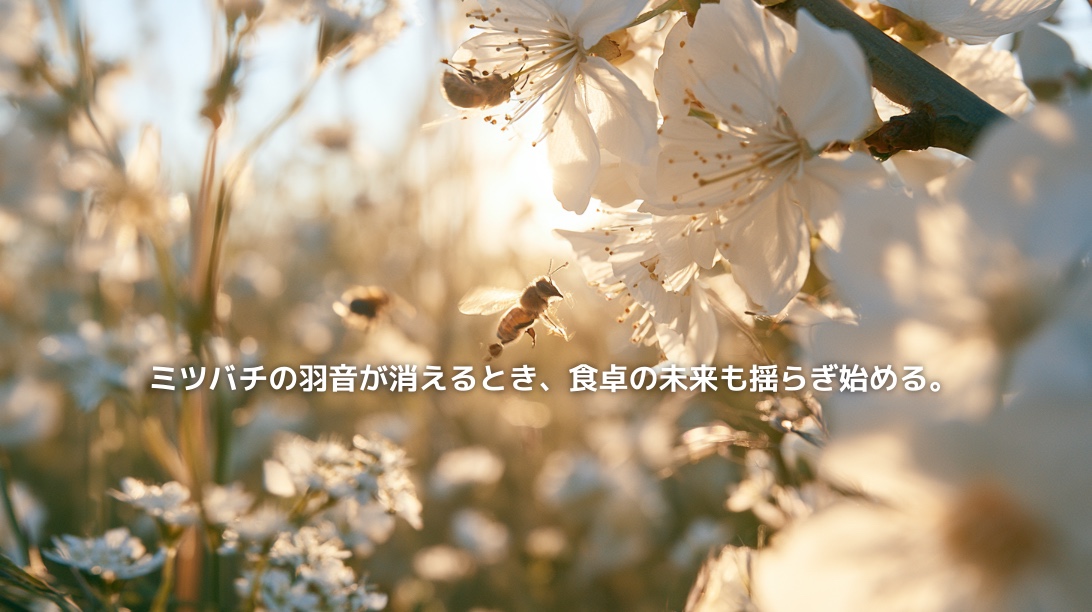
Spring arrives, and flowers begin to open.
Plum blossoms.
Cherry blossoms.
Rapeseed flowers.
Chinese milk vetch.
Fruit tree blossoms.
In fields and greenhouses, strawberries, melons, watermelons, cucumbers, and tomatoes produce flowers.
In gardens, smaller wildflowers turn toward the light.
Moving quietly from one flower to another are countless small creatures.
Honeybees.
Bumblebees.
Butterflies.
Moths.
Hoverflies.
Beetles.
Wild bees of many different kinds.
They fly in search of nectar and pollen.
As they move, they carry pollen from one flower to another.
This is pollination.
When we eat fruits and vegetables, we rarely consider how they developed.
Yet apples, strawberries, melons, pumpkins, and many other crops depend on animals that transport pollen.
Japan’s Ministry of Agriculture, Forestry and Fisheries explains that managed pollinators such as honeybees and bumblebees have become essential to the production of horticultural crops, including strawberries, tomatoes, and melons. Ministry of Agriculture, Forestry and Fisheries, Japan
Pollinating insects support not only natural ecosystems, but also the food on our tables.
Yet these small workers are now under growing pressure around the world.
Habitat loss.
Pesticides.
Climate change.
Disease and parasites.
Invasive species.
The expansion of monoculture.
Landscapes with fewer flowers.
The flowers may still bloom.
But the lives that connect them are declining.
This is an environmental crisis that is difficult to see.
What Is Pollination?
Pollination is the movement of pollen to the reproductive part of a flower.
Some pollen is carried by wind.
Some is transported by water.
But for many plants, pollen is carried by animals such as insects, birds, and bats.
Flowers are not merely beautiful.
Their colors.
Their fragrance.
Their nectar.
Their shapes.
The timing of their flowering.
These characteristics evolved through long relationships with the creatures that pollinate them.
A bee arrives.
It drinks nectar.
Pollen attaches to its body.
It moves to the next flower.
The pollen reaches another flower.
A fruit develops.
Seeds are formed.
These small journeys allow plants to pass life to the next generation.
Pollination is inconspicuous.
It is not visible like water flowing through an irrigation channel.
It does not have a physical structure like a river embankment.
Its decline cannot be seen as immediately as the clearing of a forest.
Yet without pollination, many plants struggle to produce fruit and seeds.
Pollination is an invisible infrastructure within nature.
Our Food Depends on Pollinators
Many of the foods we eat are deeply connected to animals that transport pollen.
Fruits.
Vegetables.
Nuts.
Oilseed crops.
Spices.
Some crops used as animal feed.
Not every food depends on insects. Rice and wheat, for example, are primarily pollinated by wind.
But many crops that bring color, flavor, and nutritional diversity to our tables depend at least partly on animal pollination.
The IPBES Assessment Report on Pollinators, Pollination and Food Production states that 91 of the 107 leading global crop types grown for fruits, seeds, nuts, and other products depend to some degree on animal pollination. IPBES
When pollination becomes insufficient, the consequences extend beyond a reduction in crop volume.
Fruit may become misshapen.
Quality may decline.
Harvests become less predictable.
Farmers face more work.
Prices may rise.
Regional food cultures may be affected.
A strawberry ripens red.
Apples develop along the branches.
A pumpkin grows in the field.
Behind each of these ordinary events lies the work of small creatures moving between flowers.
Food is not produced by farmland alone.
It emerges from relationships among crops, flowers, insects, forests, grasslands, waterways, and the wider ecosystem surrounding a field.
Honeybees Are Not the Only Pollinators
When people think about pollinators, the honeybee is often the first species that comes to mind.
Honeybees are certainly important to agriculture.
They are managed through beekeeping and transported to farms to pollinate crops.
But honeybees are not the only creatures performing this work.
Wild bees.
Bumblebees.
Hoverflies.
Butterflies.
Moths.
Beetles.
Ants.
Certain birds and bats.
Many different animals participate in pollination.
Wild pollinators are connected to a wide variety of plants.
Flowers blooming in early spring.
Flowers growing in summer grasslands.
Wildflowers appearing in autumn.
Shrubs flowering at forest edges.
Small plants growing around farmland.
Each season has its flowers.
And each flower has its own community of visitors.
The solution is not simply to rely on a single species of managed honeybee.
Ecosystems need a diversity of pollinators.
When one species declines, another may partially compensate.
Different pollinators remain active under different weather conditions.
Different crops are best pollinated by different species.
Diversity is nature’s insurance system.
Why Are Pollinators Declining?
There is no single cause behind the decline of pollinating insects.
One major factor is habitat loss.
Grasslands disappear.
Secondary woodlands are cleared or neglected.
Vacant land is paved.
Flowers around farmland decline.
Riverbanks are managed too intensively.
Gardens and parks become ecologically uniform.
Pollinators need more than flowers.
They need places to build nests.
Places to survive the winter.
Habitats where their larvae can develop.
Refuges from pesticides.
Continuous access to nectar and pollen throughout the seasons.
Even if many flowers bloom for a brief period, insects may not survive if food disappears during the rest of the year.
Pesticides are another concern.
Chemicals used to control agricultural pests can also affect pollinating insects.
The level of impact differs according to the type of pesticide, the amount used, the timing and method of application, and the condition of the surrounding environment.
Climate change creates further pressures.
Flowering times shift.
The timing of insect activity changes.
Extreme heat and drought become more frequent.
Heavy rainfall destroys nests.
Conditions for overwintering change.
The timing of flowers and insects may begin to separate.
Flowers open, but the pollinators have not yet emerged.
The insects become active, but the flowers have already disappeared.
Ecological relationships depend on timing.
When that timing breaks down, pollination becomes less reliable.
Landscapes Without Flowers
Places rich in flowers are disappearing from the environments around us.
Traditional rural landscapes once contained rice-field banks, meadows, secondary forests, irrigation channel edges, gardens, orchards, and open areas where wildflowers could grow.
This does not mean that the past was environmentally perfect.
Agricultural work was demanding.
Vegetation needed to be cut back.
Crop damage caused by insects was a serious concern.
But between farmland and more natural environments, there were many small transitional spaces.
The edge of a field.
The bank of a rice paddy.
The side of an irrigation channel.
The boundary of a satoyama woodland.
A vacant lot.
A riverbank.
A garden.
Flowers grew in these spaces.
Insects gathered.
Birds arrived.
Modern landscapes contain fewer of these ecological margins.
Efficiently managed farmland.
Paved roads.
Concrete drainage channels.
Closely mown parks.
Streets lined with one type of tree.
Vacant land cut before wildflowers can bloom.
A clean and carefully maintained landscape may appear comfortable to people.
But to insects, it may be a place with little food and almost nowhere to live.
Behind the decline of pollinators lies a society with fewer flowers.
Agriculture and Pollinators
Agriculture depends on pollinating insects.
At the same time, the way agriculture is practiced can affect pollinators.
Large-scale monoculture.
Pesticide use.
The loss of grassland around fields.
Greenhouse cultivation.
The transportation of commercially managed pollinators.
The use of non-native species.
Agriculture is essential to producing food.
But if food production weakens the ecological foundation supporting it, agriculture itself becomes less stable over the long term.
Japan’s Ministry of Agriculture, Forestry and Fisheries has established systems with related organizations to prepare for shortages of managed honeybees used for crop pollination. Ministry of Agriculture, Forestry and Fisheries, Japan
This shows that pollination has already become an important issue for agricultural management.
Pollination should not be viewed as labor that nature performs for free.
When that ecological function becomes unstable, people must manage, coordinate, and supplement it.
Ideally, however, farmland should be surrounded by diverse flowers and insects, allowing natural pollination processes to remain active.
Agriculture and nature are not inevitably in conflict.
Protecting pollinators is also a way of protecting agriculture.
Introduced Bumblebees and Native Ecosystems
Commercial pollination also raises questions about invasive species.
Bumblebees have been used in agriculture because of their effectiveness in pollinating crops, particularly tomatoes grown in greenhouses.
But when non-native bumblebees escape into the wild, they may compete with native bumblebees and potentially introduce ecological risks involving reproduction and disease.
According to Japan’s Ministry of Agriculture, Forestry and Fisheries, the buff-tailed bumblebee (Bombus terrestris), previously used to pollinate tomatoes and other crops, was designated as an invasive alien species under Japan’s Invasive Alien Species Act in 2006.
Efforts have since been made to replace it with native species such as Bombus ignitus. Ministry of Agriculture, Forestry and Fisheries, Japan
This reveals the difficult relationship between agricultural production and biodiversity.
Crops require pollination.
Insects are used to provide that service.
But if those insects are non-native, their effects on surrounding ecosystems must also be considered.
Moving living organisms for convenience can create unexpected problems elsewhere.
Living creatures are not merely agricultural tools.
They are participants in ecosystems.
Fewer Pollinators Mean Fewer Wildflowers
Agricultural crops are not the only plants affected by pollinator decline.
Wild plants also depend on insects and other animals.
Mountain flowers.
Grassland plants.
Shrubs along forest edges.
Wetland flowers.
Alpine plants.
Coastal vegetation.
Many of these plants need pollinators to reproduce.
When pollinating insects decline, some plants produce fewer fruits and seeds.
When plants decline, insects and birds that feed on them are also affected.
Animals that eat their fruits may lose a source of food.
Pollinators connect plants and animals.
Flowers bloom.
Insects arrive.
The insects transport pollen.
Fruit develops.
Birds and mammals eat the fruit.
Seeds are carried across the landscape.
New plants grow.
This cycle enables forests and grasslands to renew themselves across generations.
Pollination is not only about plant reproduction.
It contributes to the renewal of entire ecosystems.
The decline of small insects can gradually transform the appearance of mountains, forests, and grasslands.
When Insects Decline, Birds Decline Too
Insects do more than transport pollen.
They are also food for birds, fish, frogs, lizards, bats, and many other animals.
During spring and summer, many birds rely on insects to feed their young.
Frogs, dragonflies, and spiders also eat insects.
In rivers and ponds, aquatic insects provide food for fish.
A decline in insects weakens the foundation of the food web.
The pollinator crisis is therefore connected not only to agriculture, but to the health of entire ecosystems.
Insects are small.
That makes their decline difficult to notice.
But if insect populations fall, spring birdsong may become quieter.
Grassland flowers may decline.
Harvests may become smaller.
Aquatic ecosystems may begin to change.
Nature is not sustained only by large and visible animals.
Small insects support the web of life.
How Should We Understand the Honeybee Crisis?
Honeybee declines often attract public attention.
Colony collapse.
Pesticide exposure.
Parasitic mites.
Disease.
Climate change.
Food shortages.
Extreme heat.
Honeybees are easy for people to understand.
They produce honey.
They pollinate crops.
They are managed in hives.
Changes in their numbers can be monitored more easily than those of many wild insects.
But looking only at honeybees will not reveal the full pollinator crisis.
What is happening to wild bees?
What about butterflies?
What about hoverflies?
Are grassland flowers declining?
What is happening around farmland?
How are pesticides and climate change affecting local ecosystems?
Honeybees are an important entry point into the crisis.
But what we must ultimately examine is the entire relationship among flowers, insects, agriculture, and human society.
Cities Can Help Pollinators Too
Cities can also take action to protect pollinating insects.
Plant flowers in gardens.
Grow nectar-producing plants on balconies.
Avoid mowing every part of a park too frequently.
Leave space for flowers beneath street trees.
Reduce unnecessary pesticide use.
Plant more native species.
Connect fragmented green spaces.
Create biotopes at schools and public facilities.
Cities are difficult environments for insects.
But they are not necessarily uninhabitable.
We can increase the number of small flowering spaces.
We can connect them.
We can provide nectar and pollen across different seasons.
We can preserve places where insects can nest.
Even these small measures can begin to change urban biodiversity.
Protecting pollinators is not only a challenge for distant mountains or rural communities.
It is also connected to small gardens, balconies, streets, and parks within cities.
Conservation Can Begin by Leaving Flowers
Environmental conservation often brings to mind protecting vast forests or endangered species.
Those efforts are essential.
But for pollinating insects, preserving ordinary flowers close to home is also important.
Flowers along rice-field banks.
Garden flowers.
Small wildflowers beside roads.
Flowers at forest edges.
Fruit tree blossoms.
Plants growing on riverbanks.
Flower beds in public parks.
Wildflowers in satoyama landscapes.
Where flowers remain, insects can visit.
Where insects gather, birds may follow.
Plants produce fruit.
Seeds are formed.
Ecological relationships continue.
Leaving flowers is not merely an act of landscape design.
It preserves points of contact between living organisms.
We do not need enormous fields covered with flowers.
A continuous network of small flowering spaces can support insects as they move through the landscape.
Environmental challenges are often discussed at a global scale.
But the pollinator crisis begins with a single flower.
Is Artificial Pollination the Answer?
When pollinators are insufficient, people may pollinate crops by hand or with technology.
Pollen can be applied using brushes or other tools.
Machines can assist with the process.
Managed insects can be introduced into greenhouses.
Robotic pollination is also being researched.
Technology is important.
Human ingenuity is necessary to sustain agricultural production.
But the existence of artificial pollination does not mean that natural pollinators can safely disappear.
Artificial pollination requires labor and money.
It cannot be applied to every crop or every wild plant.
Humans cannot individually pollinate every flower in grasslands, mountains, forests, and wetlands.
Natural pollinators quietly visit an almost unimaginable number of flowers across countless landscapes.
We cannot fully replace their work.
Before attempting to substitute technology for nature, we must avoid destroying the ecological functions already working around us.
How Can We Protect Pollinators?
Protecting pollinating insects requires action from many different perspectives.
Protect their habitats.
Conserve grasslands and satoyama landscapes.
Leave flowers around agricultural land.
Review how pesticides are used.
Increase native vegetation.
Reduce the effects of invasive species.
Take action on climate change.
Monitor wild pollinators, not only managed honeybees.
Observe and record local insect populations.
Agriculture, urban planning, gardening, school education, satoyama conservation, and climate policy are all connected to the future of pollinators.
Protecting pollinators is not simply about protecting insects.
It means protecting food.
Protecting flowers.
Protecting the renewal of forests and grasslands.
Protecting food sources for birds and other animals.
Protecting the seasonal character of a region.
Protecting small insects helps protect the much larger relationships that sustain nature.
A World with Flowers but No Insects
Imagine this.
Spring arrives, and flowers bloom.
But there is no sound of wings.
Fruit trees are covered with blossoms.
But no bees arrive.
Flowers spread across a meadow.
But no butterflies fly above them.
Crops flower in the fields.
But fewer fruits develop.
It would be a quiet world.
At first glance, it might still appear beautiful.
The flowers would still be there.
But in a world where the relationship between flowers and insects has been lost, the cycles of the seasons would begin to weaken.
Flowers call insects.
Insects connect flowers.
Fruit feeds birds, animals, and people.
Seeds carry life into the next generation.
When those relationships break, nature gradually becomes less diverse.
The decline of pollinating insects is difficult to see.
But it is connected to our food, agriculture, wildflowers, birdsong, and the character of regional landscapes.
Listening for the Sound of Small Wings
The day bees disappear will not simply be the day we have less honey.
It will be the day fruit harvests become less stable.
The day pollinating agricultural crops becomes more difficult.
The day wildflowers struggle to produce seeds.
The day birds and animals lose sources of food.
The day the relationship among flowers, insects, and people begins to unravel.
Pollinators live close to us.
Yet their presence has been so ordinary that we have often failed to notice it.
Flowers bloom.
Insects arrive.
Fruit develops.
Seeds form.
People eat.
This apparently simple cycle does not continue automatically.
We must preserve landscapes where flowers can grow.
We must leave places where insects can survive.
We must reconnect agriculture and biodiversity.
We must add small areas of nature to our cities.
We must slow climate change.
Each of these actions can help preserve the sound of small wings for the future.
Humans have often regarded insects as insignificant.
But within the systems of nature, their role is anything but small.
When pollinators decline, the future of our food and the landscapes around us begins to tremble.
References
- Ministry of Agriculture, Forestry and Fisheries, Japan — Insects Used for Crop Pollination
- IPBES — Assessment Report on Pollinators, Pollination and Food Production
- IPBES — Full Assessment Report on Pollinators, Pollination and Food Production
- FAO — Global Action on Pollination Services for Sustainable Agriculture
Pollinating insects connect flowers, create harvests, and quietly sustain both our food systems and natural ecosystems.
But habitat loss, pesticides, climate change, invasive species, and landscapes with fewer flowers are beginning to destabilize their work.
NEOTERRAIN Journal will continue exploring the environmental changes hidden behind familiar and beautiful landscapes.
If this article gave you a new perspective, please bookmark it and return as we continue examining the future of flowers, insects, food, and the ecosystems that connect them.