Reading Hokkaido’s changing environment through the Sea of Okhotsk
Environmental Challenges Across Japan’s 47 Prefectures | Part 1: Hokkaido
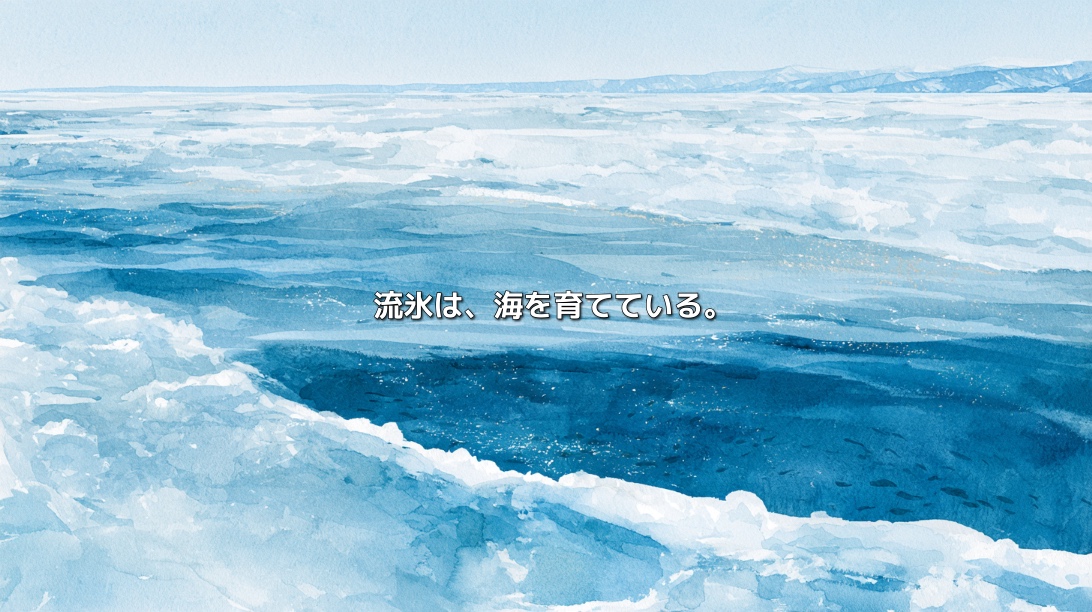
In winter, drift ice spreads a white veil across the Sea of Okhotsk.
On tourism posters and in news footage, it appears as an emblem of Hokkaido’s coldest season. Yet the ice is more than a landscape. Beneath it, microscopic life grows. As spring approaches, the marine food web gathers momentum. Its connections reach fish, seabirds, and even the forests of Shiretoko.
Over the long term, sea ice in the Sea of Okhotsk has been declining.
To understand what this means, we need to look beyond the area of white on a map. We need to consider how the seasonal rhythms that sustain this region may be changing.
The Ice Does Not Necessarily Begin in Hokkaido
Sea ice generally begins forming in the northern Sea of Okhotsk, then moves south under the influence of winds and ocean currents.
The drift ice visible from Hokkaido’s coast is the arrival of a winter that began far beyond the horizon.
The Japan Meteorological Agency defines drift ice as ice floating and moving on the sea. The date it becomes visible from Hokkaido’s coast and the extent of ice across the entire Sea of Okhotsk are different measures.
That distinction matters.
When winds push ice toward the shore, a coastal town may see an impressive expanse of white. When winds carry it offshore, the ice may disappear from view even while substantial ice remains elsewhere.
A single winter’s scenery cannot tell us whether sea ice, as a whole, is increasing or declining.
What the Longer Record Reveals
In its 2026 assessment, the Japan Meteorological Agency reported a long-term decline in the annual maximum sea ice extent of the Sea of Okhotsk over the observation period from 1971 to 2026.
The estimated decline is approximately 59,000 square kilometers per decade, equivalent to about 3.7 percent of the sea’s total area.
Year-to-year variation remains substantial. Air temperature, winds, and sea surface temperature all influence how much ice forms and where it spreads. The agency notes that global warming may be contributing to the decline, while emphasizing the need for further data to assess that relationship more confidently.
During the 2025–2026 season, the maximum sea ice extent was the second smallest on record. Yet drift ice reached Hokkaido’s Okhotsk coast at roughly the usual time.
These findings can coexist. A year with less ice across the sea does not necessarily bring a correspondingly late arrival along the coast.
What visitors see from the shore and what is happening across the wider sea must be considered separately.
The Ice Helps Prepare the Sea for Spring
One reason Shiretoko was recognized as a UNESCO World Natural Heritage site is the relationship between its productive, seasonally ice-influenced waters and the rivers and forests on land.
Japan’s Ministry of the Environment explains that sea ice formation promotes seawater mixing, helping bring nutrients from deeper water toward the surface. Microscopic algae grow beneath the ice, and phytoplankton production increases as the ice begins to melt in spring.
Zooplankton feed on this microscopic life. Fish, seabirds, and marine mammals participate in the wider food web it helps support.
This does not mean that a given percentage of ice loss translates directly into the same percentage of fish loss. Water temperature, currents, fishing pressure, and the ecology of individual species also matter.
Nevertheless, changes in when ice forms and melts may affect when and where food becomes available in spring.
The changing ice offers an important clue to understanding Shiretoko’s ecosystem.
“The Ice Came Back This Year” Is Only Part of the Story
Drift ice cannot be understood through a simple choice between arrival and absence.
When does it form? How far does it spread? How long does it remain? When does it melt?
Together, these patterns shape the sea’s seasons.
According to the Japan Meteorological Agency’s Climate Change in Japan 2025, observations at Abashiri from 1946 to 2021 show a trend toward the first sighting of drift ice occurring approximately 1.3 days later per decade, and the last sighting occurring approximately 3.6 days earlier per decade.
These figures describe coastal observations at Abashiri. They do not directly measure conditions throughout Shiretoko’s waters or changes in fish catches.
They do, however, invite us to pay attention to something less immediately visible than the ice itself: the length of time it stays.
The fiscal 2024 annual report for the Shiretoko World Natural Heritage area also identifies a declining trend in the duration of drift ice presence and concerns about ecosystem impacts. The relevant authorities have developed an adaptive management strategy to respond to climate change.
Observe the changes. Assess what they mean. Revise management as evidence develops.
That continuing process is becoming increasingly necessary.
What We Need to Protect Lies Beyond the White Horizon
Drift ice is part of Hokkaido’s tourism economy. It is also part of the region’s memory of winter.
But when its value is described only through scenery, the life beneath it can slip from view.
The long-term decline in sea ice is documented. Yet neither its arrival in a particular year nor its effects on individual species can be explained by a single number.
We need to keep following the relationships between ice, plankton, fish, seabirds, and the people who live beside this sea.
That is why this series on Japan’s environmental challenges begins with Hokkaido’s drift ice.
A visible change in the white surface opens a way to understand the less visible workings of the sea.
The next time drift ice appears in the winter news, we might ask more than whether it has arrived.
What kind of season is beginning beneath it?
EDITOR’S NOTE — NEOTERRAIN
A coastline covered in ice offers an image we can remember. The processes beneath it are harder to picture.
Yet the timing of a thaw, the growth of microscopic life, and the movement of food through the sea are also part of this landscape.
To watch the ice carefully is to look beyond its beauty—to remain attentive to the relationships that beauty allows us to glimpse.
The white horizon is where the story becomes visible. It is not where the story ends.
References
The following sources are in Japanese.
- Japan Meteorological Agency — Long-Term Trends in Sea Ice Extent in the Sea of Okhotsk, 2026
- Japan Meteorological Agency — Sea Ice Conditions in the Sea of Okhotsk, 2025–2026
- Japan Meteorological Agency — Climate Change in Japan 2025, Chapter 10
- Ministry of the Environment — Sea Ice Supporting Abundant Life in Shiretoko
- Ministry of the Environment — Fiscal 2024 Shiretoko World Natural Heritage Area Annual Report