The Tiny Shells Left Behind by Convenient Coated Fertilizers
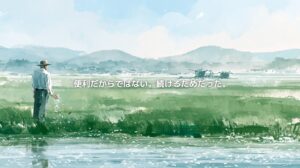
In spring, rice fields across Japan are filled with water.
The soil is leveled and stirred during a process known as puddling. Rice seedlings are planted, and excess water drains from the fields into irrigation channels. From there, it enters rivers and eventually reaches the sea.
But something else may be traveling with that water:
Tiny pieces of plastic.
One source is the empty coating left behind after the use of plastic-coated fertilizer.
When people think of marine plastic waste, they usually picture plastic bottles, shopping bags, or discarded fishing nets. Yet the plastic entering the ocean does not come only from cities or the fishing industry.
The rice fields that support our food supply are also connected to environmental problems through rivers and the sea.
Why Is Fertilizer Wrapped in Plastic?
Plastic-coated fertilizer consists of small fertilizer granules covered by a thin layer of resin.
Moisture from the soil passes through the coating and dissolves the nutrients inside. Those nutrients are then released gradually through the coating.
Because the fertilizer is supplied slowly in accordance with crop growth, these products are also known as controlled-release or slow-release fertilizers.
Conventional fertilizers often require additional applications as crops develop. With coated fertilizer, however, nutrients can be supplied over a long period through a single application before or around the time of rice planting.
According to Japan’s Ministry of Agriculture, Forestry and Fisheries, plastic-coated fertilizers can reduce both the amount of labor required and the quantity of fertilizer applied.
This is particularly significant in Japan, where the agricultural workforce is aging, the number of farmers is declining, and individual farming operations are managing increasingly large areas of land.
Reducing the need for additional fertilizer applications can substantially ease the burden on farmers.
Because the nutrients are not released all at once, coated fertilizers may also reduce the loss of nitrogen and other components through rainwater and irrigation, allowing fertilizer to be used more efficiently.
In other words, coated fertilizers have not been adopted merely because they are convenient.
They have become an important technology for compensating for labor shortages and maintaining agricultural productivity in Japan.
The Fertilizer Dissolves, but the Shell Remains
The problem begins after the nutrients inside the granule have been released.
Even when the fertilizer is gone, the plastic film that once surrounded it remains in the soil. These empty coating shells are extremely light and can easily float on the surface of the water.
Before rice planting, farmers stir soil and water together during puddling. Coating shells left in the soil from previous years may rise to the surface during this process.
When the field is later drained or water is allowed to flow through it continuously, the floating shells can escape through drainage outlets and enter irrigation channels.
Research introduced by Japan’s Ministry of the Environment has found that the accumulation of fertilizer coating shells along coastlines and lakeshores increases between May and June.
Because this period overlaps with puddling, field drainage, and rice planting, agricultural activity in rice fields is believed to be connected to their release.
Once outside the field, the shells travel through irrigation channels, rivers, and estuaries before eventually reaching the sea.
Rice fields and the ocean are not two separate environments.
Follow the water, and they become parts of one continuous ecosystem.
Tiny Shells Found Along the Shore
Research compiled by Japan’s Ministry of the Environment has reported striking results.
In areas with extensive rice cultivation, plastic fertilizer shells accounted for between 70 and 90 percent of the microplastics found along surveyed shorelines during the irrigation season.
In the rice fields included in another study, between 1 and 28 percent of the coating shells entering the fields were later discharged. The median outflow rate was 7.1 percent.
Not every shell immediately reaches the sea.
Many remain in the soil and may rise to the surface during puddling the following year—or even several years later.
This means the plastic shells left in rice fields do not disappear at the end of a single growing season.
Plastic used in the past may accumulate in agricultural soil and gradually escape into the wider environment over many years.
After entering waterways, the shells can also break into smaller fragments through exposure to ultraviolet radiation, waves, and friction with sand.
The smaller they become, the more difficult they are to recover—and the greater the possibility that aquatic organisms may ingest them.
Much remains unknown about the precise effects of microplastics from coated fertilizers on ecosystems and human health.
That uncertainty makes it even more important to prevent the plastic from entering waterways in the first place.
Blaming Farmers Will Not Solve the Problem
Farmers should not be made solely responsible for this issue.
Agriculture in Japan is confronting several pressures at once:
An aging workforce.
A shortage of successors.
The consolidation of farmland into larger operations.
Rising fertilizer prices.
And increasing demands for productivity.
Under these conditions, coated fertilizers that reduce the need for additional applications have represented a rational choice.
If their use were suddenly banned across the country, the result could be greater workloads and higher production costs. In some regions, it might become even more difficult to continue growing rice at all.
The issue cannot be reduced to a simple claim that farmers are harming the environment by using plastic.
Responsibility must be shared by the companies that manufacture fertilizers, the agricultural organizations that distribute them, the government agencies that provide guidance, the research institutions developing alternatives, and the consumers who purchase agricultural products.
We need a system capable of achieving two objectives at the same time:
Protecting agriculture while reducing the amount of plastic reaching the sea.
Stopping Plastic at the Edge of the Field
One immediate measure is to prevent fertilizer shells from leaving rice fields.
Possible actions include:
Using less water during puddling.
Installing collection nets at drainage outlets.
Avoiding the continuous flow of water after puddling.
And preventing the rapid drainage of fields before rice planting.
Research cited by Japan’s Ministry of the Environment indicates that avoiding continuous water discharge after puddling and sudden drainage during rice planting can significantly reduce the number of shells escaping from fields.
These measures, however, cannot eliminate the problem completely.
Collection nets require regular cleaning and maintenance. Their practicality also varies depending on local soils, climate, irrigation infrastructure, and water-management practices.
Most importantly, preventing the shells from leaving a field does not make the plastic already present in the soil disappear.
Measures at drainage outlets must therefore be combined with a longer-term transition toward fertilizers and application methods that do not depend on conventional plastic coatings.
Toward Agriculture That Does Not Rely on Plastic-Coated Fertilizers by 2030
In 2022, three major Japanese agricultural and fertilizer organizations set out a shared vision:
By 2030, Japanese agriculture should no longer rely on plastic-coated fertilizers.
The organizations were the National Federation of Agricultural Cooperative Associations, the Japan Fertilizer and Ammonia Producers Association, and the Japan Compound Fertilizer Manufacturers Association.
Their initiative rests on three main pillars:
Raising awareness that coated fertilizers contain plastic.
Preventing the shells from escaping farmland.
And developing and promoting alternative technologies.
An interim report published in February 2026 stated that the transition toward coated fertilizers using less plastic was progressing. Between April and December 2025, approximately 22 percent of conventional products had reportedly been replaced with reduced-plastic alternatives.
Research and trials are also advancing in several areas:
Slow-release fertilizers that use no plastic.
Coatings made from biodegradable resin.
Additional fertilizer applications using drones.
And systems that distribute nutrients through irrigation water.
However, many challenges remain.
Alternative fertilizers may cost more. Their performance must be stable. They must suit different climates, regions, soil conditions, and rice varieties. New application methods must also avoid increasing the burden placed on farmers.
The 2030 goal cannot be achieved simply by replacing one fertilizer product with another.
The deeper question is how Japan can reduce its dependence on plastic while maintaining agricultural productivity.
Both agricultural technology and public policy will be tested.
The Ocean’s Plastic Problem Can Begin in a Rice Field
Rice fields are places where food is produced.
They also temporarily store rainwater, support a wide range of organisms, and shape the landscapes and cultures of rural communities.
Yet tiny pieces of plastic are unintentionally escaping from these fields.
This does not mean that agriculture is simply destroying nature.
It reveals a more structural problem within modern society:
A technology developed to save labor and sustain food production has created an environmental burden somewhere else.
Agriculture and consumers receive the benefits of convenience and efficiency. The empty shells left after those benefits have been delivered are carried downstream toward the sea.
That is why the problem cannot be solved within the rice field alone.
We must see the place where fertilizer is produced, the rice field where it is used, the irrigation channel, the river, the estuary, and the sea as parts of a single watershed.
This perspective is the first step toward reconnecting the future of agriculture with the future of the marine environment.
A single plastic shell floating out of a rice field leaves us with a difficult question:
How can we place food production and ocean conservation within the same future?
References
- Ministry of Agriculture, Forestry and Fisheries: Continued and Strengthened Measures to Prevent the Release of Plastic Coating Shells From Slow-Release Fertilizers
- Ministry of Agriculture, Forestry and Fisheries: Current Conditions Surrounding Fertilizers
- Ministry of the Environment, Plastic Smart: Reducing Microplastics
- Ministry of the Environment: Existing Research and Future Priorities Concerning Plastic Released Into the Environment
- Ministry of Agriculture, Forestry and Fisheries: Strengthening Measures to Prevent the Release of Plastic Coating Shells
This is a little-known environmental issue unfolding between rice fields and the sea.
NEOTERRAIN Journal will continue exploring how food production, technology, and natural systems are connected across the landscape. If this article gave you something to think about, please bookmark it and return whenever you would like to revisit the question.