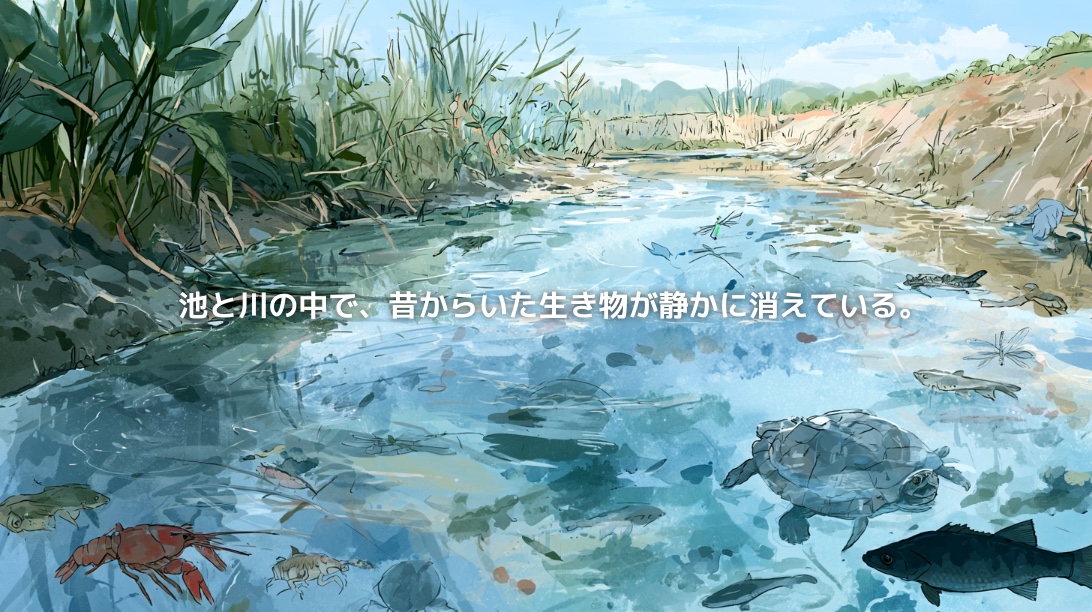
The surface of a pond appears peaceful.
Aquatic plants sway beneath the water. Dragonflies move through the air. Frogs call from the banks, while small fish swim like shadows below the surface.
Many people in Japan may remember catching crayfish in irrigation channels or seeing turtles along a river when they were children.
These scenes feel familiar and nostalgic.
Yet some of the creatures we assume have “always been there” are not native to those places.
Red swamp crayfish.
Red-eared sliders.
Largemouth bass.
Bluegill.
American bullfrogs.
Tall goldenrod.
Lance-leaved coreopsis.
Alligator weed.
An alien species is not simply an unusual animal or plant.
It is an organism introduced through human activity into an area where it did not previously occur.
Not every alien species is harmful.
Many vegetables, fruits, livestock species, and ornamental plants were also introduced from overseas.
Some introduced species, however, can seriously affect local environments and threaten biodiversity.
Japan’s Ministry of the Environment uses the term “invasive alien species” for non-native organisms that may significantly affect ecosystems, human health, agriculture, forestry, or fisheries. Ministry of the Environment, Japan
The invasive species problem is not limited to distant wilderness areas.
Ponds.
Rivers.
Rice fields.
Irrigation channels.
Agricultural reservoirs.
Public parks.
School biotopes.
Small wetlands near residential neighborhoods.
It is an environmental problem quietly unfolding in familiar places.
What Is an Alien Species?
An alien species is an organism that has been moved through human activity into a region where it did not originally live.
Ships.
Aircraft.
Cargo.
Imported soil and plants.
Pets.
Recreational fishing.
Ornamental trade.
Agriculture.
Living organisms travel through many different routes.
Some are deliberately introduced.
Others arrive unnoticed.
They may be imported as ornamental species.
They may be introduced for food production or aquaculture.
They may be released as targets for recreational fishing.
They may escape from captivity.
They may be released after their owners can no longer care for them.
They may arrive inside imported goods or in the ballast water of ships.
Organisms do not always cross borders through their own movements.
In many cases, human economies and lifestyles are behind their journeys.
The invasive species problem is therefore not only about the organisms themselves.
It is also about how human societies have treated and transported other forms of life.
Why Do Alien Species Become a Problem?
The arrival of an alien species does not automatically create an ecological problem.
Some species cannot adapt to the new environment and fail to establish themselves.
Others remain under human control without significantly affecting surrounding ecosystems.
But when an introduced species becomes established and increases rapidly, it can transform the local environment.
It may prey on native species.
Take over their habitats.
Compete for food.
Hybridize with related species.
Introduce diseases or parasites.
Consume aquatic vegetation.
Change water quality.
Damage agriculture and fisheries.
An invasive species is more than an organism that came from somewhere else.
It can abruptly alter relationships among species that developed over a very long period.
An ecosystem is not made only of its most visible animals.
There are fish.
There are aquatic plants.
There are insects.
There are frogs.
Birds visit the water.
Microorganisms break down organic matter.
Fallen leaves accumulate.
Shellfish and aquatic worms live in the mud.
When an especially competitive or predatory alien species enters this network, the balance can begin to collapse.
As one species increases, another may quietly disappear.
That is what makes invasive species so dangerous.
Why Is the Red Swamp Crayfish a Problem?
The red swamp crayfish is a familiar creature to many people in Japan.
Some may remember catching one beside a rice field or in a narrow irrigation channel during childhood.
Its red body and large claws have made it almost a symbol of playing near the water.
But the red swamp crayfish is not native to Japan.
It cuts aquatic plants.
It eats insects and other small aquatic organisms.
It disturbs sediment.
It changes wetland habitats.
It affects native species.
When crayfish populations become too large, aquatic vegetation may decline and other creatures may lose their habitat.
Aquatic plants are not simply weeds growing in water.
They provide places for fish to lay eggs.
They shelter dragonfly larvae and aquatic insects.
They offer refuges for medaka and other small fish.
They help maintain water quality.
They form the foundation of small aquatic ecosystems.
When that vegetation disappears, the character of a pond or rice field changes.
The water may become increasingly turbid, while the number and diversity of species decline.
The red swamp crayfish is both a familiar part of childhood memory and an introduced species capable of profoundly changing aquatic ecosystems.
The Red-Eared Slider: A Familiar Alien Species
The red-eared slider is another highly familiar alien species in Japan.
When young, these turtles have often been sold as “green turtles.”
They are small, attractive, and may appear easy to care for.
But they grow much larger.
They live for many years.
Their care becomes more demanding.
Eventually, some owners find that they can no longer keep them.
The turtles are then released outdoors.
Once released into ponds and rivers, red-eared sliders can affect native turtles and other wetland species.
They compete for places to bask in the sun.
They compete for food.
They consume aquatic plants and small animals.
They can alter habitats used by native species.
The important point is that red-eared sliders did not enter Japan with harmful intentions.
Humans imported them.
Humans sold them.
Humans kept them.
Humans released them.
As a result, they became established in local waterways.
The invasive species problem is also a question of human responsibility toward other living things.
Is Releasing an Animal Really an Act of Kindness?
One of the most difficult aspects of the invasive species issue is human emotion.
Someone can no longer care for an animal.
They feel sorry for it.
They want it to live freely in nature.
They believe releasing it into a pond will save it.
But releasing a captive animal is not necessarily kind—either to that animal or to the local ecosystem.
Since June 1, 2023, Japan has classified red-eared sliders and red swamp crayfish as “conditionally designated invasive alien species.”
Ordinary households are still permitted to keep them without special authorization. However, releasing them into the wild is prohibited, and their sale, distribution, and purchase are subject to restrictions. Ministry of the Environment, Japan
Being unable to continue caring for an animal does not justify releasing it into a river or pond.
Once released, it may reproduce.
It may prey on native species.
It may change aquatic vegetation and water quality.
It may become extremely difficult to capture again.
A single released animal can become the beginning of a much larger ecological change.
Release may appear to save one life.
But viewed across the entire ecosystem, it may place many other lives at risk.
Kindness without ecological understanding can sometimes damage nature.
Ponds and Rivers Are Not Closed Systems
Ponds and rivers are sometimes chosen as places to release unwanted animals.
There is water.
The animal appears capable of surviving there.
The setting looks natural.
It may seem that no human care will be necessary.
But ponds and rivers are not closed systems.
Heavy rain can cause water to overflow.
Ponds connect with irrigation channels.
Water moves into rivers.
Organisms travel downstream.
Eggs and young individuals can be carried elsewhere.
People may also capture and move animals to new locations.
Even if an animal is released into a single pond, its effects may spread throughout the surrounding area.
Aquatic environments are connected.
Rice fields.
Irrigation channels.
Agricultural ponds.
Rivers.
Wetlands.
Lakes.
The sea.
Like many of the water-related environmental issues explored by NEOTERRAIN Journal, invasive species must be understood across entire watersheds.
What occurs in one body of water can travel to another.
Invasive species management cannot end at the edge of a single pond.
It must consider upstream and downstream areas, farmland, residential districts, parks, schools, and administrative boundaries.
Why Are Native Species Vulnerable?
The issue is not as simple as invasive species being strong and native species being weak.
Native species have adapted to local environments over long periods.
But they may lack defenses against a species that suddenly arrives from somewhere else.
They may never have encountered that predator.
They may not recognize it as a competitor.
They may have little resistance to introduced diseases.
They may lose breeding grounds.
They may lose access to food.
At the same time, the habitats of many native species are already under pressure.
Concrete-lined irrigation channels.
Declining rice fields.
Poorly managed agricultural ponds.
Straightened rivers.
Vanishing wetlands.
Deteriorating water quality.
Agricultural chemicals and household wastewater.
Climate change.
Urbanization.
Native species are not being threatened by alien species alone.
Invasive species add another pressure to ecosystems that may already be weakened.
This makes survival even more difficult.
Removing an invasive species is therefore not enough.
We must also restore the conditions in which native species can live.
Invasive Species Reflect Human Society
Alien species did not cross international borders by themselves.
In most cases, people moved them.
The pet industry.
Horticulture.
Recreational fishing.
Food production.
Aquaculture.
Transportation.
International trade.
Tourism.
Urban development.
The movement of organisms overlaps with the movement of human society.
Economies expand.
Logistics accelerate.
Species from distant countries become familiar and accessible.
We keep them.
Sell them.
Display them.
Eat them.
Release them.
Abandon them.
The invasive species problem is both an ecological problem and a problem of consumption.
Humans have treated living organisms as products.
We buy them because they are cute.
We grow them because they are unusual.
We use them because they are convenient.
We become concerned when they multiply.
We abandon them when we can no longer care for them.
As a result, local environments change.
Invasive species are also shadows cast across ponds, rivers, and forests by human desire and irresponsibility.
Invasive Plants Change the Landscape
Alien species are not limited to animals.
Plants can also transform regional landscapes.
Introduced plants spread across riverbanks.
Yellow flowers appear along roadsides.
Aquatic weeds cover the surface of the water.
Non-native grasses expand across vacant land.
Plants invade farmland and wetlands.
Plants may appear unable to move.
But their seeds travel through the wind, flow with water, mix with transported soil, and attach themselves to shoes and vehicles.
Once established, invasive plants may take over space used by native vegetation.
They can cover waterways and alter water flow.
They may interfere with agriculture and river management.
Invasive plants transform landscapes gradually.
At first, they may appear to be beautiful flowers.
They may make the landscape seem greener.
But native plants may be disappearing beneath them.
A beautiful flower can quietly transform a local ecosystem.
Environmental damage does not always appear as a polluted or visibly damaged landscape.
Ecological change can advance within scenery that still appears beautiful.
Is Removal Enough?
When people hear about invasive species control, they often think of eradication.
Capture the animals.
Pull out the plants.
Dispose of them.
Reduce their numbers.
In places where invasive species have become abundant, such measures may be necessary.
But removal alone does not solve the entire problem.
Why did the species enter that place?
Why was it able to multiply?
Can native species return?
Could the invasive species be introduced again?
Can the community remain involved over the long term?
If these questions are ignored, the same problem will recur.
Prevention is therefore essential.
Do not introduce them.
Do not abandon them.
Do not spread them.
Take responsibility for an animal throughout its life.
Do not bring unfamiliar organisms home.
Do not release captive species into the environment.
Do not move aquatic plants, mud, or soil between waterways.
Once an invasive species has spread widely, complete eradication may be extremely difficult.
That is why preventing its spread in the first place is so important.
Children’s Experiences of Nature and Invasive Species
The invasive species issue is also connected to children’s experiences in nature.
Catching crayfish.
Finding turtles.
Catching small fish.
Collecting aquatic plants.
Observing organisms in a school biotope.
These experiences are valuable gateways to curiosity about the natural world.
But if children bring an organism home without knowing it is an alien species—or release it into a different location—the problem may spread.
The answer is not to discourage children from experiencing nature.
Instead, those experiences should become opportunities to learn how to interact responsibly with other living things.
What should we do with an animal after catching it?
Is it safe and legal to take it home?
Can we care for it properly?
Can we continue caring for it throughout its life?
Why must it not be released somewhere else?
Is it a native or alien species?
Learning to love nature and learning to take responsibility for nature must happen together.
Invasive species are also an educational issue.
Protecting Native Species Means Protecting Relationships
Protecting native species may sound like protecting individual rare animals or plants.
But what truly needs protection is the relationship among living things.
Medaka swim in the water.
Aquatic plants grow.
Dragonfly larvae develop beneath the surface.
Frogs breed.
Snakes hunt.
Herons visit.
Rice fields hold water.
Irrigation channels connect habitats.
Seasonal water flows shape the landscape.
Together, these relationships form a regional ecosystem.
A native species does not exist alone.
It is connected to water, soil, vegetation, insects, birds, and human livelihoods.
The introduction of an alien species changes those relationships.
Protecting native species is therefore not simply about preserving one organism.
It means protecting wetland habitats.
Maintaining connections between rice fields and irrigation channels.
Managing agricultural ponds.
Restoring natural processes within rivers.
Ensuring that local people continue observing changes in wildlife.
Protecting relationships is what ultimately protects native species.
Hating Invasive Species Is Not Enough
There is something we must remember when discussing invasive species.
We should not turn the organisms themselves into villains.
Red swamp crayfish, red-eared sliders, and American bullfrogs did not choose to come to Japan.
Humans brought them.
Humans spread them.
These species may cause problems in the places where they have been introduced.
But the organisms themselves are not morally at fault.
The problem is that humans moved them.
Allowed them to spread without adequate management.
Released them after they became difficult to keep.
Underestimated the connections within ecosystems.
Invasive species management must therefore begin with responsibility, not hatred.
We must consider how and where living organisms should be kept.
If we acquire an animal, we must care for it throughout its life.
We must research the species before buying it.
We must never release it into the wild.
We must observe local ecosystems and protect habitats where native species can survive.
Hating invasive species does not reveal the root of the problem.
The root of the invasive species crisis lies within human society.
Beginning with the Waterways Around Us
Invasive species are a global environmental challenge.
But the path toward understanding them begins close to home.
A neighborhood pond.
A wetland in a public park.
An irrigation channel beside a rice field.
A school biotope.
Grassland along a river.
A local agricultural reservoir.
Look at the organisms living there.
Have they lived in the region for a long time?
Are they alien species?
How much have their populations increased?
Do native species remain?
Is there still aquatic vegetation?
Has the water become cloudy?
Who manages the habitat?
Learning what is there is the first step.
Experts alone cannot solve the invasive species problem.
Residents must notice changes.
Governments must respond.
Schools must educate.
Researchers must investigate.
Land and water managers must continue their work.
All of these efforts must accumulate over time.
Ecosystems exist within everyday life.
That is why we need to keep observing them through everyday eyes.
What Is Disappearing from Our Ponds and Rivers?
When an invasive species increases, something else may be disappearing.
Medaka.
Weather loaches.
Aquatic plants.
Dragonfly larvae.
Small freshwater snails.
Frog eggs.
Native fish.
Species that have lived in the region for generations.
What disappears is often inconspicuous.
It may not be a large animal.
Its disappearance may not be dramatic enough to become national news.
The pond still looks like a pond.
The river continues to flow.
But the community of life within it has changed.
This is what makes invasive species so difficult to recognize.
The landscape remains, while its ecological contents are quietly replaced.
The pond is still there.
There is still water.
There is still greenery.
But the organisms that once lived there are gone.
Understanding environmental change requires us to notice what is no longer present.
Invasive Species Are Organisms That Crossed Boundaries
Alien species are organisms that crossed boundaries.
National borders.
Regional boundaries.
The boundaries between waterways.
The boundary between captivity and the wild.
The boundary between human society and nature.
In many cases, humans caused them to cross those boundaries.
The invasive species problem is therefore also about how we manage borders and limits.
The boundary between keeping an animal and releasing it.
The boundary between enjoying nature and damaging it.
The boundary between using an organism and managing the consequences.
The boundary between loving nature and accepting responsibility for it.
A single animal released into a pond or river reflects the ambiguity of those boundaries.
Invasive species are not a problem that arrived from somewhere outside nature.
They are a problem that moved from within human society into the natural environment.
Protecting the Memory of Our Watersides
Ponds and rivers carry regional memories.
An irrigation channel where children once played.
A narrow stream beside a rice field.
The sound of frogs on a summer night.
Dragonflies flying above an agricultural pond.
Medaka swimming in a small creek.
A wetland beside a natural spring.
These landscapes are more than nostalgic images.
They contain the biodiversity of a place.
They contain the movement of water.
They reveal the distance that once existed between human life and the natural world.
As invasive species increase and native species disappear, these memories also begin to change.
What will future children believe has “always lived here”?
Species that we recognize as non-native may become ordinary parts of the landscape for the next generation.
The ecological memory of a place may be rewritten.
That is why we must record, protect, and communicate the life that exists today.
The day native species disappear from our ponds and rivers will not simply be the day the number of species declines.
It will also be the day the memory of a region’s waterside quietly begins to vanish.
References
- Ministry of the Environment, Japan — Invasive Alien Species
- Ministry of the Environment, Japan — Invasive Alien Species Act
- Ministry of the Environment, Japan — Regulations for Red-Eared Sliders and Red Swamp Crayfish
- Ministry of the Environment, Japan — Conditionally Designated Invasive Alien Species
- National Institute for Environmental Studies, Japan — Invasive Species Database
The invasive species issue is not simply a story about unusual plants and animals.
It is an environmental problem unfolding in the ponds, rivers, rice fields, irrigation channels, agricultural reservoirs, and parks around us.
NEOTERRAIN Journal will continue exploring the ecological changes hidden behind familiar and beautiful landscapes.
If this article gave you a new perspective, please bookmark it and return as we continue examining the future of local waterways and the life they support.