Understanding Seaweed Habitat Decline and Japan’s “Isoyake”
From the shore, the sea looks much as it did yesterday. Waves roll in, rocks glisten, and boats pass by.
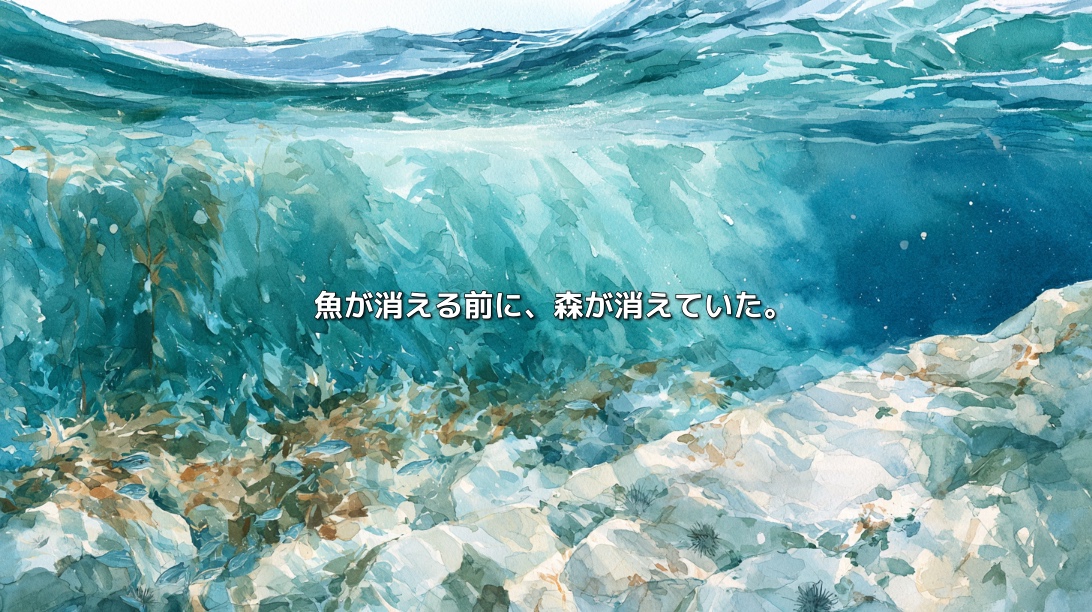
Yet beneath the surface, some places are changing. Seaweed that once covered the rocks has thinned, transforming the underwater landscape.
Seaweed beds provide shelter, spawning grounds, and places for young fish to grow. They also support the lives of countless small organisms.
In the second article in this series, we explored how marine heatwaves can change where fish live. This time, we turn to the habitats awaiting them: the underwater homes themselves. neoterrainjournal.com
What Do We Mean by an “Underwater Forest”?
The phrase may bring to mind tall seaweeds swaying above the seabed.
Along Japan’s coasts, different communities of kelp, Ecklonia, and Sargassum grow according to local conditions and water depth.
Eelgrass meadows are also important marine habitats. Eelgrass, however, is a flowering seagrass rather than a seaweed. With that distinction in mind, this article focuses primarily on beds of large seaweeds growing on rocky reefs.
Seaweeds grow using sunlight. The three-dimensional spaces they create offer shelter for fish, crustaceans, and other animals. Small organisms gather to feed on their fronds and on the life growing across their surfaces.
A seaweed bed supports overlapping activities: feeding, hiding, and growing.
That is why measuring the amount of seaweed alone is not enough.
Which species grow there? In which seasons? How densely? And which animals use them?
Understanding an underwater forest means looking closely at the life within it.
What Changes When the Water Gets Warmer?
Each seaweed species has a temperature range suited to its growth.
Prolonged high temperatures can disrupt growth and reproduction. Marine heatwaves, discussed in the second article, are periods when seawater remains unusually warm relative to the normal seasonal conditions of a particular location.
NOAA emphasizes that the ecological effects depend on a heatwave’s duration and geographical extent as well as its intensity.
Still, a decline in seaweed cannot automatically be attributed to a warm year.
Changes in currents, wave exposure, water clarity, seabed conditions, nutrient availability, and grazing animals can all play a part.
An apparent decline may even reflect seasonal loss of fronds.
To distinguish lasting change from seasonal variation, it is important to observe the same locations during the same season over several years.
Grazing Can Keep a Forest from Returning
As seaweeds grow, sea urchins and herbivorous fish feed on them.
Under many conditions, growth and grazing remain in balance. But when seaweed growth weakens and grazing pressure persists, even newly emerging plants may be consumed, making recovery difficult.
In Japan, the persistent loss of large seaweeds from rocky coastal habitats is known as isoyake.
This does not mean the seabed has become lifeless. Small algae, sea urchins, and other organisms may remain.
What changes is the relationship between the structurally complex seaweed community and the animals that depended on it.
Where sea urchins are abundant, their grazing needs to be examined. Where herbivorous fish exert strong pressure, their effects require attention.
Different causes call for different responses.
Simply sowing seaweed spores may achieve little if the relationship between seaweed growth and grazing is overlooked.
Fish May Still Be Swimming, Even as the Ecosystem Changes
Fish do not necessarily disappear altogether when seaweed beds decline.
Other species may arrive. Different small organisms may become more abundant.
But for animals that used the seaweed as shelter or feeding habitat, the conditions of life have changed.
For small fish in particular, the availability of complex places to hide can matter greatly.
Even if adult fish remain in the area, a reduction in nursery habitat may produce effects that become visible only later. This is one reason changes in fish landings alone cannot fully reveal the consequences of seaweed decline.
The relationship between fisheries and seaweed habitats also works in several directions.
Sea urchin and herbivorous fish populations, harvesting practices, seaweed-related industries, and coastal management all interact.
Restoration cannot promise that more seaweed will automatically mean more fish.
The more useful question is: Which species, at which stages of life, are we trying to support—and in what kind of coastal environment?
Isoyake Looks Different from Place to Place
Isoyake cannot be treated as a uniform phenomenon across Japan.
Rocky shores exposed to the open ocean experience different wave conditions from sheltered bays. Northern and southern coasts support different seaweed communities.
The obstacles to recovery vary, too: high temperatures may dominate in one place, grazing in another, and unsuitable attachment surfaces elsewhere.
Local investigation begins by making comparisons between “then” and “now” more specific.
The memories of fishers and underwater surveyors offer valuable starting points. Historical photographs, distribution maps, seawater temperature records, and surveys of seaweeds and grazing animals can then help test those observations.
Bringing experience and data onto the same nautical chart makes it possible to examine what has changed.
Nutrients, explored in the third article, also matter.
The supply of nutrients needed by seaweeds varies among locations and seasons. Yet nutrient availability alone cannot explain the condition of a seaweed bed.
Temperature, light, grazing, waves, and seabed conditions need to be considered together.
What Does Restoration Aim to Bring Back?
Seaweed restoration can involve transplanting, installing cultivated juveniles or seeded materials, and reducing grazing pressure.
But restoration does not end with planting.
Are conditions suitable for continued growth? Does a new generation establish the following year? Do fish and small organisms use the restored habitat?
Methods need to be adjusted in response to what monitoring reveals.
The goal may also need to extend beyond recreating the exact scene in an old photograph.
As the ocean warms, some locations may no longer provide suitable conditions for the species that once grew there. Restoring the same species at the same density may become difficult.
What, then, are we trying to protect?
A particular seaweed species? A place where marine life can grow? The relationships connecting coastal ecosystems, fisheries, and community life?
Without a clear goal, it becomes difficult to judge whether restoration is succeeding.
Reading Ocean Change Through the Places Fish Call Home
The first article followed oxygen. The second examined heat. The third traced nutrients arriving through rivers.
These processes meet in the same environment.
The water surrounding a fish and the seaweed forest sheltering it change together.
When fish are no longer visible, we can look beyond the fish themselves and examine the places where they grew.
What grows on the rocks? What feeds on it? What small lives find shelter there?
The beginnings of change may lie in places that cannot be seen from the harbor.
When an underwater forest changes, more than the color of the seabed is altered.
The very map of where the next generation can live is being redrawn.
References and Starting Points for Further Reading
- NOAA — Marine Heatwaves
- Fisheries Agency of Japan — Fisheries White Paper
- Japan Fisheries Research and Education Agency — Marine environmental information