Sponge Cities, Urban Wetlands, and Making Room for Rain
When rain falls, send it into a drain.
From the drain, into a sewer.
From the sewer, out to a river or the sea.
Modern cities have been built to move water out of everyday living spaces as quickly as possible.
Roads were paved. River channels were lined with concrete. Rice paddies and wetlands became residential neighborhoods and commercial districts. Urban life grew more convenient, while the places where rain could soak into the ground gradually disappeared.
Under ordinary conditions, this system works efficiently.
But when large amounts of rain fall within a short period, the situation changes.
Water falling on roofs and roads rushes toward drainage inlets. Once the capacity of sewers and channels is exceeded, water spills from manholes and roadside drains into streets, underground spaces, and homes.
The faster a city tries to move water away, the more runoff can converge within a short window.
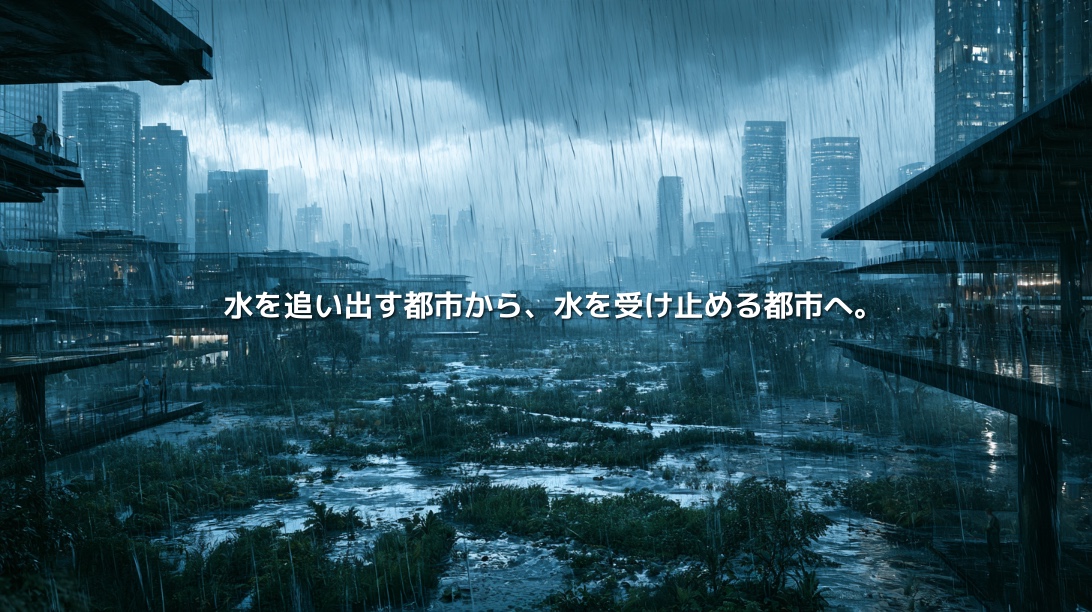
The idea of the sponge city confronts this contradiction. neoterrainjournal.com
Cities Have Lost the Places That Once Held Rain
In forests and grasslands, some rainfall is intercepted by leaves and branches. Some infiltrates the soil and replenishes groundwater. Water flowing across the surface is slowed by vegetation and the shape of the land.
Wetlands, rice paddies, and floodplains give rising water room to spread temporarily.
In cities, however, much of the ground is covered by asphalt, concrete, and buildings.
These largely impermeable surfaces absorb little rain. Instead, much of the rainfall becomes surface runoff, quickly entering sewers and rivers.
The problem is not simply how much rain falls.
The same volume of water can create very different flood risks depending on whether it reaches a river over several hours or converges within a few dozen minutes.
Urbanization means more than an increase in buildings.
It also means losing the time that water once spent soaking into the ground and moving slowly through the landscape.
A City Can Flood Without a River Overflowing
When people think about urban flooding, they often picture a major river bursting its banks.
Yet cities can flood even when river embankments remain intact.
This happens when rainfall overwhelms sewers, roadside drains, and other drainage channels, causing water to accumulate within the built environment. It is often described as pluvial flooding or surface-water flooding.
Underground shopping areas, subway stations, basement parking garages, road underpasses, and low-lying residential neighborhoods are particularly exposed.
Rising river levels can also make it difficult to discharge urban runoff. With nowhere to drain, rainwater can remain trapped inside the city.
Larger sewer pipes, additional pumping stations, and underground storage facilities are important.
But when nearly all runoff is directed into the same drainage network, rainfall beyond its design capacity can concentrate the load very quickly.
Another approach is therefore needed: holding rain close to where it falls, before it enters the drainage system.
What Is a Sponge City?
A sponge city is an approach to urban design that allows the city to function more like a sponge.
Instead of immediately draining rainfall away, it creates several pathways for water:
- Holding it temporarily at the surface.
- Allowing it to infiltrate the soil.
- Supporting uptake by plants.
- Returning it to the atmosphere through evaporation and transpiration.
- Collecting it for reuse where appropriate.
- Releasing it gradually into rivers.
Urban wetlands, rain gardens, parks, planted drainage channels, permeable paving, green roofs, and storage tanks can all contribute.
Although the term “sponge city” became widely known through China, its underlying principles are shared elsewhere.
Low-impact development in the United States, sustainable urban drainage in Europe, nature-based solutions, and Japan’s green infrastructure and river basin flood management all draw on related ideas.
The name matters less than the shift it describes.
A city can become a place that receives water and supports its circulation.
Why China Began Turning Cities into Sponges
Rapid urbanization in China transformed wetlands, farmland, and low-lying riverside areas into built-up districts.
At the same time, cities faced several overlapping water problems: urban flooding, water shortages, pollution, and declining groundwater levels.
Sponge city policy emerged as an effort to address these problems together by retaining, infiltrating, treating, and reusing rainwater within urban areas.
China set a goal of bringing 80 percent of urban areas into line with sponge city requirements by 2030, combining runoff management with objectives such as water-quality improvement and groundwater recharge.
Parks can be lowered to create temporary storage. Concrete channels can be redesigned as planted waterways. Roads and sidewalks can incorporate permeable surfaces. Urban wetlands can be restored to help treat runoff.
Individual interventions may be small. Distributed across a catchment, however, they can delay the arrival of water at the sewer network.
The ambition extends beyond flood protection: retaining water for drier periods while improving water quality and the urban environment.
Can a Sponge City Withstand Extreme Rainfall?
Sponge cities cannot eliminate flooding.
Rain gardens, wetlands, and parks have finite storage capacity. Infiltration rates depend on soil conditions, and areas with high groundwater levels may have little room to absorb additional water.
After prolonged rainfall, soils can become saturated. During exceptionally intense storms, nature-based facilities alone cannot manage all the incoming water.
Their effectiveness is also limited if only a few parks or redevelopment sites adopt sponge measures while most of the surrounding catchment remains paved.
The area covered by new facilities is therefore an incomplete measure of a city’s safety.
Where does rain fall? Where does it flow? Which low-lying areas receive it?
Answering these questions requires rivers, sewers, topography, underground spaces, and land use to be considered together.
Sponge cities work alongside dams, embankments, sewers, and drainage pumps, distributing some of the burden across the urban landscape.
A Park Can Change Its Role When the Rain Arrives
In cities where land is scarce, setting aside large areas exclusively for flood protection is difficult.
One response is to give the same place several functions.
On a sunny day, a park offers space for children to play, people to walk, and communities to gather. During heavy rain, it temporarily receives runoff from nearby streets and buildings.
A plaza or sports field can sit slightly below the surrounding ground. Planting beds can function as rain gardens. Ponds and wetlands can accommodate changing water levels.
A park designed to hold floodwater is performing an intended function when it temporarily fills.
It is multipurpose urban infrastructure.
Conventional planning has often treated inundation as a problem wherever it occurs.
As protecting every location from every possible flood becomes increasingly difficult, deciding where water can be stored safely becomes essential.
Can Small Rain Gardens Help Protect an Entire City?
A rain garden is a small planted area that temporarily holds runoff from roofs, sidewalks, or parking areas and allows it to infiltrate through soil.
Its storage capacity is modest compared with a large detention basin.
But rain gardens distributed among homes, schools, parks, roads, and commercial properties can help reduce the simultaneous rush of water into sewers.
Tokyo has promoted rainwater green infrastructure, including rain gardens, to reduce runoff. Suginami City has also developed park-based initiatives that allow residents to experience how rain gardens work.
Their value lies in receiving small amounts of water at many locations throughout a catchment.
Flood-management infrastructure begins to appear within everyday scenery: beside a school, along a sidewalk, outside a home.
This distributed structure is central to the sponge city approach.
Urban Wetlands Do More Than Store Water
Urban wetlands provide more than temporary storage.
Runoff from roads and parking areas can carry sediment, oil, tire-wear particles, heavy metals, and nutrients.
As water moves through a wetland, its flow slows. Some sediment settles, while plants and microorganisms participate in nutrient and organic-matter cycling.
Wetlands can therefore serve as an intermediate zone that helps improve the quality of water moving from the city toward rivers and the sea.
Evaporation and transpiration can also influence local temperatures. Vegetation provides habitat for birds and insects. For people, these spaces offer opportunities for walking, rest, and environmental learning.
When rainwater enters a vast underground facility, its movement disappears from view.
When it passes through an urban wetland, the water cycle becomes part of the visible landscape.
Flood management connects with the quality of everyday life.
Infiltration Must Fit the Land
Sponge city design needs to respond to local conditions.
On unstable ground or slopes, excessive infiltration can affect ground stability. Where groundwater is already close to the surface, there may be little capacity for additional water.
At former industrial sites or on contaminated land, infiltrating water can carry pollutants deeper underground.
Coastal lowlands may also require consideration of sea-level rise, storm surges, and groundwater salinization.
Maintenance matters, too.
Leaves and sediment can block inlets and reduce the performance of rain gardens and infiltration facilities. Planting vegetation is only the beginning. Cleaning, vegetation management, and sediment removal remain necessary.
Infrastructure that uses natural processes still requires care.
Assumptions that greenery automatically produces safety, or that nature-based infrastructure is always inexpensive, can lead to disappointing results.
Beneath the City Lie Forgotten Waterways
The present-day streetscape rarely reveals the full history of the land beneath it.
Wetlands, rice paddies, ponds, small valleys, streams, and former river channels may have been filled or covered before roads and buildings were constructed above them.
Enclosing a stream underground does not erase the valley through which it once flowed.
Filling a wetland does not necessarily remove its position within the surrounding lowland.
During heavy rainfall, water follows topography, crossing roads and administrative boundaries along the way.
When it gathers along former channels and depressions, the landscape’s “memory of water” becomes visible again.
Planning a sponge city therefore requires more than a map of current land use.
Historical maps, terrain data, former river courses, groundwater conditions, and past flood records can help identify where space for water is most needed.
Sponge Cities and Japan’s River Basin Flood Management
Japan’s approach to river basin flood management seeks to reduce flood damage across entire catchments.
National and local governments, businesses, and residents combine measures such as:
- Improving river channels and embankments.
- Using dams and floodwater detention areas.
- Temporarily storing water in rice paddies and ponds.
- Receiving runoff in parks and green spaces.
- Installing storage and infiltration facilities at homes and other buildings.
- Reviewing land use in areas with high flood risk.
- Improving evacuation information and hazard maps.
China’s sponge city policies and Japan’s river basin approach developed under different institutions and circumstances.
They nevertheless share an emphasis on distributing water management across cities, farmland, forests, and wetlands.
Urban rain gardens and wetlands bring that catchment-wide thinking into places people encounter every day.
The Question Is Where to Make Room for Water
Building a sponge city requires agreement about how land will be used.
A park that temporarily stores runoff may be unavailable for a time after heavy rain. Replacing part of a road with planted space can reduce room for parking or traffic.
A property owner who installs rainwater storage may find it difficult to see the benefits received by communities downstream.
Some land accepts water to improve safety elsewhere.
Who carries that responsibility? Who maintains the facilities? How should the costs be shared?
Engineering alone cannot settle these questions.
Subsidies, development rules, floor-area incentives, taxation, insurance, and community management can help create arrangements that recognize the public value of land that holds water.
Combining Gray and Green Infrastructure
Sewers, drainage pumps, underground storage facilities, and embankments will remain essential.
Rain gardens, wetlands, parks, green spaces, and permeable paving also have limits.
A resilient city combines their strengths.
Gray infrastructure conveys and discharges large volumes of water. Green and blue infrastructure receives runoff across many locations and slows its movement. Evacuation systems, public information, and land-use planning help reduce the consequences when flooding occurs.
Together, these layers can reduce the likelihood that one overwhelmed facility causes widespread disruption.
The sponge city expresses an idea of urban flexibility.
It makes room in advance for water to occupy space—and to take time moving through it.
Giving Water a Place to Stay
Rain does not fall with the intention of becoming a disaster.
It soaks into soil, supports plants, replenishes groundwater, and travels toward rivers and the sea. It reaches the city as part of the water cycle.
When a city loses the soil and wetlands that once received it, rain converges rapidly at drainage inlets and becomes a concentrated burden.
Future cities need places where water can spread temporarily, remain, infiltrate, and begin moving again.
A park holds water during a storm.
A small roadside garden collects the rain.
An urban wetland helps clean runoff and passes it slowly toward a river.
These are landscapes designed to accommodate the movement of water while reducing harm.
Protecting a city means giving water a place to stay.