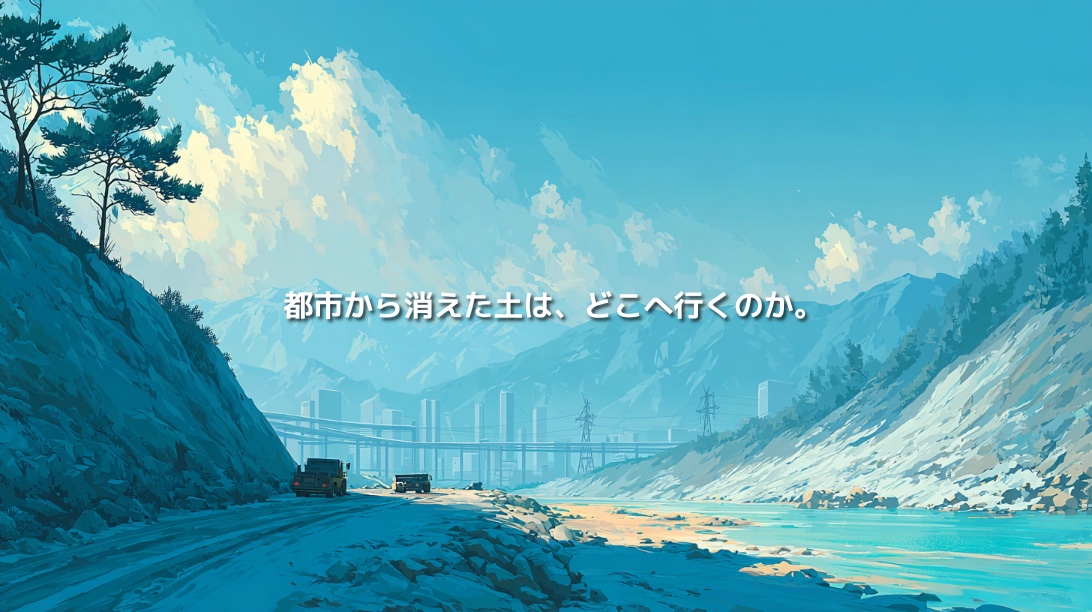
Rethinking the Relationship Between Cities and Regions Through the Journey of Excavated Soil
Cities continue to build.
Developers excavate beneath skyscrapers, lay foundations for apartment buildings, construct roads and tunnels, redevelop areas around railway stations, and reshape the urban landscape.
Completed buildings are visible. New roads, improved stations, and rising property values are recorded as economic achievements.
But where does all the soil excavated during construction go?
Digging into urban ground inevitably produces soil. If it cannot be reused on-site, it is loaded onto dump trucks and transported out of the city.
Some of this soil becomes material for another construction project. Some is stored temporarily in stockyards. Other loads are carried to mountain valleys, former quarry sites, or land-development areas.
While the urban surface becomes more orderly, the terrain beyond the city is being reshaped by the soil removed from it.
A previous article examined where cities obtain the sand and aggregate needed for construction.
This article asks the opposite question:
Where do we send the soil left behind after building a city?
“Surplus Construction Soil” Is Not Waste
Although it is commonly described as surplus construction soil, Japanese authorities generally use the term “construction-generated soil.”
According to the Ministry of Land, Infrastructure, Transport and Tourism, construction-generated soil refers to soil and sediment transported away from construction sites. In principle, it is not classified as waste under Japan’s Waste Management and Public Cleansing Act.
Construction sludge—the muddy material produced by excavation—is treated differently and is classified as industrial waste.
This distinction matters.
Construction-generated soil is not inherently something that should be discarded. If its quality and safety are suitable for the intended purpose, it can be reused for road embankments, levees, land development, and backfilling.
Soil left over from one project can be transported to another project that needs it. If soil can circulate within a city or region, the need to extract new material from mountains and rivers can be reduced.
Shorter transport distances can also reduce dump-truck traffic, carbon dioxide emissions, and pressure on surrounding roads.
The problem begins at the moment the soil becomes unnecessary to the project that produced it.
If no recipient has been identified, the soil cannot remain indefinitely at the construction site. Urban sites generally have little spare space, and the soil must be removed quickly so the next stage of construction can proceed.
Even when it is not legally considered waste, it becomes something the project urgently needs to move elsewhere.
This is why construction-generated soil continually shifts between being a resource and being an inconvenient surplus.
What Lies Behind Japan’s 79.8 Percent Utilization Rate?
According to a national survey of construction by-products conducted by the Ministry of Land, Infrastructure, Transport and Tourism, Japan’s effective utilization rate for construction-generated soil rose from 71.7 percent in fiscal 2008 to 79.8 percent in fiscal 2018.
The fact that around 80 percent is being utilized reflects years of regulatory development and effort by the construction industry.
Viewed another way, however, approximately 20 percent has yet to enter the effective utilization stream fully.
Even when soil is officially recorded as having been utilized, the complete environmental impact cannot be understood without asking how far it was transported and what kind of land alteration it was used to create.
Soil reuse is more complicated than the percentage suggests.
The soil quality, quantity, project schedules, and distance must align between the project producing the soil and the project that needs it.
If the excavated material is clay-rich but the receiving project requires sandy soil, it may be unsuitable. If the removal and delivery schedules do not match, temporary storage will be necessary.
When transport distances become too long, the financial cost and emissions generated by transportation may outweigh some of the environmental benefits of reuse.
A review presented to the Ministry of Land, Infrastructure, Transport and Tourism also notes that inter-project reuse requires compatible soil quality and construction schedules, a transport distance generally within 50 kilometers, and detailed coordination at the project level.
The soil exists. Projects that need soil also exist.
Yet if timing, quality, and location do not align, circulation cannot take place.
Stockyards and inland receiving sites are the places that ultimately absorb these mismatches.
Soil Removed from the City Is Deposited Somewhere Else
Soil does not disappear when it leaves a city.
It is placed somewhere.
Properly designed and constructed embankments can become valuable infrastructure supporting roads, housing developments, levees, and industrial land. The use of construction-generated soil is not itself the problem.
Risk emerges when large quantities of soil are deposited in areas with inadequate drainage, when valleys and slopes are filled beyond their safe capacity, when soil quality and compaction are not properly managed, or when the volume delivered exceeds the original plan.
Valleys are natural pathways where water gathers.
When soil is placed in a valley, the movement of rainwater and groundwater changes. If water accumulates inside an embankment, its stability may decline, increasing the risk of collapse or sediment discharge.
The consequences extend beyond disaster risk.
Changes to terrain through excavation and filling can alter the land’s ability to retain and transmit water. They may affect surface runoff, groundwater, soil functions, and ecosystems.
Japan’s Ministry of the Environment has also noted that land alteration through excavation, embankment construction, reclamation, and changes to groundwater conditions can change the functions and structure of soil and ground systems.
At the urban construction site, the removal of the soil may be recorded as complete.
At the receiving site, however, that same soil becomes new terrain, a new pattern of water movement, and a new long-term management responsibility.
The problem has not ended.
Its location has changed.
What the Atami Debris Flow Forced Society to Confront
In July 2021, a devastating debris flow struck the Izusan district of Atami in Shizuoka Prefecture.
The collapse of an artificial embankment in the upper part of the affected area intensified the disaster.
What shocked society was not simply that soil had collapsed. Soil deposited through human activity had remained on the land for years before threatening communities downstream.
Of course, not all embankments or construction-generated soil are dangerous.
Many embankments are used safely through appropriate design, permitting, construction, drainage, inspection, and maintenance.
The fundamental question is therefore not whether embankments themselves are dangerous.
It is whether responsibility remains connected throughout the entire process—from the generation and transportation of the soil to its acceptance, placement, and long-term management.
The Atami disaster became one of the catalysts for a fundamental revision of Japan’s former Act on Regulation of Residential Land Development.
The revised legislation, commonly known as the Embankment Regulation Act, came into force in May 2023. It introduced a comprehensive regulatory system for potentially dangerous embankments, regardless of whether the land is classified as residential, agricultural, or forest land.
Within regulated areas, the system establishes approval standards based on topography and geology, periodic reporting and interim inspections during construction, and final inspections after completion.
It also clarifies the maintenance responsibilities of landowners and enables authorities to issue corrective orders to those responsible for creating unsafe conditions.
Management of construction-generated soil destinations has also been strengthened.
Under the Ministry of Land, Infrastructure, Transport and Tourism’s system, prime contractors must prepare resource-reuse promotion plans and confirm that the proposed destinations are appropriate.
Since June 2024, projects covered by the requirements must, in principle, confirm where the soil ultimately ends up.
The purpose is to prevent responsibility from ending the moment soil leaves the construction site.
In other words, society has finally begun to question the “exit” through which soil leaves urban development.
Why Does the Burden Move Toward Mountains and Suburbs?
Urban land is expensive, and there are few places where enormous volumes of soil can be stored. The effects on residents and traffic are also significant, making it difficult to secure receiving sites within cities.
Mountainous and suburban areas, by contrast, contain valleys, former quarry sites, and disused land that may appear capable of receiving large quantities of soil.
From the city’s perspective, transporting soil to these places can seem like a rational way to keep construction moving.
But what does it look like from the perspective of the receiving community?
Dump-truck traffic, noise, dust, damaged roads, altered landscapes, disaster risks, and the long-term responsibility of maintaining embankments remain with the receiving area.
The economic value created in the city and the burden left at the destination do not appear in the same place.
This should not be reduced to a simple conflict between cities and rural regions.
People in both urban and rural communities benefit from roads, buildings, and logistics networks. Rural construction projects also generate excavated soil.
The objective is not to identify a villain.
It is to recognize the structure through which the destination of soil becomes invisible when the places receiving the benefits of development are separated from the places carrying its burdens.
If we look only at the completed city, development appears successful.
But if the soil excavated to complete that city leaves another landscape with danger and decades of management responsibility, can we really say that the development is complete?
From “Soil to Be Discarded” to “A Regional Resource Held in Trust”
The first step toward solving the construction-generated soil problem is not finding another disposal site.
It is considering the soil’s entry and exit at the same time, beginning in the planning and design stages rather than after excavation has already started.
Projects should first examine whether the total volume of excavation can be reduced.
The amounts of cut and fill should be balanced within the site whenever possible, minimizing the volume transported elsewhere.
The quantity, quality, and timing of soil generation should be identified early and matched with nearby projects that need material.
If construction schedules do not align, registered stockyards capable of safely storing the soil temporarily should be used.
Soil unsuitable for its intended purpose may be transformed into usable material through appropriate improvement and treatment.
Systems that share information across public and private projects are also essential. Japan’s Ministry of Land, Infrastructure, Transport and Tourism has promoted both information exchange between public works projects and public-private matching systems that connect government and private-sector construction.
But placing information into a database is not enough to move the soil.
People are still needed to inspect soil quality, coordinate schedules, compare transport distances and costs, and verify the safety of receiving sites.
Soil circulation requires more than logistics. It requires a role that connects and coordinates the region as a whole.
The future must move beyond optimizing one construction project at a time toward managing a regional “soil balance.”
Where, when, and in what quantities will different types of soil be generated?
Which projects will need soil, and when?
Where are the safe temporary storage facilities, and which transport routes can minimize environmental impacts?
Rather than treating soil as the final residue of construction, regions should manage it as a resource held temporarily before being transferred to its next use.
With this perspective, mountains and valleys would be less likely to become invisible destinations for the city’s unwanted material.
Extending the Boundaries of Urban Development Beyond the City
Every building site has a property boundary.
The effects of development do not stop at that line.
Construction materials arrive from distant mountains, rivers, quarries, and factories. Excavated soil is transported to other projects, stockyards, and receiving sites in mountainous areas.
Even after the building is complete, the movement of resources and burdens continues beyond the city.
Urban development has traditionally been evaluated through the buildings and roads it completes.
In the future, evaluation must include not only what was built but also what was excavated, where it was transported, and what kind of landscape it left behind.
Construction-generated soil is not merely a by-product.
It is material displaced by urban growth—and a record revealing the full geography of development.
A city can make soil disappear from view.
It cannot make soil disappear from the planet.
Soil removed from a city becomes part of another landscape’s future.
The completion of a city, therefore, cannot be defined solely by the completion of a building.
Development is complete only when the excavated soil has a destination that is safe, accountable, and connected to another productive use.
We must move beyond an era in which success is measured only inside the city.
Prosperity should also account for the places where resources are extracted, the destinations receiving excavated soil, and the people who will continue living with the transformed land.
The question should no longer be:
“Where can we dump this soil?”
It should become:
“Where—and how—can this soil be used responsibly?”
Changing the question is the first step toward transforming development debt into a resource for the next region.