Why Doesn’t Excavated Soil Circulate? The Barriers of Time, Distance, and Responsibility
Every day, soil is excavated beneath our cities.
Building foundations, subway lines, roads, sewer systems, and tunnels—all of these projects bring enormous volumes of soil to the surface whenever a city acquires new infrastructure.
Meanwhile, outside urban centers, soil is needed to build embankments, prepare development sites, construct roads, and reinforce river levees.
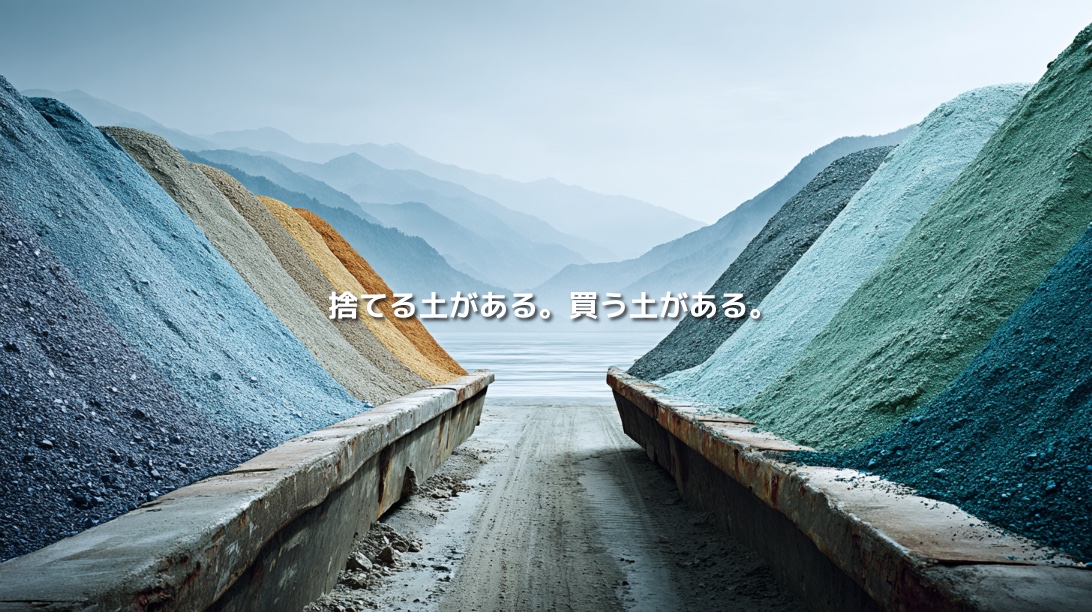
Some places have too much soil. Others need it.
At first glance, the solution appears simple: connect supply with demand.
In reality, however, it rarely works that way.
One construction site may pay to transport surplus soil elsewhere, while another nearby project purchases newly quarried sand or fill material. Soil that might have been reusable becomes “surplus,” while soil extracted from another landscape is transported and sold as a commercial product.
Why does this mismatch occur?
A closer look at construction-generated soil reveals more than differences in soil quality. It exposes a fragmented development system in which schedules, distances, storage sites, contracts, and responsibilities are managed separately.
Soil Is Not Waste—but It Is Not Always a Resource
The first point to understand is that construction-generated soil is not, in principle, classified as waste under Japan’s Waste Management and Public Cleansing Act.
Japan’s Ministry of Land, Infrastructure, Transport and Tourism defines soil and sediment removed from construction sites as “construction-generated soil” and distinguishes it from construction sludge, which is treated as industrial waste.
Excavated soil can be used for embankments, backfilling, land development, and levee construction. If an appropriate location and purpose exist, it is not something to be discarded. It becomes material for shaping another piece of land.
This is also where the difficulty begins.
Unlike concrete debris or metals, which can be processed into relatively standardized recycled materials, the characteristics of soil vary from one location to another.
Is it sandy or clay-rich? Does it contain excessive moisture? Can it be compacted easily? Can it provide the strength required for the intended structure? Does it need to be tested for hazardous substances, including those that occur naturally?
Soil does not become a resource merely because it exists.
It becomes a resource only when location, purpose, timing, and quality align.
Its value is not contained in the material alone. It emerges through its relationship with the surrounding land and projects. In this sense, construction-generated soil is an inherently place-dependent resource.
Approximately 133 Million Cubic Meters Were Transported Off-Site Nationwide
According to a fiscal 2018 survey by Japan’s Ministry of Land, Infrastructure, Transport and Tourism, approximately 132.63 million cubic meters of construction-generated soil were transported off construction sites nationwide. The reported effective utilization rate was 79.8 percent.
For comparison, Tokyo Dome has a volume of roughly 1.24 million cubic meters. The amount of soil transported off-site was therefore equivalent to more than 100 Tokyo Domes.
However, this figure does not mean that around 80 percent of the soil circulated directly into other construction projects.
The effective utilization rate includes not only on-site reuse and transfers between construction projects, but also appropriate uses such as restoring former quarry sites and accepting soil on agricultural land.
Such uses can play an important role in restoring land functions, but they are not necessarily equivalent to circulating excavated soil as construction material for the next project.
The next nationwide survey covers fiscal 2024, with results scheduled for publication during 2026. At the time of writing, the fiscal 2018 figure of 79.8 percent remains the latest published nationwide value.
The deeper question is not simply whether the soil was “used” or “not used.”
How much circulated directly from one project to another? How much was transported over long distances? How much was placed at a receiving site without ever finding another productive use?
To understand soil circulation, we must examine not only the utilization rate but also the route the soil follows.
Four Mismatches That Interrupt Soil Circulation
Four major mismatches make it difficult to reuse construction-generated soil between projects.
1. The Quantities Do Not Match
A tunnel project may produce an enormous amount of soil within a short period. A nearby land-development project, however, may require only a small fraction of that volume.
If the scale of supply does not match the scale of demand, some soil may be reused, but another destination must still be found for the remainder.
2. The Quality Does Not Match
A receiving project may require high-quality sandy soil that can be compacted easily. The supplying site, however, may produce wet, clay-rich soil that cannot be used in its original condition.
Soil improvement can expand the range of possible applications. But this requires processing equipment, quality control, additional costs, and enough space to carry out the work.
“There is soil available” is not the same as “there is soil suitable for this project.”
3. The Timing Does Not Match
Time is one of the least visible—and most important—barriers.
If one project excavates soil in April but another project does not need it until October, the soil must be stored somewhere for six months.
In an urban area, simply securing enough land to store tens of thousands of cubic meters safely can be extremely difficult.
Construction delays and design changes create further uncertainty. If a planned receiving project changes the date when it needs soil, the supplying project may have to find a new destination at short notice.
Soil circulation requires more than a transportation network.
It also requires places capable of absorbing differences in time.
4. The Distance Does Not Match
Soil is heavy and bulky relative to its unit value. As transportation distances increase, so do fuel consumption, labor costs, vehicle requirements, traffic impacts, and carbon dioxide emissions.
Even if an ideal construction project needs soil farther away, transporting it to a closer, properly managed receiving site may be more reasonable in terms of cost and schedule.
Japan’s recycling principles for public works have generally used a radius of 50 kilometers from the construction site as a guideline for utilizing construction-generated soil, while also considering timing and soil quality.
Yet in some regions, there is little or no demand within that radius. A case reported by the Kinki Regional Development Bureau illustrates the difficulty of transferring soil between projects when there are few nearby construction sites or private facilities able to accept it.
Soil surpluses are not distributed evenly across the country.
Urban areas, mountainous regions, and coastal zones generate and require different quantities of soil. Rather than being a commodity that can be freely traded across a national market, construction-generated soil is a regional resource with a limited practical range of movement.
The Paradox of Discarding Soil While Buying New Soil
This creates a striking paradox.
Within the same region, one project may be paying to remove unwanted soil while another purchases new soil.
This contradiction is not necessarily caused by negligence.
Each project has its own budget, client, design, contract, and construction schedule. The responsibility of the project producing the soil is to transport it to an appropriate destination by a fixed deadline. The responsibility of the project receiving soil is to secure material of guaranteed quality on the exact date it is needed.
When both sides optimize their individual projects, inefficiency can remain across the region as a whole.
This is not a failure of individual construction sites. It is a failure of the system connecting them.
Urban planning determines where buildings and roads will be placed. Logistics planning considers how materials will be delivered. Yet the amount of soil that will be excavated and where it will go are rarely planned across multiple projects as a regional soil balance.
Cities design the spaces that will exist after construction. The ground that moves during the construction process, however, is still often managed one project at a time.
Stockyards Are Infrastructure for Time, Not Merely Warehouses for Soil
Stockyards and soil-improvement plants can help reconcile differences in quantity, quality, and timing.
A stockyard can temporarily hold soil excavated in spring and supply it to a project that needs it in autumn. A soil-improvement plant can modify soil that would otherwise be difficult to use, expanding the number of potential destinations.
These facilities are therefore more than storage sites.
They serve as intermediate hubs that can:
- Absorb timing gaps between construction projects
- Combine different volumes of soil and divide them according to demand
- Inspect soil quality and prepare material for specific uses
- Connect records of where the soil came from and where it ultimately went
However, if another user cannot be found, temporary storage may become long-term storage. A facility intended to support circulation can gradually become a de facto final disposal site.
A 2024 Ministry of Land, Infrastructure, Transport and Tourism review positioned soil-improvement plants and stockyards as facilities for coordinating reuse between construction projects. At the same time, it warned that some sites were not moving enough soil onward and were effectively turning into surplus-soil disposal sites.
It is not enough to measure how much soil enters a facility.
The real measure of success is how much soil is connected to its next use.
Responsibility for Confirming Soil Destinations Has Been Strengthened Since the Atami Disaster
The debris flow disaster that struck Atami, Shizuoka Prefecture, in July 2021 became a turning point in Japan’s regulation of embankments and deposited soil.
Previously, regulatory requirements differed according to land use and administrative zoning. As a result, some dangerous embankments could not be addressed comprehensively.
In response, Japan enacted the Act on Regulation of Residential Land Development and Specified Embankments—commonly known as the Embankment Regulation Act. The law came into force in May 2023 and introduced nationwide standards for regulating dangerous embankments regardless of how the land is classified or used.
At the same time, requirements for planning and confirming the destinations of construction-generated soil were strengthened under the Act on the Promotion of Effective Utilization of Resources.
For projects above a certain scale, prime contractors must prepare a resource-reuse promotion plan identifying where the soil will be transported. They must also confirm the suitability of the destination before removal and verify delivery afterward through receipts and other records.
According to guidance from the ministry, these planning requirements apply, among other cases, to projects that transport 500 cubic meters or more of soil off-site.
A registration system for stockyard operators has also been introduced to strengthen appropriate management and recordkeeping.
This represents significant progress.
The system is moving toward making it easier to trace who transported which soil, where it was taken, and whether responsibility was maintained throughout the process.
However, reducing inappropriate destinations through regulation is not the same as circulating soil as a resource.
Even if a safe and legitimate destination can be confirmed, regulation alone does not create demand for the soil. Increasing the number of approved receiving sites is not enough to complete the circulation system.
Three elements are necessary: regulate entry, record the route, and create demand at the exit.
From Optimizing Individual Projects to Managing a Regional Soil Balance
If construction-generated soil is to circulate effectively, it is too late to begin searching for a destination only after construction has started.
The soil balance must be understood at the planning stage across multiple projects within the same region.
Over the next several years, which projects will produce soil? What type of soil will they generate, and how much? When and where will other projects require it? If the timing does not match, where can it be stored safely? How much unsuitable soil could become usable through improvement?
In effect, each region needs its own “soil budget.”
Achieving this requires several fundamental changes.
Build the Destination into the Design
Instead of waiting until soil has been excavated, projects should incorporate destinations into the planning process.
Designs that reduce excavation, reuse soil within the same site, and coordinate with nearby projects should become part of planning, engineering, and cost estimation—not an effort made only after construction begins.
Connect Information from Public and Private Projects
Information about roads, rivers, buildings, and land development should not remain separated by commissioning authority.
Data on soil quantity, quality, timing, and location should be shared at the regional level. Information-exchange systems can function effectively only when projects register accurate data early enough for others to act on it.
Treat Stockyards as Regional Infrastructure
Stockyards should be recognized not simply as places that receive soil but as hubs responsible for short-term storage, quality inspection, soil improvement, record management, and onward transportation.
Their performance should be measured by the amount of soil successfully connected to another use—not merely by the amount they accept.
Include Transportation and Land Risks in the Price
If destinations are chosen only by comparing immediate disposal costs, the environmental impact of long-distance transportation and the future maintenance responsibilities of receiving sites are pushed outside the price.
What appears inexpensive in the short term is not necessarily the option with the lowest cost to society as a whole.
Preserve the History of Soil as Part of the History of the Land
Records should show where the soil came from, what characteristics it had, where it was placed, and how the land was formed.
This information should not remain buried in administrative documents after construction is completed. It should be carried forward into land maintenance and disaster-risk assessment.
Just as a building has architectural drawings, developed land needs a documented history of its ground.
Circulating Soil Means Rewriting the Relationship Between Cities and Regions
Construction-generated soil is not merely a material.
In cities, it appears as a consequence of creating underground space. In rural and suburban areas, it may be accepted as material for development or restoration. Once placed, it becomes part of the landscape and continues to influence drainage, groundwater movement, slope stability, and safety for many years.
From the perspective of the construction site, the soil may disappear once a dump truck drives through the gate.
But the soil itself has not disappeared.
It has moved to another municipality, another watershed, or another landowner, where it begins a new life over a different timescale.
The issue of construction-generated soil therefore cannot end with the question of how to dispose of surplus material.
It is also a question of who will bear the burden created by urban renewal, on which land, and for how many years.
Projects that produce soil and projects that use it.
Cities and rural regions.
Construction costs today and land-management responsibilities tomorrow.
As long as these remain in separate accounts, soil will continue to become “surplus” halfway through the cycle.
What is needed is a new understanding of soil movement as a regional system.
Circulating construction-generated soil is not simply a form of recycling.
It means reconnecting projects, timelines, landscapes, and responsibilities that have been separated from one another.
Development is complete only when we design not just what a city builds—but also the future of the soil it excavates.