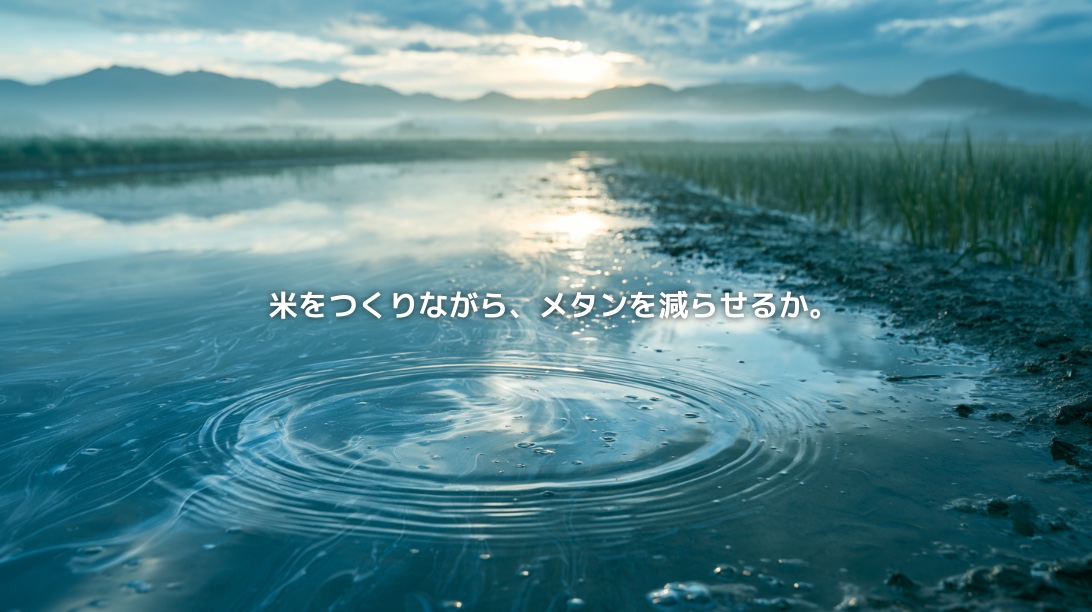
In early summer, the sky is reflected in flooded rice paddies.
When the wind stops, the water becomes as still as a mirror, and rows of newly planted seedlings stretch across its surface.
Rice paddies are part of Japan’s traditional landscape.
They produce food, temporarily store rainwater, support wildlife, and sustain the scenery of rural communities.
Yet beneath that tranquil surface, an invisible gas is being produced.
Methane.
Methane emitted from rice paddies accounts for approximately 40 percent of Japan’s total methane emissions. In fiscal 2024, greenhouse gas emissions from rice cultivation were estimated at approximately 11.84 million metric tons of CO₂ equivalent.
Why do rice paddies produce methane?
Can emissions really be reduced by keeping the fields drained for longer?
And should farmers alone be expected to bear the burden of climate action?
Why Do Rice Paddies Produce Methane?
Methane is a greenhouse gas, like carbon dioxide.
Although it remains in the atmosphere for less time than carbon dioxide, its ability to warm the planet is much greater over a given period.
Japan’s Ministry of Agriculture, Forestry and Fisheries calculates methane’s global warming effect over 100 years as approximately 28 times that of carbon dioxide.
The reason methane is produced in rice paddies lies in the flooded soil.
When a paddy is covered with water, oxygen can no longer easily reach the soil below. Under these oxygen-poor conditions, microorganisms known as methanogens become active.
Organic matter in the soil, including rice straw that has been plowed into the field, is broken down by microorganisms, producing carbon dioxide, acetate, and other substances.
Methanogens then use these substances to produce methane.
Much of the methane travels from the soil through the roots and stems of the rice plants before being released into the atmosphere.
In other words, methane does not emerge from a visible outlet like the smokestack of a factory.
It is produced beneath the water and reaches the atmosphere through the rice plants themselves.
Methane from Rice Paddies Is a Significant Agricultural Issue in Japan
Greenhouse gas emissions from Japan’s agriculture, forestry, and fisheries sectors account for 4.4 percent of the country’s total emissions.
At first glance, this may not appear to be a particularly large share.
Within these sectors, however, emissions from rice cultivation cannot be ignored.
In fiscal 2024, greenhouse gas emissions from agriculture, forestry, and fisheries were approximately 46.38 million metric tons of CO₂ equivalent. Rice cultivation accounted for approximately 11.84 million metric tons.
Greenhouse gases are therefore produced not only by farm machinery and facilities that consume fuel, but also by the soil of the rice paddies themselves.
It would nevertheless be too simplistic to conclude that rice paddies are harmful to the environment.
Paddies help reduce flooding, replenish groundwater, provide habitats for wildlife, and maintain local culture and landscapes. These functions cannot be measured by emissions alone.
The answer is not to eliminate rice paddies.
It is to determine how methane production can be reduced while rice cultivation continues.
What Is Midseason Drainage?
Rice paddies are not kept continuously flooded throughout the entire growing season.
Several weeks after planting, farmers temporarily drain the water and allow the surface of the field to dry. In Japan, this practice is known as nakaboshi, or midseason drainage.
Midseason drainage helps keep rice roots healthy, limits excessive tillering, and firms the ground so agricultural machinery can enter the field during harvest.
Draining the water also allows oxygen to enter the soil, suppressing the activity of methane-producing microorganisms.
Research by Japan’s National Agriculture and Food Research Organization and other institutions has found that extending the conventional midseason drainage period by approximately one week can reduce methane emissions from rice paddies by around 30 percent.
This approach does not require the large-scale introduction of new equipment.
It changes the way water is managed.
The Japanese government therefore promotes extended midseason drainage as a relatively accessible climate measure.
It Is Not as Simple as Keeping the Field Dry
Extending the drainage period can reduce methane emissions.
But that does not mean a rice paddy should simply be kept dry for as long as possible.
If the soil becomes excessively dry, rice roots may be damaged, affecting subsequent growth and yield.
Cultivation trials conducted across eight Japanese prefectures found that extended midseason drainage resulted in an average yield reduction of approximately 3 percent.
Some regions reported higher yields or improvements in rice quality, but the results varied according to weather, soil conditions, water management, and rice variety.
A well-drained paddy and a field that retains water will not dry at the same rate, even when both are drained for seven days.
In colder regions, keeping a paddy drained for too long may lower soil temperatures and increase the risk of cold-weather damage.
In areas with elevated cadmium concentrations, maintaining flooded conditions around the heading stage is also important because it can limit cadmium uptake by the rice.
Food safety and crop yields must not be sacrificed solely to reduce greenhouse gas emissions.
Extended midseason drainage is not a measure that can be applied uniformly for the same number of days across the entire country.
It is a technique that must be adjusted to the condition of each paddy.
How Does Drainage Affect Paddy-Field Wildlife?
A rice paddy is both an agricultural production system and an artificial wetland.
Frogs, loaches, medaka fish, aquatic insects, shellfish, and many other organisms use paddies and irrigation channels as habitats.
The timing of midseason drainage may overlap with important stages in the development of these species.
If a field dries rapidly before tadpoles have completed metamorphosis, they may lose their habitat. Fish and aquatic insects may also become stranded if they cannot move into nearby irrigation channels.
Water management intended to reduce greenhouse gas emissions could therefore harm biodiversity.
Several countermeasures are being considered.
These include creating channels or depressions within paddies where water remains, staggering planting schedules, and maintaining connections between paddies and surrounding waterways.
Japan’s Ministry of Agriculture, Forestry and Fisheries also recommends locally appropriate measures, such as preserving water-filled refuge channels in areas where extended drainage may affect aquatic organisms.
Climate action and biodiversity protection must not be considered separately.
Methane emissions should be reduced while places remain where wildlife can escape and survive.
Water management must be designed around the ecological conditions of each location.
When Should Rice Straw Be Returned to the Soil?
Water management is not the only factor affecting methane emissions.
The amount of organic matter in the soil—the material from which methane is produced—is also important.
If rice straw left after harvest is incorporated into the soil in spring and the paddy is flooded soon afterward, organic matter that has not yet fully decomposed becomes a source of food for methane-producing microorganisms.
One proposed methane-reduction measure is autumn tillage.
Rice straw is incorporated into the soil soon after the autumn harvest, allowing decomposition to progress before the paddy is flooded the following spring.
If extended midseason drainage suppresses the activity of methanogens during the growing season, autumn tillage reduces the amount of material available for methane production in advance.
Autumn, however, is already a busy period for farmers after the rice harvest.
Bad weather may leave the soil too muddy for machinery. The practice can also create additional work and fuel costs.
A technology may be effective in principle without being sustainable under actual farming conditions.
Turning Methane Reduction into Environmental Value Through J-Credits
In 2023, extending the midseason drainage period in rice cultivation became eligible under Japan’s national J-Credit Scheme.
If farmers extend drainage by at least seven days compared with their previous practice and meet requirements such as maintaining the necessary records, the resulting greenhouse gas reductions can be certified as carbon credits.
Companies can purchase these credits and apply them toward their greenhouse gas reduction targets.
Historically, environmental measures undertaken by farmers have often increased work and risk without generating direct income.
J-Credits have the potential to transform the environmental value created through water management into a new source of revenue for farmers.
For the 2025 rice crop, Japan’s Ministry of Agriculture, Forestry and Fisheries reported that extended midseason drainage had been introduced across approximately 79,700 hectares nationwide.
Calculating emission reductions and completing the application process, however, is difficult for individual farmers.
Program-based initiatives have therefore become the main approach. Companies and organizations aggregate multiple farmers and assist with measurement, recordkeeping, applications, and the sale of credits.
The important questions are how much revenue reaches the farmers, whether contract terms are transparent, and whether the system can continue over the long term.
If most of the financial value remains with intermediaries, the scheme will not improve sustainability in the fields where the reductions are actually achieved.
Can Consumers Identify Environmentally Responsible Rice?
When consumers choose rice in a store, they can usually see its region of origin, variety, and price.
They rarely have access to information about how water was managed in the paddy or how much greenhouse gas was reduced during cultivation.
Japan’s Ministry of Agriculture, Forestry and Fisheries has introduced the Mieru Label—literally, a “visible label”—which uses a star rating to show how agricultural products contribute to reducing environmental impacts.
For rice, the assessment considers not only reductions in chemical fertilizers and pesticides, but also methane reduction through paddy-water management and measures to protect biodiversity.
As this type of labeling becomes more widespread, consumers may be able to choose rice based not only on price, but also on how it was produced.
A label alone, however, is not enough.
Why do rice paddies produce methane?
What changes are farmers making?
What risks accompany extended midseason drainage?
Only when the story behind the label is communicated can it become a meaningful reason for choosing one product over another.
Farmers Should Not Carry the Entire Burden of Climate Action
Reducing methane emissions from rice paddies requires farmers to monitor water levels, drain the fields at the appropriate time, and record the condition of the soil surface.
In some regions, farmers cannot freely control when water enters their fields.
Water may be managed collectively across an entire community, making it difficult for one farmer to change the drainage period of an individual paddy.
Climate action cannot depend solely on the efforts of individual farmers.
It requires a system involving land-improvement districts, agricultural cooperatives, local governments, research institutions, companies purchasing carbon credits, retailers selling rice, and consumers.
Possible measures include:
- Installing sensors to monitor water levels in individual paddies
- Remotely operating water-control gates
- Testing drainage periods suited to local conditions
- Supporting farmers when yields decline
- Developing markets for environmentally responsible rice
Unless the additional work and risks involved in methane reduction are reflected in rice prices or carbon-credit revenue, these efforts will not continue.
Rice Paddies Are Both Emission Sources and Environmental Assets
Rice paddies emit methane.
That is a fact.
But if we see them only as sources of greenhouse gas emissions, we overlook the many roles they have long played in rural communities.
They produce food.
They temporarily store rainwater.
They allow water to infiltrate into the ground.
They provide habitats for birds, frogs, and aquatic insects.
They shape rural landscapes, festivals, and the rhythms of local life.
The challenge is to preserve these functions while reducing the invisible methane produced beneath the water.
Extend the drainage period slightly.
Return rice straw to the soil earlier.
Maintain areas of water where wildlife can find refuge.
Measure the environmental value of emission reductions and connect it to farmers’ income.
Give consumers the opportunity to choose rice produced with greater environmental care.
Methane emissions from rice paddies are not solely a question of agricultural technique.
They also raise a broader question about how society values rice cultivation.
The methane released from the surface of a paddy cannot be seen.
But the work farmers undertake to reduce those emissions must not remain invisible as well.
Japan must confront climate change while preserving the rice paddies that define so much of its traditional landscape.
Achieving both goals does not begin by turning rice paddies into villains.
It begins by updating rice cultivation for the next era.
References
- Ministry of Agriculture, Forestry and Fisheries, Japan: The J-Credit Scheme for Extended Midseason Drainage in Rice Cultivation
- Ministry of Agriculture, Forestry and Fisheries, Japan: Expanding Carbon Credits in the Agriculture, Forestry, and Fisheries Sectors
- Ministry of Agriculture, Forestry and Fisheries, Japan: Visualizing Efforts to Reduce the Environmental Impact of Agricultural Products
- National Agriculture and Food Research Organization: New Water-Management Technology Manual for Reducing Methane Emissions from Rice Paddies
- National Agriculture and Food Research Organization: Methane Emission Reduction Through Alternate Wetting and Drying in Irrigated Rice Paddies in Southeast Asia
Article Excerpt
Methane emitted from rice paddies accounts for approximately 40 percent of Japan’s methane emissions. Extending midseason drainage can reduce paddy methane emissions by around 30 percent, but its effects on crop yields, food safety, and biodiversity must also be considered. This article explores how rice farming can continue while reducing greenhouse gas emissions.