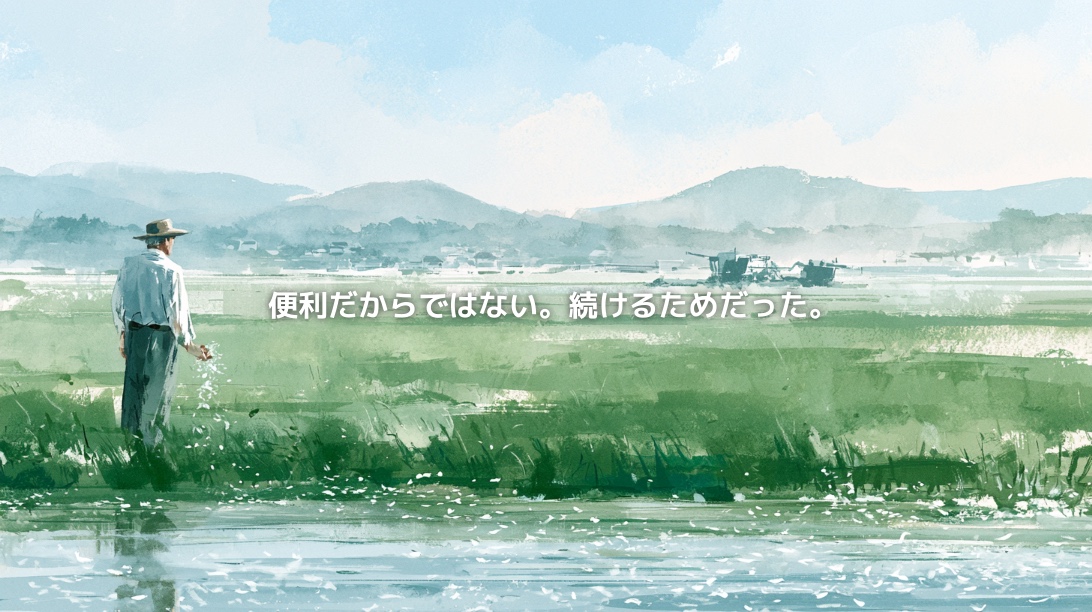
Rice paddies are beautiful in summer.
Green rice plants sway in the wind, and their heads gradually fill with grain as the season progresses.
The work required to maintain that landscape, however, is far from peaceful.
Farmers must monitor the growth of the rice, manage water levels, prevent pests and diseases, and apply fertilizer at the appropriate stages.
Additional fertilization during summer is particularly demanding. Farmers must transport heavy fertilizer in intense heat and walk through waterlogged paddies or along narrow ridges while applying it.
Plastic-coated fertilizer was introduced to reduce that burden.
The nutrients are enclosed inside a plastic resin coating and released gradually as the rice grows. By applying the fertilizer once during planting, farmers can avoid much of the additional fertilization work required in summer and manage larger areas with fewer people.
Once the nutrients have dissolved, however, the empty plastic shells remain.
Some may leave the paddies, travel through irrigation channels and rivers, and eventually reach the sea.
Why did a technology now associated with environmental concerns become so deeply embedded in agriculture?
The answer is not a lack of environmental awareness among farmers.
It lies in the structure of Japanese agriculture itself: fewer farmers, an aging workforce, and larger areas of farmland being managed by each remaining agricultural business.
Supporting Rice Until Harvest with a Single Application
Rice does not require the same amount of nutrients throughout the entire growing season.
During its early stages, the plant produces more stems and leaves. It later forms panicles and fills its grains.
Nitrogen and other nutrients must therefore be supplied in appropriate quantities at each stage.
Conventional fertilization begins with a basal application before or around the time of planting. Farmers then apply additional fertilizer during the growing season, including fertilizer intended to support panicle formation.
This allows them to adjust the amount according to the condition of the rice.
It also requires several separate operations, often during the hottest and most humid part of the year.
This is why “one-shot basal fertilizers,” which combine quick-release and coated fertilizer components, became widely used.
The resin coating around each granule releases nutrients gradually in response to moisture and temperature.
Manufacturers can adjust the release rate and duration, allowing a single application to supply nutrients from the early stages of growth through the period of panicle formation.
When a rice transplanter is fitted with a fertilizer applicator, planting and fertilization can take place simultaneously.
Fertilization can be completed in a single operation.
This apparently simple advantage had enormous significance for Japanese rice farming.
Eliminating Additional Fertilization Means More Than Removing One Task
Additional fertilization involves far more than simply spreading fertilizer.
Farmers must:
- Purchase and transport the fertilizer
- Inspect crop growth in each field
- Load fertilizer into spreading equipment
- Move machinery between fields
- Clean the equipment after use
If rice paddies are scattered across several locations, farmers must travel between them repeatedly.
Rain, wind, and changes in crop development may also force them to reschedule the work.
Rice farming depends on completing each task within a limited period.
If several paddies require additional fertilizer at the same time, a small workforce may not be able to respond quickly enough.
One-shot basal fertilizers can substantially reduce this summer workload.
For older farmers in particular, avoiding the need to carry heavy fertilizer and spreading equipment in extreme heat is also important for safety.
Plastic-coated fertilizer was not merely a convenient agricultural material.
It became a labor-saving technology that could determine whether farmers were physically able to continue working.
Japan’s Agricultural Workforce Has Fallen by More Than Half
The decline of Japan’s agricultural workforce cannot be ignored when considering the country’s reliance on coated fertilizers.
According to materials published by Japan’s Ministry of Agriculture, Forestry and Fisheries, the number of core agricultural workers in individually managed farms fell from 2.4 million in 2000 to approximately 1.02 million in 2025.
The workforce declined by more than half in 25 years.
Its average age reached 67.6 in 2025, with people aged 70 and over forming the largest group.
When farmers retire, not all of their land immediately falls out of production.
Local agricultural corporations and active farmers often take responsibility for the paddies of those who leave the industry.
As a result, the number of agricultural businesses is declining while the area managed by each one is increasing.
Preliminary figures from the 2025 Census of Agriculture and Forestry show that the number of agricultural management entities fell by 23 percent over five years.
During the same period, the average cultivated area per entity increased from 3.1 to 3.7 hectares.
For the first time, agricultural businesses managing at least 20 hectares accounted for more than half of Japan’s total cultivated area.
Fewer people must protect and cultivate more land.
Japanese agriculture has been forced to move in this direction.
Farmland Can Expand, but the Day Does Not Become Longer
Larger farms may be able to use machinery more efficiently and reduce production costs.
Increasing the area under management, however, does not create more hours in the day or more people to perform the work.
Japanese rice paddies are not always consolidated in a single location.
Small fields may be scattered across different areas, each with its own irrigation channels, access roads, and operating conditions.
Planting, water management, mowing, pest control, fertilization, and harvesting must all be coordinated across these fields according to the weather and the development of the rice.
As the area under management grows, the value of any technology that eliminates even one operation becomes greater.
One-shot fertilization using coated fertilizer became integrated into the system supporting larger-scale rice farming.
It may therefore be more accurate to say that agriculture did not simply choose plastic.
Rather, as labor shortages intensified and farmland became increasingly concentrated among fewer farmers, agriculture found it difficult to move away from a plastic-based technology that saved essential labor.
It Was Also a Technology for Reducing Environmental Impacts
Coated fertilizer has another important dimension.
It was also developed as a more efficient way to deliver nutrients to crops.
Conventional quick-release fertilizers dissolve readily in water.
If too much is applied at once, nutrients that the crop cannot absorb may leave the field with rainwater or irrigation water.
Excessive nitrogen and other nutrients entering rivers and lakes can contribute to declining water quality and eutrophication.
Coated fertilizers release nutrients gradually, matching their availability more closely with the stages when crops require them.
This can improve fertilizer-use efficiency and reduce both the total amount applied and the quantity leaving rice paddies.
Some cultivation techniques have reportedly maintained stable yields while reducing nitrogen fertilizer use compared with conventional fertilization methods.
Plastic-coated fertilizer was therefore not originally a technology indifferent to environmental concerns.
It was valued because it could reduce nutrient-related water pollution, lower agricultural labor requirements, and stabilize yields.
Yet the resin coating used to reduce fertilizer runoff created a different form of plastic pollution.
A technology designed to reduce one environmental burden left behind another.
This is what makes the issue so difficult.
One-Shot Fertilizer Is Not a Complete Answer to Climate Change
One-shot basal fertilizers also have limitations.
Their nutrients are released according to conditions such as soil temperature and moisture.
Products may be designed for the climate and rice varieties of a particular region, but the weather is never identical from one year to the next.
In unusually hot years, nutrients may be released earlier than expected.
The rice may then lack nutrients during the later stages of growth, making additional fertilization necessary after all.
Conversely, if crop development is slower than expected, the timing of nutrient release may no longer match the period when the rice needs it.
Record-breaking temperatures, torrential rainfall, and other weather conditions that are difficult to manage using conventional cultivation calendars have become increasingly common.
Applying a predesigned fertilizer only once is highly effective for reducing labor.
When farmers need to adjust nutrients in response to the actual condition of the crop, however, additional fertilization offers greater flexibility.
Should labor-saving efficiency be prioritized?
Or should fertilizer application be adjusted to the condition of the rice each year?
Moving away from coated fertilizers is not only a plastic-pollution issue.
It is also connected to the challenge of adapting rice farming to a changing climate.
Alternative Technology Does Not Mean Returning to the Past
Some may argue that farmers can simply stop using plastic-coated fertilizer and return to conventional additional fertilization.
That would once again require the labor that coated fertilizers helped replace.
Considering the current agricultural workforce and the growing size of farming operations, there is a limit to how much additional work can be demanded from farmers.
What is needed is a new system that reduces environmental impacts without losing the benefits of labor-saving technology.
Several alternatives are currently being examined.
Paste fertilizer can be placed in the soil beside rice seedlings during planting. Two-level paste fertilization positions nutrients at different depths to control when they become available.
These methods may reduce the need for later fertilization without using plastic coatings.
Introducing liquid fertilizer through a paddy’s water inlet can also reduce the burden of walking through the field while spreading it.
Drones can observe crop development from the air and apply the appropriate amount of fertilizer only where it is needed.
Trials introduced by the Ministry of Agriculture, Forestry and Fisheries suggest that drone-based additional fertilization may require less application time than motorized backpack spreaders.
Development is also progressing on coated fertilizers that use less plastic and slow-release fertilizers that require no coating.
Every technology, however, comes with conditions.
These may include:
- Initial installation costs
- Machinery purchases
- Fertilizer prices
- Field shape
- Water availability
- Communications infrastructure
- Compatibility with local soils and rice varieties
- Availability of qualified drone operators
No single technology can replace plastic-coated fertilizer in every rice paddy.
Who Should Pay for the Environmental Transition?
The development of alternative fertilizers and new machinery does not guarantee their adoption.
If environmentally preferable fertilizer costs more than conventional products, farmers’ production costs will rise.
If additional fertilization work is restored, labor costs and working hours will increase.
Drones and automated water-management systems also require significant investment.
If these costs cannot be reflected in the selling price of rice, the burden will remain concentrated on farmers.
Consumers expect agriculture to protect the environment.
At the same time, they also expect inexpensive food.
If farmers alone are required to satisfy both demands, agricultural management will become even more difficult.
The movement of fertilizer coating shells from rice paddies to the sea is not solely the responsibility of the farmers who use them.
Consumers have benefited from the stable food supply supported by labor-saving technologies.
Fertilizer manufacturers, distributors, agricultural organizations, national policymakers, and local governments also have roles to play.
The cost of transition must be shared across society through:
- Research and development of alternative technologies
- Financial support for new equipment
- Regional systems for sharing machinery
- Fair pricing for environmentally responsible agricultural products
Dependence on Plastic Is Not a Sign of Agricultural Weakness
There was practical logic behind agriculture’s use of plastic.
The workforce declined.
Farmers became older.
Each agricultural business had to manage more rice paddies.
Yet planting and harvesting seasons did not wait.
To continue producing rice with limited time and labor, farmers selected coated fertilizers that could remain effective over long periods after a single application.
That decision supported Japanese rice production and, ultimately, the food placed on our tables.
We therefore cannot look only at the empty coating shells reaching the sea and declare that the choices made in the past were simply wrong.
The central question is not whether individual farmers should be blamed for using coated fertilizer.
It is how to redesign an agricultural system whose workforce has declined so far that continuing production without such technology has become increasingly difficult.
The Answer Is Not to Condemn Dependence, but to Create the Next Option
Plastic-coated fertilizer reflects a contradiction within Japanese agriculture.
It reduces farm work, improves the efficiency of fertilizer use, and supports rice production.
At the same time, empty coating shells remain in the fields, and some may travel to the sea.
Convenience and environmental damage appear in different places.
In the rice paddy, the technology produces the benefit of labor savings.
On the coast, its residue may appear as small pieces of plastic waste.
Solving this problem does not mean demanding that farmers tolerate greater hardship or perform additional work.
It means replacing the functions of coated fertilizer through other technologies and social systems.
The transition must:
- Avoid increasing the agricultural workforce required
- Maintain crop yields
- Protect farmers’ incomes
- Reduce the movement of plastic into the sea
These are difficult conditions.
But unless they are considered together, the transition will not be genuine or sustainable.
Agriculture became dependent on plastic not because farmers ignored the environment.
It happened because they had to protect rice paddies and continue producing food with fewer people.
The next question, therefore, should not only be why plastic was used.
Can society create options that allow farming to continue without depending on it?
The future of both rice paddies and the sea begins with that question.
References
- Ministry of Agriculture, Forestry and Fisheries, Japan: Current Conditions Surrounding Agricultural Management
- Ministry of Agriculture, Forestry and Fisheries, Japan: Summary of the 2025 Census of Agriculture and Forestry—Preliminary Results
- Ministry of Agriculture, Forestry and Fisheries, Japan: Current Conditions and Challenges of Fertilization in Rice Farming
- Ministry of Agriculture, Forestry and Fisheries, Japan: Examples of Fertilizer Cost Reduction
- Ministry of Agriculture, Forestry and Fisheries, Japan: Questions and Answers on Additional Fertilization Methods for Rice Farming
- Ministry of Agriculture, Forestry and Fisheries, Japan: Continued and Strengthened Measures to Prevent the Runoff of Plastic Coating Shells from Slow-Release Fertilizers
- Ministry of Agriculture, Forestry and Fisheries, Japan: Case Studies Supported by the Green Food System Strategy Promotion Grant
- Kyoto Prefecture: Alternative Technologies to Plastic-Coated Fertilizers in Rice Farming
In the first article of this series, we followed the empty fertilizer coating shells that move from rice paddies toward the sea.
This second article examined why these fertilizers became necessary to Japanese agriculture.
The next article explores plastic-free fertilizers, drone application, biodegradable materials, and whether these alternative technologies can provide a genuine solution.