The Aging Landscapes That Store Water
Where there are rice fields, there are often irrigation ponds.
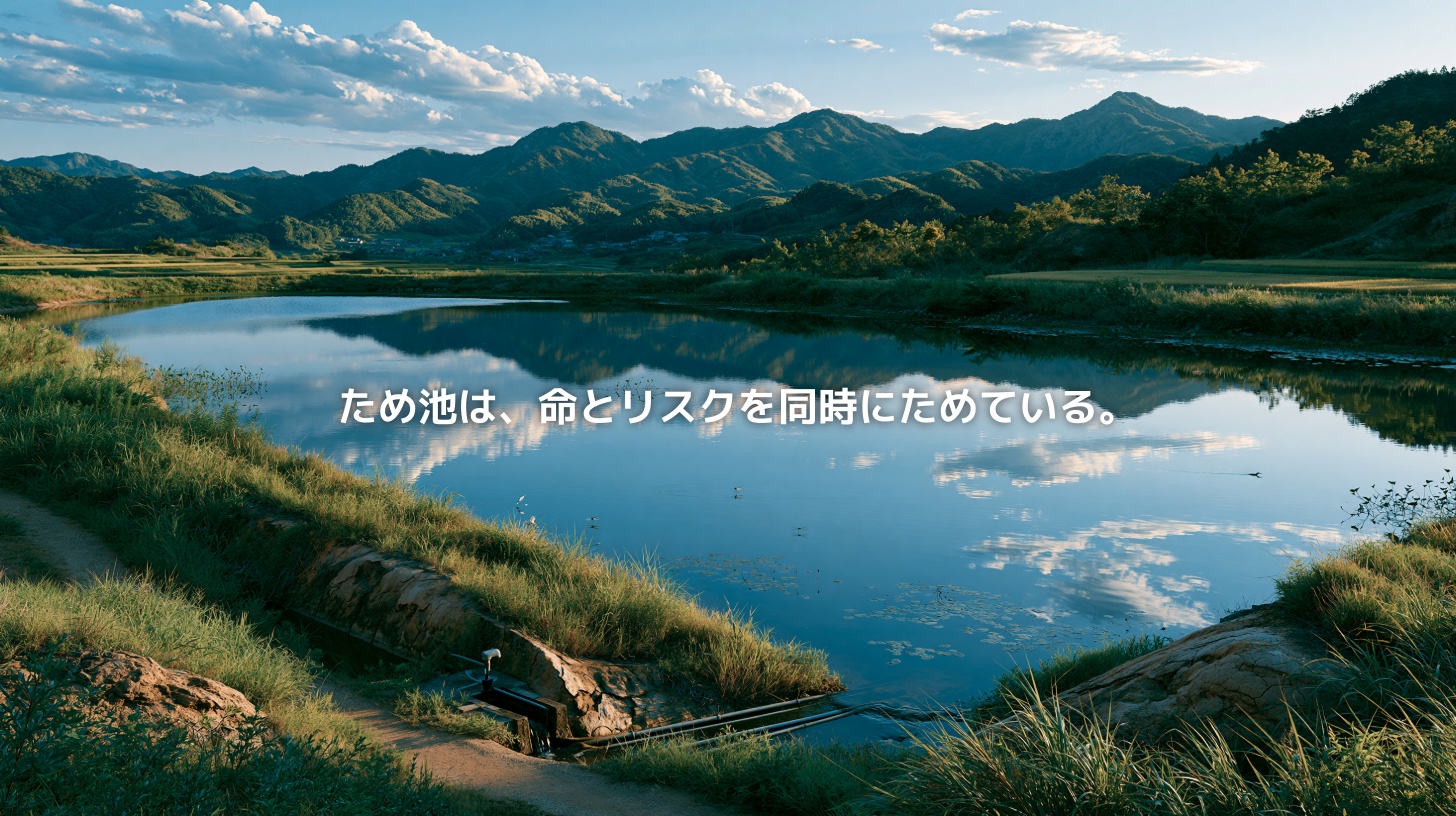
A quiet body of water lies beyond a village in the hills.
Its surface appears at the end of a path between the paddies.
In spring, it sends water to the fields.
In summer, it supports the growing rice.
In autumn, it reflects the sky.
In Japan, these reservoirs—known as tameike—are remembered as part of the nostalgic rural landscape.
In recent years, however, they have increasingly been discussed in very different terms:
Danger.
Deterioration.
Dam failure.
Disaster-prevention priority ponds.
A shortage of people to manage them.
Accident prevention.
Places that once sustained local water supplies are now also regarded as potential risks to the communities around them.
Yet an irrigation pond is more than a dangerous body of water.
It stores water for agriculture. It provides habitat for wildlife. It preserves the memory of how a community has lived with water.
Why, then, have these ponds come to be seen as dangerous?
Behind this change are the transformation of agriculture, rural depopulation, the aging of those responsible for maintenance, increasingly intense rainfall, and a fundamental question:
Who will protect the local waterscape in the future?
To look at an irrigation pond is also to reconsider the relationship between a community and its water.
What Is a Tameike?
A tameike is an artificial reservoir created to secure water for agriculture.
These ponds have played a particularly important role in areas with limited rainfall or without access to large rivers. By storing rainwater and runoff, they make it possible to supply rice fields with water when it is needed.
According to Japan’s Ministry of Agriculture, Forestry and Fisheries, there are approximately 150,000 agricultural irrigation ponds across the country, with particularly high concentrations in western Japan.
A tameike, therefore, is not a natural lake.
It is agricultural infrastructure developed by people to collect, store, manage, and distribute water.
Rice cultivation requires a stable supply of water every year.
Rain, however, does not fall according to the agricultural calendar.
Communities therefore created systems for holding water:
Collecting runoff from the mountains.
Storing rainfall.
Releasing water into irrigation channels when needed.
Delivering it to the rice fields.
The irrigation pond was the reservoir behind the paddy landscape.
Behind every visible rice field lies a less visible water system. For centuries, the tameike stood at the center of that system.
A Reservoir of Local Memory
An irrigation pond does more than store water.
It also stores the memory of how a community has managed water.
Where should the water come from?
Which rice fields should receive it first?
How should it be shared during a drought?
When should the water level be lowered before heavy rain?
Who should cut the grass and inspect the embankment?
These ponds have traditionally been protected through collective management.
Water did not belong to one person alone.
Farmers, village residents, land improvement districts, and other local groups negotiated how it should be used and shared over long periods of time.
There was engineering knowledge within these systems, but there was also communal wisdom.
Managing agricultural water could be burdensome, and disagreements sometimes occurred. Yet this coordination made local agriculture possible.
The surface of an irrigation pond may appear still.
Behind it lies a long history of people negotiating with water.
A tameike is also a record of a community’s attempt to live with, distribute, and control a limited natural resource.
Both Agricultural Infrastructure and Wildlife Habitat
An irrigation pond is an agricultural facility, but it is also a waterside ecosystem.
Aquatic plants grow there.
Dragonflies cross the surface.
Frogs call from the banks.
Small fish swim below.
Waterbirds arrive.
The pond connects with surrounding grasslands, forests, waterways, and rice fields.
Japan’s Ministry of Agriculture, Forestry and Fisheries recognizes that agricultural ponds have multiple functions beyond securing irrigation water. They can conserve habitats, support biodiversity, and provide spaces where local people encounter nature.
Together, ponds, irrigation channels, and rice fields form a connected waterside network.
Some organisms develop in the pond.
Some travel through channels into the paddies.
Others reproduce in the rice fields and later return to the channels and reservoirs.
These are not entirely separate environments.
They form one interconnected water system.
For people, the water supports agriculture.
For wildlife, it sustains life.
An irrigation pond is a place where these two purposes overlap.
Its environmental value, however, is easy to overlook.
The surface remains quiet. The pond may not be a tourist destination or part of a national park. It may simply exist at the edge of a village or below a wooded hillside.
Yet these ordinary, easily overlooked bodies of water have helped sustain local biodiversity.
Why Have Irrigation Ponds Become Dangerous?
One reason irrigation ponds are now regarded as dangerous is their age.
Many have been used by local communities for generations.
Their embankments deteriorate.
Leaks develop.
Sediment accumulates.
Water levels rise during heavy rain.
Vegetation makes inspection more difficult.
Maintenance gradually becomes less consistent.
Because these facilities hold large volumes of water, structural failure can cause serious damage.
The danger is especially significant when homes, roads, schools, or other public facilities lie downstream. If an embankment collapses, the released water can rapidly inundate the surrounding area.
The Japanese government has therefore designated certain reservoirs as “disaster-prevention priority agricultural ponds” and introduced measures to strengthen inspections, repairs, emergency planning, and disaster-prevention works.
More intense rainfall has made the issue increasingly urgent.
Rainfall may exceed the amount assumed when a pond was originally built or later assessed. A large volume of water can flow into an aging reservoir within a short period, placing extraordinary pressure on its embankment and drainage structures.
Climate change is altering the conditions under which these ponds must operate.
It may not be that irrigation ponds suddenly became dangerous.
Rather, changes in climate and community structures have made their risks more visible—and more difficult to manage.
The Number of People Managing Them Is Declining
The problem is not limited to aging embankments.
There is also the question of who will maintain them.
Irrigation ponds require continuous care:
Regular inspection.
Grass cutting.
Water-level control.
Sediment removal.
Monitoring for leaks and erosion.
Checking embankments and drainage structures.
At the same time, many rural areas in Japan are experiencing population decline and rapid aging.
Farmers retire.
Rice fields are abandoned.
The demand for agricultural water declines.
The number of people responsible for maintaining the pond also decreases.
The Ministry of Agriculture, Forestry and Fisheries has noted that rural depopulation, an aging agricultural workforce, farm abandonment, and the expansion of uncultivated land have left a growing number of agricultural ponds unused or insufficiently maintained.
This reveals the central contradiction of the problem:
The number of people using the water decreases.
But the pond remains.
The number of people managing the pond decreases.
But the risk remains.
An irrigation pond does not disappear simply because agriculture has stopped using it.
It continues to hold water.
Its embankment continues to age.
Vegetation grows around it.
Inspection becomes more difficult.
During extreme rainfall, it may become a hazard.
Agricultural infrastructure that is no longer actively used can remain behind as a disaster-management challenge.
This issue is not unique to irrigation ponds.
It can also be seen in abandoned waterways, farm roads, forests, terraced fields, and uncultivated land throughout Japan’s mountainous and semi-mountainous regions.
Should an Unused Pond Be Removed or Preserved?
What should happen to an irrigation pond that is no longer being used?
Should it be decommissioned because it is dangerous?
Should it be preserved because agriculture still needs it?
Should it be protected for its ecosystem and landscape?
Should it be repaired because its failure would threaten downstream communities?
There is no simple answer.
If a pond remains necessary for agriculture, repairs, seismic reinforcement, and disaster-prevention work may be required.
If it is no longer used and cannot be maintained safely, decommissioning may be the most responsible option.
But removing a pond does not resolve every issue.
Wildlife may live there.
The pond may shape the local landscape.
It may hold cultural and historical meaning.
Its ability to store water may support flood control or other environmental functions.
The Ministry of Agriculture, Forestry and Fisheries advises that biodiversity and the natural environment should be considered even when disaster-prevention priority ponds are decommissioned.
The future of a tameike cannot therefore be reduced to a choice between preserving it and eliminating it.
Which ponds should be maintained for agriculture?
Which should be repaired for disaster prevention?
Which should be decommissioned?
How should wildlife and the landscape be protected during that process?
How should decisions be made with local communities?
Every pond exists within a different geographic, ecological, and social context.
There cannot be only one answer.
The Less Visible Danger of Water-Related Accidents
Dam failure is not the only danger associated with irrigation ponds.
People can also fall into them.
The water may appear calm, but the banks can be steep and slippery. Some ponds become deep very quickly, and their sloping sides can make it extremely difficult for someone to climb out after falling in.
Children approaching the water to play or fish may be particularly vulnerable.
An irrigation pond can be much more dangerous than it looks.
Safety measures are therefore essential:
Fences.
Warning signs.
Lifesaving equipment.
Community alerts.
Water-safety education for children.
If an irrigation pond is to remain part of the community landscape, it must be managed with the understanding that people may approach it.
Here again, it becomes clear that the pond is not simply natural scenery.
It is a human-made waterscape—and people remain responsible for its safety.
An irrigation pond can be beautiful.
But beauty does not guarantee safety.
Both realities must be communicated.
Reconsidering Irrigation Ponds as Community Assets
Despite their risks, irrigation ponds also have the potential to serve as local resources.
They can support:
Waterside landscapes.
Wildlife observation.
Environmental education.
Agricultural experiences.
Disaster-prevention education.
The preservation of local history and culture.
Some irrigation ponds are already managed with the involvement of residents, nonprofit organizations, schools, and other groups beyond the agricultural community.
Simply enclosing a pond and treating it only as a dangerous place can weaken the relationship between the water and the people who live nearby.
Safety must always come first.
But once safety has been addressed, the value of the pond can also be shared across the community.
Children can learn its history.
Residents can survey the species living there.
Students can observe how it connects with waterways and rice fields.
The pond can be included in local hazard maps.
Companies and civic organizations can participate in conservation activities.
An irrigation pond does not need to remain a facility understood only by those who manage it.
It can become a place where an entire community shares an understanding of both value and risk.
The important thing is not to romanticize it.
The pond offers benefits.
It also contains danger.
The future must be considered with both realities in view.
The Aging of a Landscape That Stores Water
The deterioration of an irrigation pond does not refer only to its embankment or physical structures.
The management system itself is also aging.
The number of people maintaining it is declining.
The communities that once negotiated the sharing of water are weakening.
The agricultural demand for the water is changing.
Climate change is making earlier assumptions unreliable.
In other words, it is not only the pond that is growing old.
The social system that supported it is aging as well.
A tameike is a human-made structure.
Even when it resembles a natural body of water, it exists because people created and maintained it.
When human involvement disappears, the pond does not immediately “return to nature.”
Instead, it may become an unmanaged body of water carrying unresolved risks.
The same is true of rice fields and irrigation channels.
These are forms of nature sustained through human activity.
When that activity disappears, the landscape changes.
How should society respond to that transformation?
An irrigation pond is both a memory of local water management and a mirror reflecting the sustainability of the community around it.
Who Will Protect These Ponds?
When considering the future of irrigation ponds, the central question is:
Who will protect them?
Farmers alone?
Land improvement districts?
Municipal governments?
Local residents?
Could companies and nonprofit organizations also participate?
Could pond management be connected with school education and disaster preparedness?
Irrigation ponds were originally created for agriculture.
Today, however, their meaning extends beyond agriculture.
Disaster prevention.
Biodiversity.
Landscape.
Culture.
Local education.
Experiences in nature.
If all these functions are considered, it becomes increasingly difficult to leave responsibility entirely to farmers.
The value and risks of each pond need to be shared across the wider community.
The first step is to make the system visible.
Where are the ponds located?
Who manages them?
Which rice fields receive their water?
Where would the water flow if an embankment failed?
What species live there?
What memories and meanings does the pond hold for local people?
A pond should be understood not merely as a point on a map, but as part of a community’s story.
From that perspective, new forms of management may begin to emerge.
More Than a Dangerous Body of Water
Irrigation ponds can be dangerous.
That fact must not be ignored.
Preventing accidents, reducing the risk of failure, and protecting downstream residents must remain the highest priorities.
But if a pond is described only as dangerous, something important disappears from view.
The water that supported agriculture.
The water that communities learned to share.
The habitat that sustained living things.
The place where children encountered nature.
The surface that shaped the landscape of the village.
An irrigation pond is evidence of how a community learned to live with water.
Today, these ponds are deteriorating. Their managers are disappearing, while heavier rainfall creates new risks.
This is not merely a problem of maintaining old infrastructure.
It reflects a deeper change in the relationship between communities and water.
Landscapes that stored water were created through local knowledge.
But the systems that maintained those landscapes are weakening.
Should a pond be preserved?
Repaired?
Decommissioned?
Given a new role?
Within that decision lies part of the community’s future.
Where does the water in the rice fields come from?
Where do the irrigation channels lead?
Who is watching over the pond?
At the end of this series on waterside ecosystems, the irrigation pond quietly leaves us with one final question:
A place that stores water holds both life and risk.
Who will protect its surface in the years ahead?
References
- Ministry of Agriculture, Forestry and Fisheries: Agricultural Irrigation Ponds
- Ministry of Agriculture, Forestry and Fisheries: Overview of Agricultural Irrigation Ponds
- Ministry of Agriculture, Forestry and Fisheries: Ecological Considerations When Decommissioning Disaster-Prevention Priority Agricultural Ponds
- Ministry of Agriculture, Forestry and Fisheries: Manuals and Case Studies Concerning Agricultural Ponds
- Ministry of Agriculture, Forestry and Fisheries: Public Information About Agricultural Ponds
Irrigation ponds store water for agriculture, support wildlife, and preserve the memory of how communities have lived with water.
NEOTERRAIN Journal will continue exploring the connections between natural environments and human society hidden within familiar landscapes. If this article gave you something to think about, please bookmark it and return whenever you would like to revisit the question.