The water flowing from a tap is clear and almost odorless.
Yet transparency alone cannot tell us whether that water is safe.
Across Japan, a group of organofluorine compounds known as PFAS is being detected in rivers and groundwater. Because these substances resist natural degradation and can remain in water, soil, and living organisms for long periods, they are often called “forever chemicals.”
In a nationwide survey conducted at 3,941 locations in fiscal 2024, the combined concentration of PFOS and PFOA exceeded Japan’s guideline value at 629 locations across 26 prefectures.
Where did this invisible contamination come from?
And what does it mean for people who depend on tap water or private wells?
What Are PFAS?
PFAS is a collective term for a large group of synthetic organofluorine chemicals characterized by extremely strong bonds between carbon and fluorine atoms.
These substances repel both water and oil and are highly resistant to heat. Because of these properties, they have been used for decades in a wide range of products and industrial processes.
Common applications include:
- Water- and stain-resistant treatments for clothing and textiles
- Food packaging
- Semiconductor and electronic component manufacturing
- Metal plating
- Surfactants
- Firefighting foam
There are many different types of PFAS, but PFOS and PFOA have received particular attention in Japan’s water-quality management policies.
PFOS was widely used in firefighting foam and metal-plating agents, while PFOA was used in water-repellent coatings, surfactants, and other products.
Because of concerns about their long-term persistence and possible health effects, international regulations have gradually been strengthened. In Japan, the manufacture and import of PFOS and PFOA are now prohibited in principle.
However, restricting their present use does not make the chemicals already released into the environment disappear.
This persistence lies at the heart of the PFAS problem.
Why Are They Called “Forever Chemicals”?
The defining characteristic of PFAS is the exceptional strength of the carbon–fluorine bond.
Their resistance to heat and chemical reactions made PFAS useful for creating durable products. In the natural environment, however, the same resilience prevents them from breaking down easily.
PFAS released through industrial wastewater, the use of firefighting foam, or waste disposal can enter the soil with rainwater and surface runoff. From there, the chemicals may reach groundwater and slowly travel beneath the land.
Even if their use at the original source ended years ago, the effects of past releases may remain for decades.
The problem does not end simply because the chemicals are no longer being used.
3,941 Locations Surveyed, with Guideline Exceedances in 26 Prefectures
According to the fiscal 2024 survey compiled by Japan’s Ministry of the Environment, PFOS and PFOA concentrations were measured in public water bodies and groundwater at 3,941 locations across all 47 prefectures.
The surveyed locations included:
- Rivers: 1,469 locations
- Lakes and reservoirs: 37 locations
- Coastal waters: 115 locations
- Groundwater: 2,320 locations
The combined concentration of PFOS and PFOA exceeded the guideline value of 50 nanograms per liter at 629 locations in 26 prefectures.
Of these 629 locations:
- 282 were sites where exceedances had previously been identified and monitoring was continuing
- 217 were surrounding locations examined to determine the possible extent of contamination
- 130 were newly identified through general surveys and other monitoring activities
It is important to understand that not all 629 locations represent newly discovered contamination.
The survey included areas already known to exceed the guideline and sites surrounding them that were monitored more intensively. The results therefore do not mean that a fixed percentage of all groundwater in Japan is contaminated.
Nevertheless, the discovery of 130 additional exceedance locations shows that PFAS is not an isolated regional issue. Continued investigation is necessary across the country.
Groundwater Flows Beyond Administrative Boundaries
Groundwater makes PFAS contamination especially difficult to understand and manage.
Because rivers are visible on the surface, the relationship between upstream and downstream areas is relatively easy to trace. Groundwater, by contrast, is influenced by many factors, including topography, geology, rainfall infiltration, and groundwater extraction.
Water that enters the ground travels through soil, sand, gravel, and fractures in bedrock. Its movement may take months, years, or even decades.
Groundwater does not follow the borders of municipalities or prefectures.
A PFAS source located in one municipality could potentially affect wells or rivers in another. Conversely, even if a factory, military base, airport, or industrial facility is located near a contaminated sampling point, that facility cannot automatically be identified as the source.
Investigators must consider groundwater flow, historical land use, chemicals previously handled at nearby facilities, drainage routes, and soil conditions.
Water is connected underground, yet it is managed above ground through administrative boundaries.
This mismatch creates one of the structural difficulties of PFAS regulation.
Where Did the PFAS Come From?
Potential sources of PFOS and PFOA include factories that manufactured or used these chemicals, facilities that stored or deployed firefighting foam, and waste-treatment or disposal sites.
Firefighting foam containing PFAS was used and stored at airports, military bases, fire stations, petroleum facilities, and other locations where fires involving fuel or oil were a concern.
However, detecting PFAS does not necessarily prove that a particular nearby facility caused the contamination.
Historical records may be incomplete. Several sources may exist in the same area. Groundwater movement may also carry PFAS far from its original release point, causing high concentrations to appear at locations some distance away.
PFAS were used in many applications over a long period. Tracing exactly when, where, and through which route they entered the environment is rarely straightforward.
Even after contamination is found, the responsible party may remain unknown.
When the source cannot be identified, another question emerges: who should bear the cost of investigation, removal, water treatment, and compensation?
PFAS contamination is not only a chemical issue. It is also a social and institutional question about who records the history of industrial activity and who accepts responsibility for its long-term consequences.
How Should We Understand the Health Risks?
Studies in Japan and other countries have examined possible associations between PFAS exposure and cancer, immune-system effects, lipid metabolism, birth weight, and other health outcomes.
However, the detection of PFAS—or drinking water that exceeded a guideline value at a particular point in time—does not automatically mean that immediate health damage will occur.
In 2024, Japan’s Food Safety Commission established a tolerable daily intake of 20 nanograms per kilogram of body weight per day for PFOS and the same amount for PFOA.
A tolerable daily intake is the estimated amount that a person can consume every day over a lifetime without an appreciable risk of adverse health effects.
Japan’s Ministry of the Environment has also explained that temporarily drinking water exceeding the quality standard does not mean that immediate health effects will occur.
It is essential not to confuse three different situations:
- A chemical has been detected
- A guideline or regulatory limit has been exceeded
- Actual health damage has been confirmed
The PFAS problem should not be underestimated. At the same time, spreading excessive fear based only on detection results can also prevent an accurate understanding of the issue.
How Did Japan’s Drinking-Water Standard Change in 2026?
Since 2020, Japan had maintained a provisional target value of 50 nanograms per liter for the combined concentration of PFOS and PFOA in drinking water.
On April 1, 2026, this value became an official water-quality standard under Japan’s Water Supply Act.
Water utilities and operators of private water-supply systems are now required to comply with the standard and, in principle, conduct testing approximately once every three months or more frequently.
If the standard is exceeded, possible responses include:
- Suspending water intake from the affected source
- Switching to a different water source
- Introducing treatment using activated carbon or other appropriate methods
According to drinking-water surveys published by the Ministry of the Environment, utilities that previously exceeded the provisional target have already implemented measures such as suspending intake, changing sources, and improving water-treatment processes.
It is also important to distinguish between drinking water supplied to households and the water measured in rivers or groundwater surveys.
Even if PFAS is detected in nearby groundwater, that does not necessarily mean the same water is being delivered directly from household taps. Public drinking water is treated at purification facilities, and utilities may combine water from several different sources.
Residents should therefore check the test results published by their local water utility.
What Should People Using Private Wells Do?
Drinking-water standards apply to water supplied by regulated water utilities and other designated systems.
Some privately owned wells, however, are not covered by the Water Supply Act. When well water is used for drinking, responsibility for confirming its quality may rest with the owner.
If PFOS or PFOA concentrations exceeding the guideline are found nearby, local authorities may advise residents to avoid drinking well water. In such cases, residents should follow municipal guidance and switch to public tap water or another source confirmed to be safe.
Boiling water does not remove PFAS.
In fact, as water evaporates, the concentration of PFAS may increase. Boiling should therefore not be regarded as an effective countermeasure.
Not all household water filters are designed or certified to remove PFAS. Anyone considering a filter should confirm:
- Its tested removal performance for PFOS and PFOA
- The required filter-replacement schedule
- Whether its performance has been verified by an independent organization
If there is uncertainty, the first step should be to contact the environmental department, public health center, or water-supply division of the local municipality rather than relying solely on personal judgment.
What Is Being Tested Is Also Our Ability to Measure
Invisible contamination cannot be addressed unless it is measured.
Where water has not been tested, we cannot even know whether PFAS is present. As monitoring expands, more locations exceeding the standard may be discovered.
A newly identified exceedance should not automatically be interpreted as evidence that contamination has suddenly spread.
In some cases, increased testing may simply have made a long-standing problem visible for the first time.
A single nationwide survey is not enough.
Monitoring locations must be selected with an understanding of groundwater movement and regional industrial history. Changes must be tracked continuously, and the results must be disclosed in a form that residents can understand.
When an exceedance is confirmed, authorities must prevent people from consuming the affected water while simultaneously investigating the extent and possible source of contamination.
Society Must Take Responsibility for the Memory Carried by Water
PFAS contamination is a problem in which chemicals used in the past reappear in the lives of people today.
Substances that once supported convenience and industrial development entered the soil, moved into groundwater, and remained long after records of their original users had faded.
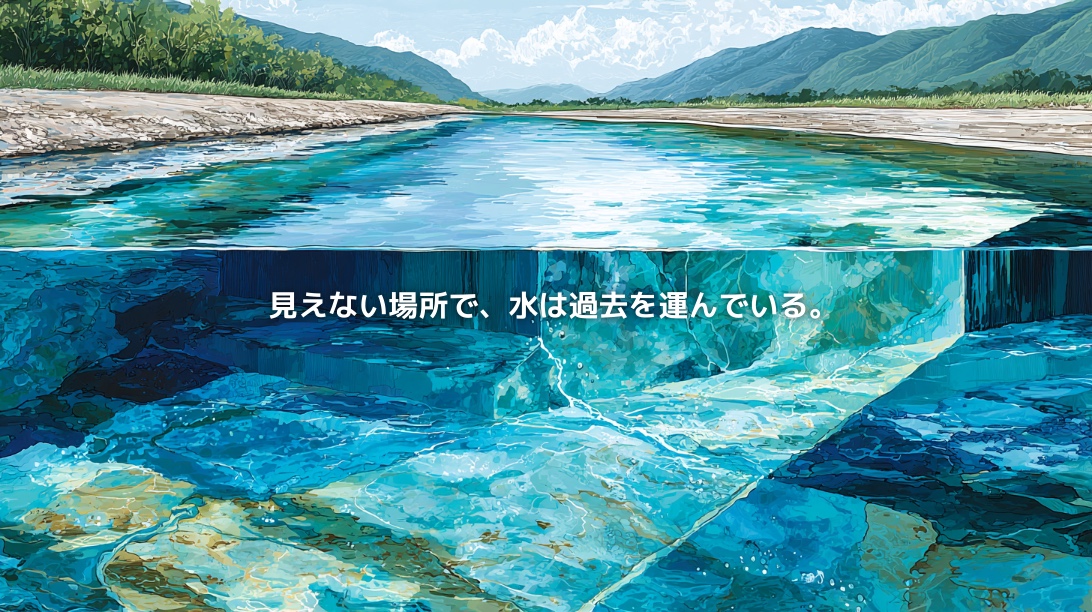
Groundwater is invisible to us.
Yet even where we cannot see it, water continues to flow.
Rain falling on mountains seeps into the earth, travels beneath the land, and eventually reaches wells, rivers, and the sea. That movement crosses municipal boundaries, corporate property lines, and even the divide between past and present.
The PFAS issue is not simply about stopping the use of water that exceeds a regulatory limit.
It asks how society records past industrial activity, measures invisible environmental burdens, and builds systems that prevent those burdens from being passed on to future generations.
What exists within water that appears perfectly clear?
The effort to protect the safety of water—and the lives connected to it—begins by confronting that question.
References
- Ministry of the Environment, Japan: Information on PFAS
- Ministry of the Environment, Japan: Fiscal 2024 Results of Water-Quality Monitoring in Public Water Bodies and Groundwater
- Ministry of the Environment, Japan: Frequently Asked Questions About PFAS
- Ministry of the Environment, Japan: Revision of the Ministerial Ordinance on Drinking-Water Standards for PFOS and PFOA
- Ministry of the Environment, Japan: Water-Quality Monitoring Results for Organofluorine Compounds
- Food Safety Commission of Japan: Information on the Risk Assessment of PFAS
- Food Safety Commission of Japan: Questions and Answers on the PFAS Risk Assessment
This article is based on information publicly available as of July 2026.