Fertilizer from the Sky: How Nitrogen Deposition Is Changing Forests and Ecosystems
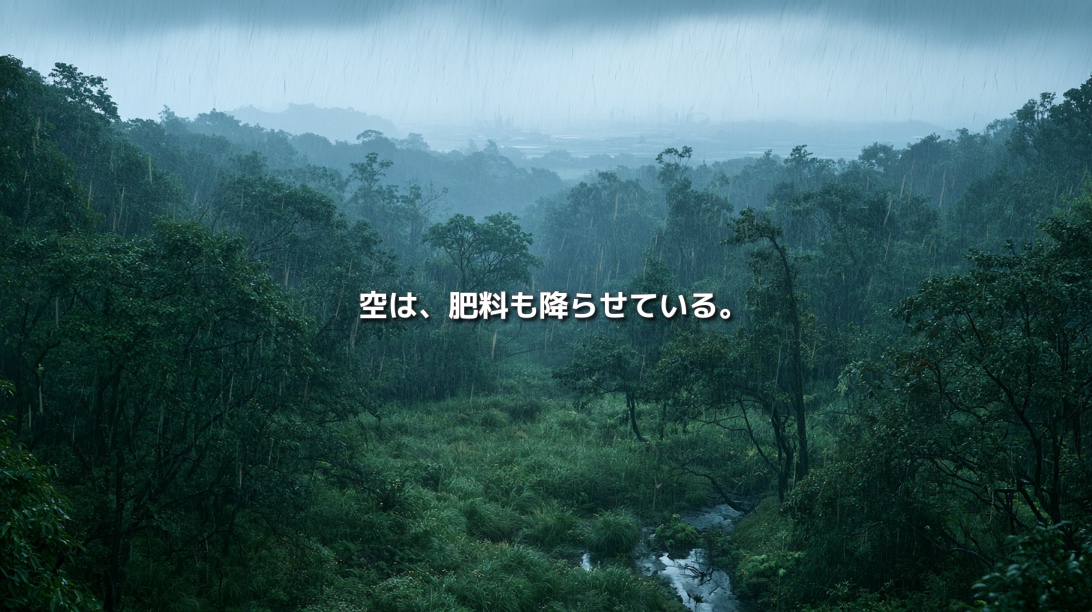
After the rain, the air in a forest feels clear.
Water drips from the leaves, and the scent of damp soil rises from the ground. Looking at that scene, few people would imagine that “fertilizer” has been falling from the sky.
Yet some of the nitrogen compounds released by factories, vehicles, power plants, farmland, and livestock facilities return to the Earth through rain, snow, fog, gases, and airborne particles. They reach forests, grasslands, lakes, and the sea.
This process is called nitrogen deposition.
Nitrogen is essential to plant growth. Just as crops need nutrients, living organisms in natural ecosystems depend on nitrogen.
But more nutrients do not always mean a healthier environment.
Excess nitrogen generated by human activity can quietly alter the balance that ecosystems have developed over long periods of time.
If the Air Is Mostly Nitrogen, Why Do Plants Need Fertilizer?
About 78% of Earth’s atmosphere is nitrogen gas.
If nitrogen is so abundant, why do crops need nitrogen fertilizer?
Nitrogen gas is highly stable. Most organisms cannot use it directly. Plants generally take up nitrogen in forms such as ammonium and nitrate, which are part of a broader group known as reactive nitrogen.
In nature, processes including lightning and biological nitrogen fixation have converted atmospheric nitrogen into forms that living organisms can use. Nitrogen then circulates through plants, animals, soil, and microorganisms.
Over time, ecosystems have developed around the amount of nitrogen available in each place.
Since the twentieth century, however, humans have learned to produce ammonia on an industrial scale. Synthetic fertilizer has helped sustain food production, while greatly increasing the amount of reactive nitrogen entering the environment.
Burning fossil fuels and raising livestock add further emissions.
Nitrogen has become both a vital nutrient and a substance that human societies produce and release in large quantities.
How Does Nitrogen Enter the Atmosphere?
Two major types of emissions contribute to atmospheric nitrogen deposition.
The first is nitrogen oxides, commonly called NOx, which are generated when fuels are burned in vehicles, factories, and power plants.
The second is ammonia, released from sources including livestock manure, compost, and the application of fertilizer.
The main sources differ between urban and agricultural areas. Once released, however, nitrogen compounds do not necessarily stay nearby.
Wind can carry them away. They can react with other substances in the atmosphere and eventually reach forests, lakes, and other environments far from their original source.
Nitrogen returns to the surface in two main ways.
Wet deposition occurs when nitrogen compounds are carried down in rain, snow, or fog.
Dry deposition occurs when gases or particles settle on vegetation, soil, or water.
“Fertilizer falling from the sky” is a metaphor. But the nitrogen involved does not arrive only with rain. Some of it reaches ecosystems invisibly, as gases and fine particles.
Why Can More Nutrients Mean Fewer Species?
It seems reasonable to expect plants to grow better when more nitrogen becomes available.
Some do.
But the benefit is not shared equally.
Many plants have adapted to nutrient-poor environments. They grow slowly and use limited resources efficiently, allowing them to survive in places where faster-growing species struggle.
When large amounts of nitrogen enter such habitats, fast-growing grasses and other plants can gain an advantage. They grow taller, capture more light, and occupy more space.
Plants adapted to low-nitrogen conditions may gradually be pushed out.
The total amount of vegetation can increase while the number of species declines.
This change can be difficult to notice. To an observer, the landscape may even appear greener.
An ecosystem does not decline only when plants die and the ground becomes bare. It can also decline when a few species expand and the diversity particular to that place disappears.
When Forests Can No Longer Retain the Nitrogen
When nitrogen enters a forest, plants and microorganisms initially use or store some of it.
If nitrogen continues to arrive faster than the forest can absorb it, the system may eventually lose its ability to retain the excess. Nitrate can then move through soil water into groundwater and streams.
This condition is known as nitrogen saturation.
As nitrate leaches from soil, it can carry away nutrients that plants need, including calcium and magnesium. Soil acidification may also affect tree roots and microbial activity.
The response is not identical in every forest.
Research cited by Japan’s Ministry of the Environment shows that the effects of nitrogen inputs depend on local climate, vegetation, soil, and nutrient cycling. Some forests may retain additional nitrogen for longer, while others may show the effects of increased inputs sooner.
A forest without obvious damage is therefore not necessarily a forest without change.
From Forests to Rivers, Lakes, and the Sea
Nitrogen that forests and farmland cannot retain may travel through groundwater and rivers.
When substantial amounts reach lakes or sheltered coastal waters, they can encourage the growth of algae and other phytoplankton. Under some conditions, this contributes to eutrophication, deteriorating water quality, and oxygen depletion.
The habitats available to aquatic life may then change.
Research by Japan’s National Institute for Environmental Studies in the Lake Kasumigaura watershed has examined another pathway: ammonia released from farmland and livestock facilities can travel through the air and be deposited directly onto the lake.
Nitrogen does not reach a lake only through its rivers.
Some of it arrives from above.
Air pollution, changes in forests, groundwater contamination, and the eutrophication of lakes may appear to be separate environmental problems. Nitrogen connects them.
Once Released, Nitrogen Keeps Moving
A nitrogen compound does not necessarily cause one problem in one place and then disappear.
Nitrogen oxides from vehicles and factories contribute to air pollution and the formation of fine particles. They may later be deposited on land or water.
Ammonia from agriculture can move through the atmosphere, settle on forests or lakes, and eventually travel from soil into rivers and coastal waters.
Some nitrogen in soil can also be transformed into nitrous oxide, a greenhouse gas.
This movement of reactive nitrogen through air, water, soil, and living systems—causing different effects along the way—is known as the nitrogen cascade.
According to Japan’s National Institute for Environmental Studies, human activities add more than 250 million tonnes of nitrogen to terrestrial environments worldwide each year. Nitrogen is now an issue that spans climate change, biodiversity, water quality, and air pollution.
A World Without Nitrogen Fertilizer Is Not the Answer
Synthetic fertilizer has supported food production around the world.
Nitrogen cannot simply be treated as a harmful substance that society should stop using. Too little fertilizer can reduce harvests and affect food prices and farmers’ livelihoods.
The task is to use nitrogen more efficiently and prevent unnecessary losses.
That includes applying fertilizer in amounts and at times that match crop needs, monitoring soil conditions, and reducing excessive application.
It also includes improving how livestock manure and compost are stored and handled so that less ammonia escapes into the air.
Reducing food waste helps ensure that more of the nitrogen used to produce food actually nourishes people.
In transport and energy, reducing nitrogen oxide emissions from combustion is another part of the response.
Agriculture, air quality, water quality, waste, and energy cannot be considered in isolation. We need to follow nitrogen through the whole system: where it enters, where it is used, and where it escapes.
Nature Can Be Changed by Things It Needs
When we think of environmental pollution, we often picture toxic chemicals or visible waste.
But an ecosystem can also be changed by an excess of something living organisms need.
Water, light, and nutrients all support life. Their effects change when the amount, timing, or location changes.
Nitrogen deposition is especially difficult to see.
Forests do not immediately die. Some plants may grow more vigorously. A lake may not change overnight.
Still, nitrogen arriving from the atmosphere can alter which plants thrive, change the chemistry of soil, and eventually flow into rivers.
To produce food and energy, human societies have profoundly changed the natural nitrogen cycle.
The question is how fully we can use the nutrients we create to support life—and how much we allow to escape into the wider environment.
The invisible fertilizer falling from the sky is not a distant environmental problem.
It is the imprint of how we eat, travel, and use energy, appearing in forests and lakes.
References
- National Institute for Environmental Studies: What Is the Nitrogen Problem?
- Research Institute for Humanity and Nature: Sustai-N-able Project
- National Institute for Environmental Studies: Atmospheric Ammonia and Deposition in the Lake Kasumigaura Watershed
- Ministry of the Environment, Japan: Research on the Effects of Acidic and Oxidising Substances on Terrestrial Ecosystems
- FAO: Nitrogen Use Efficiency Must Be Improved