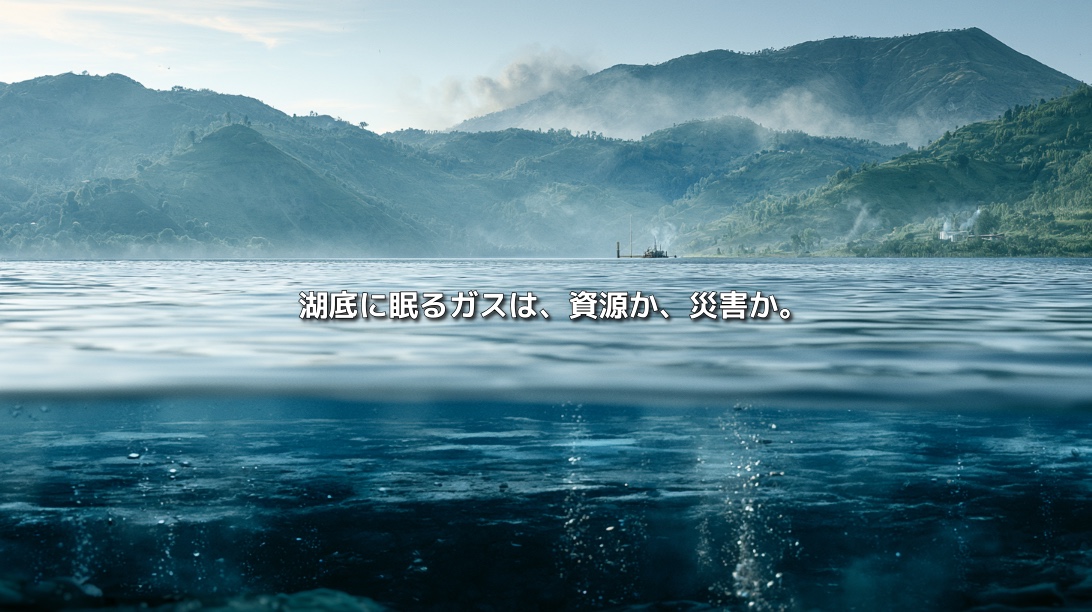
Lake Kivu lies on the border between Rwanda and the Democratic Republic of the Congo. Surrounded by green mountains, its calm waters support fishing, transport, tourism, and the daily lives of lakeside communities.
Yet below a depth of roughly 250 meters, large quantities of invisible gas are dissolved in the water: carbon dioxide and methane.
Lake Kivu is both a vast body of water and a geological system that holds these gases in place. A sudden release could cause a disaster. Carefully extracted methane, meanwhile, can be used to generate electricity.
Is the gas beneath the lake a danger or a resource? At Lake Kivu, the two questions cannot be separated. neoterrainjournal.com
A lake formed where the Earth is pulling apart
Lake Kivu sits within the East African Rift, where parts of the African continent are slowly moving away from one another. Faults run through the region, and active volcanoes, including Nyiragongo and Nyamuragira, stand nearby.
Heat and volcanic material from underground enter the lake through water rising from its bed. Lake Kivu reaches a maximum depth of about 485 meters. Its deep waters contain dissolved carbon dioxide and methane, while water with much lower gas concentrations lies above them.
According to the Swiss Federal Institute of Aquatic Science and Technology (Eawag), the lake contains an estimated 300 cubic kilometers of dissolved carbon dioxide and 62 cubic kilometers of methane.
The gases are not collected in a hollow space beneath the lakebed. Most remain dissolved in deep water under high pressure, somewhat like the carbon dioxide held in a sealed bottle of sparkling water.
Why does the gas stay in the depths?
In many lakes, seasonal temperature changes and wind help mix surface water with deeper water. Lake Kivu behaves differently. Temperature, salinity, and the concentration of dissolved substances change with depth, creating layers of water with different densities.
Denser water stays below lighter water. This stable layering makes vertical mixing difficult, allowing deep water to remain near the bottom for long periods. A lake whose layers do not regularly mix completely is called a meromictic lake.
Carbon dioxide enters Lake Kivu’s deep waters through volcanic activity and groundwater. Microorganisms within the lake also produce methane from sunken organic matter and carbon dioxide. Together, these processes supply gases that remain trapped beneath the lake’s stable upper layers.
A still surface does not mean nothing is happening below it. Geology, water temperature, salinity, and microbial activity all help maintain the conditions in which gas accumulates.
When a lake suddenly releases its gas
If gas-rich deep water rises for some reason, the pressure on it decreases and dissolved gas begins to form bubbles. The bubbles make the water more buoyant, causing it to rise further. As it rises, the pressure falls again and still more gas separates from the water.
If this chain reaction accelerates, it can produce a limnic eruption: a sudden release of gas from a lake. Despite the name, it does not involve lava erupting from the water.
The main danger is a large release of carbon dioxide. Because carbon dioxide is denser than air, it can flow along the ground and collect in low-lying areas. At high concentrations, it can displace the oxygen people and animals need to breathe.
In 1986, a limnic eruption at Lake Nyos in Cameroon sent carbon dioxide into nearby valleys and villages, killing many people and livestock. Lake Kivu is far larger than Lake Nyos and is surrounded by densely populated areas, including cities. Scientists have therefore studied the possibility of a similar event there for many years.
Is Lake Kivu about to erupt?
Lake Kivu is sometimes described as an “exploding lake.” That phrase alone gives a misleading impression of what scientists currently know.
A limnic eruption would require conditions that allow accumulated gas to escape and substantially disturb the lake’s stable layers. Nearby volcanoes and seismic activity mean that the possible effects of an eruption, an underwater landslide, or a strong earthquake cannot be ignored.
At the same time, measurements published by an international research team in 2020 did not confirm a continuing rise in methane concentrations that earlier studies had suggested. The researchers concluded that the amount of gas in the deep water was broadly stable.
A limnic eruption remains a possible hazard, but the evidence does not show that the lake is rapidly becoming more dangerous or that a disaster is imminent. The essential response is sustained monitoring of gas concentrations, temperature, salinity, and the density structure of the water. The lake’s risk cannot be judged by looking at its surface.
Turning methane into electricity
The methane dissolved in Lake Kivu is also an energy resource. In Rwanda, projects pump gas-rich water from the depths, reduce its pressure to separate the methane, and use the recovered gas as fuel for electricity generation.
More reliable electricity can support industry, healthcare, education, and households. Lake methane could also reduce reliance on imported fuels. The World Bank Group has supported a power project that uses methane recovered from Lake Kivu.
Removing methane may reduce the amount stored in the lake. Turning a potential hazard into local electricity appears to offer two benefits at once. Yet extracting gas also creates a demanding management challenge.
Extraction must preserve the lake’s stability
Methane cannot simply be lifted out of the lake on its own. Operators must bring deep water containing dissolved gas to the surface, separate the methane, and return the remaining water to the lake.
The depths at which water is withdrawn and returned matter. Deep water differs from surface water in temperature, salinity, nutrients, and dissolved gases. Returning it at an unsuitable depth could alter the density structure that keeps the lake stable. If nutrient-rich deep water enters upper layers, it could also encourage algal growth and change water quality.
Extracting methane from Lake Kivu is therefore unlike developing a conventional underground gas field. The resource is part of the lake’s layered water system.
Rwanda has established a Lake Kivu monitoring program to oversee extraction safety and the stability of the lake. Monitoring must track more than electricity output: it must follow changes in temperature, gas concentrations, salinity, and density throughout the lake over time.
One lake, two countries
Lake Kivu’s management is further complicated by its location across the border between Rwanda and the Democratic Republic of the Congo. The water does not divide neatly at the border.
If gas extraction or returned water on one side changes the lake’s layers, the effects could reach the other side. A major gas release would likewise be impossible to contain within national boundaries.
Keeping the lake safe calls for shared monitoring data, consistent extraction standards, emergency evacuation plans, and agreement on how the resource will be used over the long term. Lake Kivu raises a question beyond which country owns a natural resource: who is responsible for managing an environmental risk that crosses a border?
Can the lake be used while keeping it stable?
The gases deep within Lake Kivu cannot be seen from its surface. Beneath fishing boats and lakeside communities lies an immense volume of water containing carbon dioxide and methane.
Methane can provide electricity for the region. Poorly managed extraction could also disturb the lake’s layers and ecosystems, while volcanic activity and earthquakes cannot be predicted with certainty.
The task is to measure the lake’s condition, detect changes, and adjust both the amount of gas extracted and the methods used. Lake Kivu calls for technology that works within the lake’s delicate balance.
Calm water is no guarantee of safety. But danger is not the lake’s only story. Beneath one shared surface, Lake Kivu connects geological forces, daily life, an energy resource, and the responsibilities of two countries.
References cited in the original article: Eawag, PLOS ONE, World Bank, and Rwanda Ministry of Infrastructure. neoterrainjournal.com