Japan is a nation of forests.
Travel toward the mountains, and trees spread across the slopes while water flows through the valleys. The colors of the landscape change with every season.
New leaves emerge in spring.
Deep green covers the mountains in summer.
Autumn colors fill the valleys.
Bare branches reach into the winter sky.
Whether viewed on a map or through the window of a train, Japan appears to be rich in forests.
It is easy to assume that its mountains must therefore be healthy—and that its forests are being protected.
But having a large area of forest is not the same as having a healthy forest.
According to Japan’s Forestry Agency, forests covered approximately 25.02 million hectares as of March 2022—roughly two-thirds of the country’s total land area. About 40 percent of those forests are plantations established and managed by people. Forestry Agency of Japan
Japan does indeed have an abundance of trees.
Yet much of its forest was planted on the assumption that people would continue to enter the mountains, thin the trees, harvest the timber, replant the land, and sustain the cycle.
Japanese cedar.
Hinoki cypress.
Japanese larch.
Many of these trees were planted during Japan’s postwar reconstruction and rapid economic growth, with the expectation that they would eventually be used as building materials.
People would plant them.
Care for them.
Thin them.
Harvest them.
And plant again.
That was the cycle on which many of Japan’s mountain landscapes were built.
But society changed.
Timber prices declined.
The forestry workforce shrank.
Mountain villages lost population.
Communities aged.
Plantation forests were left unmanaged.
Deer populations expanded and damaged vegetation.
Extreme rainfall became more destructive.
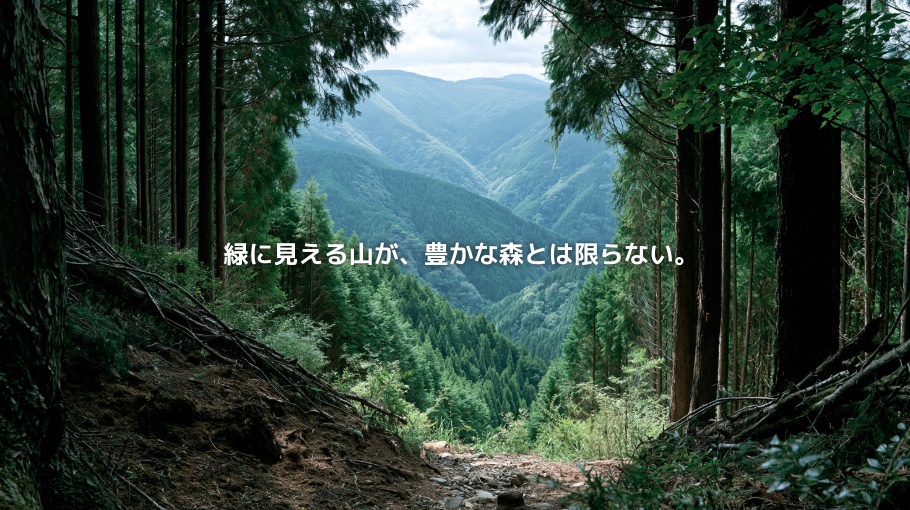
From a distance, the mountains are still covered in green.
Inside, however, some of those forests are quietly growing weaker.
A green mountain is not necessarily a healthy forest.
Is a Forest Healthy Simply Because It Has Trees?
When we think about forests, we often think about the number of trees or the amount of land covered in green.
There are many trees.
The mountains are green.
Therefore, nature must be thriving.
But the richness of a forest cannot be measured by the number of trees alone.
Does sunlight reach the forest floor?
Can understory vegetation grow?
Are fallen leaves forming healthy soil?
Are roots stabilizing the slopes?
Can birds, insects, fungi, and mammals live there?
Does rainwater slowly penetrate the soil before flowing into the valleys?
A forest is not made of trees alone.
There is soil.
There is water.
There are fungi.
There are insects.
There are birds.
There are animals.
There is human involvement.
And there is time.
Japan’s Forestry Agency identifies a wide range of functions provided by forests, including watershed conservation, soil protection, disaster prevention, biodiversity conservation, climate regulation, recreation, cultural value, and timber production. Forestry Agency of Japan
A forest is not simply a warehouse for timber.
It stores and regulates water.
It protects soil.
It provides habitat.
It supports local communities.
When a forest weakens, the problem is not limited to the loss of trees.
Water flows change.
Soil becomes more vulnerable to erosion.
Biodiversity declines.
Wild animals move closer to human settlements.
Rural livelihoods disappear.
The landscape becomes less resilient to disasters.
A forest crisis does not remain in the mountains.
It travels into rivers, seas, villages, and cities.
Plantation Forests Were a Promise to the Future
Japan’s mountains contain extensive areas of plantation forest.
A plantation forest is not necessarily unnatural. It is a forest planted by people and historically connected to human livelihoods.
After World War II, Japan needed large amounts of timber for houses and infrastructure. Cedar and cypress were planted across many mountain slopes.
This was an investment in the future.
Plant the trees.
Let them grow for several decades.
Thin the forest.
Harvest and use the timber.
Then plant again.
If this cycle continues, plantation forests can support local industries, create employment in mountain communities, provide construction materials, and store carbon.
But when the cycle breaks down, plantation forests reveal another side.
Trees grow too densely.
Sunlight no longer reaches the ground.
Understory vegetation disappears.
Root systems may remain poorly developed.
Soil becomes exposed.
Biological diversity declines.
From outside, the mountain still appears green.
Step inside, however, and some forests are dark and uniform, with little vegetation covering the ground.
There may be trees, but the forest’s ecological functions are not necessarily working as they should.
Plantation forests were created by people.
They were therefore built on the assumption that people would remain involved.
An abandoned plantation forest is also the visible result of a broken promise between society and the mountain.
What Happens When Forestry Workers Disappear?
Forests need people.
People who harvest trees.
People who build and maintain forest roads.
People who thin overcrowded stands.
People who plant seedlings.
People who confirm land boundaries.
People who monitor wildlife damage.
People who notice the early signs of erosion or disaster.
Forestry is not only the work of producing timber.
It is also the work of continually observing the mountain.
Yet the number of people working in forestry has declined in many parts of Japan.
Mountain villages lose population.
Residents grow older.
Fewer people are physically able to enter the forest.
Landowners move far away.
Inheritance makes forest ownership and boundaries increasingly difficult to identify.
When fewer people are watching the mountains, changes become harder to detect.
Fallen trees.
Damaged forest roads.
Neglected plantations.
Deer browsing.
Eroding soil.
Changes in water flow.
A forest does not always become healthy simply because it is left alone.
This does not mean that every natural forest requires human intervention. Old-growth and relatively untouched forests may retain their value precisely because people do not disturb them.
But plantation forests and satoyama landscapes developed through long relationships between human use and ecological processes. When that relationship disappears, the balance can begin to collapse.
Protecting a mountain is not simply a matter of planting trees.
It also means ensuring that people remain in the region to watch over them.
Deer Are Changing Japan’s Forests
It is impossible to discuss the condition of Japan’s forests without considering deer.
The population of sika deer once declined in some regions. In recent decades, however, their distribution has expanded across much of Japan, causing increasingly serious damage to agriculture, forestry, and natural ecosystems.
Japan’s Ministry of the Environment reports that wild animals such as sika deer and wild boar have expanded their ranges, causing damage to agricultural land, human communities, and ecosystems—including the loss of rare alpine plants. Ministry of the Environment, Japan
Deer eat grasses.
They eat new shoots.
They eat young trees.
They strip bark from trunks.
Over time, this can eliminate the lower layers of vegetation inside a forest.
Understory plants disappear.
Young trees fail to grow.
Rain strikes the exposed ground directly.
Topsoil is more easily washed away.
Habitats for insects and birds change.
Natural forest regeneration slows.
A forest renews itself as old trees fall and younger trees grow to replace them.
But when deer repeatedly consume seedlings and young trees, the next generation of forest cannot develop.
This is difficult to recognize if we look only at the trees standing today.
The present forest may still appear green.
But the future forest is not growing beneath it.
Deer damage is therefore not only changing the appearance of forests.
It may also be stopping the forest’s biological clock.
When the Forest Floor Disappears, the Mountain Weakens
Understory vegetation rarely attracts much attention.
It does not stand as tall as a tree.
It is not admired like a flower.
It cannot be sold like timber.
Yet the plants covering the forest floor help protect the mountain’s soil.
Rain falls.
Leaves and grasses absorb the force of the droplets.
Roots hold the soil in place.
Fallen leaves cover the ground.
Water slowly penetrates the earth.
Through these processes, forests retain water and reduce soil erosion.
When the understory disappears, rain strikes the ground directly.
Soil begins to move.
Slopes become more vulnerable.
Muddy water enters streams and valleys.
River ecosystems are affected downstream.
The health of a forest cannot be understood simply by looking up at its canopy.
We must also look down.
Is the ground covered in vegetation?
Are fallen leaves accumulating?
Are young seedlings growing?
Are insects present?
Is the soil soft and porous?
The condition of a forest is revealed at our feet.
When a mountain begins to weaken, the first warning signs may appear on the forest floor.
Mountains and Water Are Connected
Forests do not create water.
But they influence how water moves.
They intercept rainfall.
They help water penetrate the soil.
They release it slowly into valleys.
They support groundwater recharge.
They help stabilize the flow of rivers.
Japan’s Forestry Agency describes watershed conservation as one of the multiple functions of forests. Forest canopies and soils absorb precipitation, moderate floods and droughts, and contribute to water purification. Forestry Agency of Japan
When mountain forests weaken, the way water moves through the landscape can change.
Heavy rain flows downhill more rapidly.
Sediment enters rivers.
Normal river flows become less stable.
Aquatic ecosystems are affected.
Eventually, the effects may reach the sea.
Forests, rivers, and oceans are connected.
Poor forest management is therefore not only a mountain issue.
It can affect river turbidity, sediment accumulation in dams, coastal nutrient flows, seaweed beds, and fishing grounds.
A forest problem can also become an ocean problem.
NEOTERRAIN Journal has explored seaweed bed loss, blue carbon, ocean acidification, and coral bleaching.
These may appear to be events taking place entirely beneath the sea.
But much of the water entering the ocean begins in the mountains.
When the mountains weaken, the sea cannot remain unaffected.
Forests and Landslide Disasters
In recent years, landslides caused by extreme rainfall have become a growing concern across Japan.
Of course, it would be misleading to claim that landslides occur simply because forests are poorly managed.
Rainfall volume.
Geology.
Topography.
Historical land use.
Roads and forest tracks.
Development.
The stability of individual slopes.
River conditions.
Many factors overlap.
Nevertheless, the role of forests in protecting soil and reducing mountain hazards remains important.
Tree roots help stabilize slopes.
Fallen leaves and understory vegetation protect the soil.
Forest soils absorb water.
Vegetation can slow the movement of water into valleys.
These functions form an invisible infrastructure within the mountains.
Concrete dams and levees are not the only forms of disaster prevention.
Forests themselves are part of a region’s protective infrastructure.
Forest management is therefore not only an environmental policy.
It is also a disaster-prevention policy.
We Should Not Be Reassured by the Color Green
From a distance, Japan’s mountains appear green.
But the meaning of that green varies greatly.
A well-managed plantation forest.
An abandoned plantation forest.
A natural forest.
A secondary forest shaped by human use.
A satoyama landscape overtaken by bamboo.
A forest floor stripped bare by deer.
A harvested slope that was never replanted.
Woodland converted into a solar power facility.
A valley damaged by disaster.
They may all appear green when seen from afar.
But they do not have the same ecological condition or social meaning.
There is greenery, so everything must be fine.
There are trees, so it must be nature.
The mountains look lush, so the landscape must be healthy.
Such assumptions can hide the real problem.
What matters is not simply the amount of green.
We must look inside the forest.
What kinds of trees are growing there?
Are young trees developing?
Is there vegetation on the ground?
Is the soil protected?
How does water move through the landscape?
Can wildlife survive there?
Are people still involved in caring for the mountain?
To see a forest is not merely to see a color.
It is to see a network of relationships.
Using Timber Can Also Help Protect Forests
Discussions about forest conservation sometimes assume that cutting trees is inherently harmful.
Unregulated logging and destructive development can certainly damage forests.
But in plantation forests, a carefully managed cycle of growing, thinning, harvesting, using, and replanting trees is essential.
If timber is not used, the cycle may stop.
Trees are not harvested.
Forests are not thinned.
People no longer enter the mountains.
Local timber loses its market.
Forestry businesses disappear.
Fewer people remain to manage the land.
This does not mean that trees should simply be cut without restraint.
Forests must be replanted after harvesting.
Young trees must be cared for.
Soil must not be destroyed.
Water flows must be considered.
Biodiversity must be protected.
Economic benefits must return to local communities.
Using timber and protecting forests are not necessarily opposing actions.
In plantation landscapes, the use of wood can support continued forest management.
The central question is not simply whether trees should be cut.
How are they cut?
How is the wood used?
How is the land replanted?
Who will continue to monitor the forest?
The future of the forest depends on these questions.
The Memory of Satoyama Is Fading
Mountains were once much closer to everyday life in Japan.
People gathered firewood.
They made charcoal.
They collected fallen leaves.
They picked mushrooms and edible plants.
They drew water from the mountains for farmland.
They regarded mountains as places of festivals, spirituality, and belief.
The mountain was part of daily life.
But lifestyles changed.
Sources of fuel changed.
Agriculture changed.
People entered the mountains less frequently.
Satoyama refers to landscapes located between human settlements and deeper natural environments.
They are neither untouched wilderness nor fully developed urban spaces. Their diverse habitats were maintained through long-term human involvement.
When that involvement ends, the landscape changes.
Bamboo spreads.
Dense thickets develop.
Wild animals move closer to settlements.
Paths disappear.
Water channels become blocked.
Land boundaries fade from memory.
The decline of satoyama is both an environmental issue and a cultural one.
How did people once understand the mountains?
What did they receive from them?
How did communities maintain an appropriate distance from wildlife and the forest?
When this memory disappears, the mountain becomes little more than scenery.
But a mountain is not a background.
It is part of the foundation that supports everyday life.
Forests Are Regional Infrastructure
Roads, bridges, and water systems are not the only forms of infrastructure.
Forests are also regional infrastructure.
They retain water.
They protect soil.
They cool the air.
They provide habitat.
They produce timber.
They offer places for rest and recreation.
They help reduce the effects of disasters.
But forest infrastructure is difficult to see.
It does not appear on engineering plans like a water pipe.
It does not display an expected service life like a bridge.
Its deterioration is not as obvious as cracks in a road.
That is why decline can go unnoticed.
The forest weakens.
Water conditions change.
Soil moves.
Wild animals enter communities.
Rivers become muddy.
Disaster risks increase.
Only then do we recognize that the forest was part of the region’s essential foundation.
Protecting forests is not only about conserving nature.
It is also about protecting water, disaster resilience, local industries, culture, and everyday life.
Why Should a Forest-Rich Country Be Concerned?
Japan has a great deal of forest.
That is a fact.
But many of those forests were shaped and maintained through human involvement.
There are plantation forests.
There are satoyama landscapes.
There are secondary forests.
There are watershed forests.
There are mountain communities.
There are forestry industries.
A forest does not always become richer when it is abandoned.
Forests created by people—and forests maintained through relationships between people and nature—can lose their balance when those relationships disappear.
There are trees.
But there is little light.
There is greenery.
But no vegetation covers the ground.
There are mountains.
But few people enter them.
There is a forest.
But the trees of the future are not growing.
This contradiction lies at the heart of Japan’s forest crisis.
Japan has extensive forests.
Yet some of its mountains are growing weaker.
The appearance of the landscape and the reality inside it are beginning to diverge.
Bringing the Mountains Back into Everyday Life
What can be done?
We must begin to see mountains not as distant scenery outside our lives, but once again as part of everyday society.
Use locally produced timber.
Support forest management.
Understand where our water comes from.
Treat wildlife damage as a regional issue.
Participate in satoyama restoration.
Promote forest education.
Connect governments, forestry workers, residents, businesses, and researchers.
Recognize forest value beyond the market price of timber.
Forests cannot be sustained by economic profit alone.
But if their value is never expressed, it becomes difficult for society to share a reason to protect them.
Their value as watersheds.
Their value in disaster prevention.
Their value for biodiversity.
Their value as carbon storage.
Their value for tourism and education.
Their value as repositories of local memory.
Future forest management will require us to make these values more visible.
Mountains are not distant pieces of nature.
They are connected to the water from our taps, the rivers flowing through our cities, the sediment reaching the sea, the risks posed by disasters, the food on our tables, and the materials used to build our homes.
Beyond the Green Surface
Japan’s mountains still look green today.
But behind that green surface, a quiet crisis is unfolding.
Unmanaged plantation forests.
A declining forestry workforce.
Expanding deer populations.
Disappearing understory vegetation.
Weakening soil.
Changing water flows.
The fading memory of satoyama.
Japan has extensive forests.
But we cannot understand the true condition of its mountains without looking inside them.
Green is the color of reassurance.
It can also be the color that hides a problem.
We must do more than admire the mountains from a distance. We must look at what is happening within them.
A forest is not made of trees alone.
It is water.
It is soil.
It is wildlife.
It is human work.
It is regional memory.
Japan is covered in forests.
Yet its mountains are growing weaker.
By confronting that contradiction, we can begin to understand the quiet environmental crisis unfolding across Japan’s landscapes.
References
- Forestry Agency of Japan — FY2024 Annual Report on Forest and Forestry in Japan: Proper Forest Development and Conservation
- Forestry Agency of Japan — The Multiple Functions of Forests
- Ministry of the Environment, Japan — Wildlife Management and Measures Against Invasive Species
From a distance, Japan’s mountains appear to be covered in rich greenery.
Inside them, however, a quiet environmental crisis is advancing: neglected plantation forests, a declining forestry workforce, damage caused by deer, and changes to soil and water.
NEOTERRAIN Journal will continue exploring the environmental changes hidden behind beautiful landscapes.
If this article gave you a new perspective, please bookmark it and return as we continue examining the future of Japan’s forests and mountains.