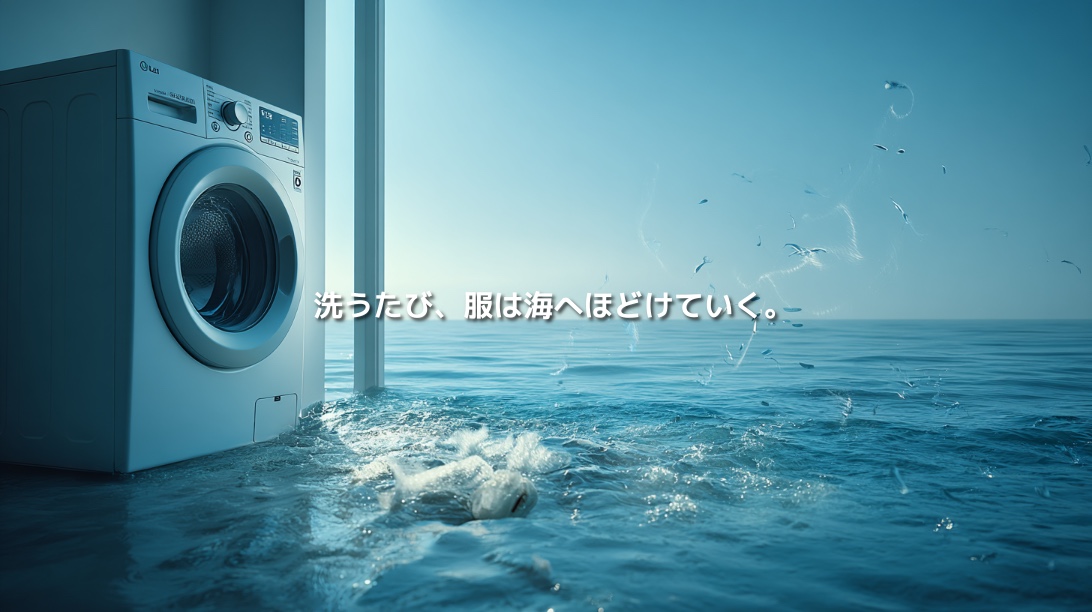
Inside a washing machine, clothes turn through the water.
Dirt is removed, the scent of detergent remains, and clean garments return to our daily lives.
At the same time, fibers too small to see are gradually breaking away from the fabric.
These fibers leave the washing machine with the wastewater and travel toward a sewage treatment plant. Many are removed during treatment, but not all can be captured. Some may enter rivers and eventually reach the ocean.
Polyester, nylon, acrylic.
Lightweight, quick-drying, durable, and relatively inexpensive, synthetic fibers have become essential to modern clothing.
But they are also forms of plastic.
Marine plastic pollution does not come only from discarded bottles and shopping bags.
Tiny pieces of plastic can also be released from clothes we value and continue to wear—every time we wash them.
What Are Microfibers?
The term “microfiber” refers to tiny fibers shed from clothing and other textile products.
Natural materials such as cotton, linen, and wool also release fibers, so not every microfiber is plastic.
However, fibers shed from polyester, nylon, acrylic, polyurethane, and other synthetic materials are microscopic pieces of plastic. Plastic particles smaller than five millimeters are generally classified as microplastics.
Fleece jackets, sportswear, quick-drying shirts, stretch trousers, winter clothing, blankets, and carpets all rely heavily on synthetic fibers.
Modern life has become so dependent on their convenience that it is difficult to imagine the global textile industry functioning without them.
Japan’s Ministry of the Environment also describes synthetic fibers as useful materials that allow people to enjoy fashion while helping meet the world’s growing demand for textiles.
The problem is not simply that synthetic fibers are used.
The deeper problem is that we still do not adequately manage where these fibers go throughout a garment’s life—from manufacturing and wearing to washing, drying, and disposal.
Source: Ministry of the Environment, Japan
Clothes Are Gradually Worn Away Inside the Washing Machine
Inside a washing machine, clothes become wet, rotate, and rub against other garments and the drum.
Friction and water movement cause small fibers to separate from the surface of the fabric.
The amount released is not determined by the material alone.
It varies according to fiber length and strength, yarn construction, fabric weave, surface brushing, sewing methods, the age of the garment, the type of washing machine, wash duration, temperature, detergent, and drying method.
Fleece and microfleece fabrics with raised surfaces are generally considered more likely to shed fibers. By contrast, even among polyester products, tightly constructed and abrasion-resistant yarns and fabrics may release fewer fibers.
The issue therefore cannot be reduced to a simple formula such as “polyester is bad” or “natural materials are safe.”
What matters is not only which material is used, but also how the garment is made, how long it can remain in use, and how resistant it is to fiber loss during washing and wearing.
The OECD has similarly noted that microfiber emissions are influenced not only by fiber composition but also by yarn and fabric structure, manufacturing processes, and washing and drying methods.
Source: OECD, Policies to Reduce Microplastics Pollution in Water
A Preliminary Estimate of Around 350 Tonnes a Year Entering the Sea from Japan
A report released by Japan’s Ministry of the Environment provisionally estimated that approximately 350 tonnes of textile fibers generated through laundry may enter the marine environment from Japan each year.
The estimate combines several factors, including the weight of clothing washed per cycle, fiber types, the amount of fiber debris generated, the number of households, annual washing frequency, and the capture rate of washing-machine filters.
However, the Ministry itself clearly states that this is not a definitive figure.
The estimated rate of discharge into the sea was not developed specifically for textile fibers, and there is still insufficient data on differences among garment types, washing machines, and sewage-treatment systems.
The figure of 350 tonnes should therefore not be treated as an established fact.
Even so, the estimate draws attention to something important.
A potentially significant volume of microscopic fibers may be escaping through laundry wastewater—a pathway that has long been regarded as just another part of ordinary household drainage.
Source: Ministry of the Environment, Japan
Sewage Treatment Does Not Make the Problem Disappear
If laundry wastewater travels to a sewage treatment plant, does that not mean the fibers will be removed there?
Sewage treatment plants do capture many textile fibers and plastic particles.
Through processes such as sedimentation and filtration, some facilities can separate a large proportion of particles from wastewater.
But removing most particles is not the same as preventing all environmental leakage.
Because the volume of water being treated is enormous, even a small percentage that escapes can amount to a considerable total discharge into rivers and seas. Shorter and thinner fibers may also be more likely to pass through treatment systems.
There is another problem.
Microfibers removed from the water do not disappear. They are transferred into sewage sludge.
If that sludge is later used as fertilizer or a soil conditioner, the fibers may move onto land. Some may become airborne, while others may be washed back into rivers by rainfall.
The OECD has reported that fibers originating from textiles have been found not only in oceans and rivers but also in air and in soils where sewage sludge has been applied.
The pathway is therefore more complicated than a straight line from the washing machine to the ocean.
Microfibers may move between water, sludge, soil, and air while remaining in the environment for long periods.
Washing-Machine Filters Cannot Capture Every Fiber
Washing machines in Japan are generally equipped with lint filters, drainage filters, or dryer filters.
These components help reduce fiber emissions.
However, they cannot capture fibers of every size.
Research reviewed by Japan’s Ministry of the Environment found that lint filters in top-loading washing machines captured about 70 percent of fibers measuring three millimeters or longer, while capturing almost none of those shorter than three millimeters.
Drum-type machines produced fewer fibers in the cited study, but their built-in filters had relatively large openings and provided only limited capture of smaller fibers.
Source: Ministry of the Environment, Japan
The presence of a filter does not automatically mean the problem has been solved.
We need to ask which fiber sizes a filter can capture, how effectively it performs, and whether users can easily remove the collected material and dispose of it as solid waste.
Good design must address not only filtration performance but also ease of cleaning and appropriate disposal.
It may be time to treat microfiber capture as a standard function of washing machines rather than an optional feature.
Laundry Is Not the Only Source
Microfibers are not released only when clothes are washed.
We walk in our clothes. We sit in chairs. We take off jackets. We move blankets. We use tumble dryers.
Everyday friction and air movement can also separate fibers from clothing and household textiles.
The OECD has pointed out that textile fibers may be released at every stage of a product’s life cycle, including manufacturing, wearing, washing, drying, and disposal.
Fibers are generated when fabric is cut in factories. More can be released when discarded garments deteriorate outdoors.
Installing high-performance filters in washing machines is important, but filters alone cannot stop every source.
Materials and fabric structures that resist shedding must be selected before garments are produced.
Fibers generated in factories must be collected.
Clothing must be made durable enough to remain in use for longer.
Garments collected after use must be properly reused or recycled.
Effective action must begin much further upstream than the household washing machine.
What Do We Know About the Effects on Marine Life and Human Health?
Synthetic fibers released into the environment do not break down easily.
Because of their thin, elongated shape, they can remain suspended in water, settle on the seabed, or be ingested by living organisms.
Studies have examined the possible physical effects of microfiber ingestion on aquatic species, as well as the effects of additives, dyes, and chemicals that may be contained in or attached to the fibers.
However, results vary according to the material, fiber length, thickness, concentration, and experimental conditions. Much remains unknown about the long-term effects under real environmental conditions.
The effects on human health also cannot yet be stated conclusively.
People may be exposed to microscopic plastic particles through water, food, and air. Yet considerable uncertainty remains about the health effects caused by exposure at concentrations found in everyday environments.
The World Health Organization has assessed dietary and inhalation exposure to nano- and microplastic particles, while emphasizing that major data gaps remain and that further research is necessary.
Source: World Health Organization
Uncertainty does not mean that no problem exists.
At the same time, fear should not be exaggerated before the risks have been fully established.
Because synthetic microfibers can persist in the environment, a precautionary approach is needed. Rather than continuing to release them until every effect has been proven, emissions should be reduced at their source.
France Has Introduced Legal Requirements for Washing-Machine Filters
The microfiber problem cannot be solved through consumer awareness alone.
For this reason, some governments have begun trying to change the design of appliances and products themselves.
France’s anti-waste and circular economy legislation stipulates that new household and commercial washing machines must be equipped with a microfiber filter or an equivalent internal or external solution intended to reduce the release of plastic microfibers from laundry.
The provision took effect in January 2025.
Source: France’s Anti-Waste and Circular Economy Law, Article 79
This approach no longer treats textile fibers as unavoidable household wastewater. It extends responsibility to appliance manufacturers, clothing companies, and public authorities.
But installing a filter is not the end of the discussion.
How should capture performance be measured? Which fiber sizes should be covered? Who should dispose of the material collected in the filter? How can clogging and additional energy consumption be minimized?
Regulation, technology, and user behavior must be connected if real reductions are to be achieved.
Replacing Everything with Natural Fibers Is Not a Complete Solution
If synthetic fibers are plastic, it may seem that the answer is simply to replace them with natural materials.
Natural fibers, however, also have environmental impacts.
Cotton cultivation requires land and water and may involve pesticides and fertilizers, depending on how it is grown. Wool is associated with land use and greenhouse gas emissions from livestock. Regenerated cellulose fibers such as rayon raise questions about forest resources and chemical processing.
Even naturally derived fibers may have been treated with dyes, resins, and other substances. We still need to consider how they break down in the environment and what effects those treatments may have.
Replacing one material with another does not make every environmental burden disappear.
Synthetic fibers may also provide valuable performance where quick drying, insulation, stretch, or durability is required.
The question is not simply whether a material is synthetic or natural.
The real challenge is how to preserve necessary functions while reducing the garment’s overall environmental impact—from manufacturing through disposal.
What Clothing Manufacturers Can Do
The most effective solution is not to capture fibers after they have already broken away. It is to make clothing that sheds fewer fibers in the first place.
Apparel companies and material manufacturers need to measure fiber loss and use the results in product design.
They can strengthen yarns, improve fabric structures, reconsider excessive brushing, reduce emissions from cut edges and seams, and remove loose fibers during manufacturing before products are shipped.
They can also make garments that remain wearable for years instead of deteriorating after only a few washes.
Alongside price, appearance, and functionality, resistance to fiber shedding could become a new measure of clothing quality.
Consumers cannot determine how many fibers a garment will release simply by looking at it in a shop.
Companies and governments therefore have a responsibility to establish reliable testing methods and provide information that allows people to make informed choices.
What We Can Do When Washing Clothes
There are also practical steps that can be taken at home.
Japan’s Ministry of the Environment recommends following garment care labels, using laundry bags, and cleaning washing-machine filters regularly.
Fine-mesh laundry bags can reduce friction between fabrics while also helping prevent loose fibers from entering wastewater.
Fibers collected in filters should be placed in household waste rather than washed down the drain.
Unnecessarily high temperatures and excessively long wash cycles should be avoided. Washing machines should not be overloaded, but very small loads should not be washed more frequently than necessary. Clothes should be washed appropriately, taking both hygiene and the condition of the garment into account.
These practices can also reduce damage and help clothing last longer.
But responsibility must not be placed entirely on consumers.
No matter how carefully people wash their clothes, emissions will remain difficult to prevent if the market continues to offer garments that shed fibers easily.
Household action becomes truly effective only when combined with better product design, improved washing-machine technology, effective sewage treatment, and appropriate regulation.
Keeping the Pleasure of Clothing from Becoming a Burden on the Sea
Clothing does more than protect the body.
It allows us to experience the seasons, express who we are, work, play sports, and prepare ourselves emotionally to meet other people.
Fashion is culture. It is an industry. It is also one of the small pleasures of everyday life.
That is why this issue should not be reduced to blaming people who buy clothes or people who wash them.
The problem is not that we enjoy clothing.
The question is how much responsibility society is willing to take for what falls away while garments are made, worn, washed, and eventually discarded.
A plastic bottle can be picked up.
A shopping bag can be found on a beach.
But a single fiber shed from a piece of clothing is almost invisible.
Precisely because we cannot see it, we must reduce it before it escapes.
What enters the water beyond the clean clothes we take from the washing machine?
Imagining the invisible waterway connecting our laundry to the ocean is not an invitation to abandon fashion.
It is a step toward creating a society in which we can wear the clothes we love for longer—and with greater peace of mind.