How Construction Demand Is Eroding Rivers and Coastlines
Skyscrapers, apartment buildings, roads, bridges, airports, and levees.
The cities in which we live are supported by enormous quantities of concrete.
Concrete may appear to be a modern material manufactured by humans. Yet most of its volume consists of natural resources such as sand and gravel.
The gray surfaces beneath our cities were once part of a riverbed, seabed, or sediment carried down from mountains over long periods of time.
Whenever we build a city, we move sand from somewhere else.
The scale of that movement is beginning to exceed nature’s ability to replace what has been removed.
The World Uses Around 50 Billion Tonnes of Sand and Gravel Every Year
According to a report published by the United Nations Environment Programme in May 2026, the world uses approximately 50 billion tonnes of sand and gravel each year.
Demand for sand used in buildings is expected to increase by as much as 45 percent by 2060.
Population growth, urbanization, housing construction, and transport infrastructure all increase demand. As economies grow and living standards improve, the amount of sand society requires also rises.
Sand and gravel are often described as the world’s most heavily used resources after water. Yet compared with oil or forests, there is relatively little public awareness of where sand is extracted or how it reaches consumers.
Sand appears to be everywhere.
But the existence of enormous quantities of sand on Earth does not mean that all of it can be used for construction without damaging the environment.
Concrete aggregate must meet requirements concerning particle size, shape, strength, salt content, and impurities. Sand from deserts, rivers, beaches, and the seabed cannot all be used in the same way.
The world is not simply facing the disappearance of sand.
The deeper problem is that the supply of construction-grade sand that can be extracted without destroying ecosystems is struggling to keep pace with the locations and speed of urban demand.
Source: UNEP—Sand: Wanted Dead and Alive. Use It Wisely
Sand Moves from Mountains to the Sea
Sand does not remain still in nature.
Rock in the mountains is gradually weathered by rain, wind, and changes in temperature. The resulting sediment enters rivers and is carried downstream, especially during floods.
It eventually reaches river mouths and the sea, where waves and coastal currents redistribute it along the shoreline.
A beach was not placed there fully formed.
It developed gradually through a long sediment cycle connecting mountains, rivers, estuaries, and the sea.
When large quantities of sand and gravel are removed from a riverbed, less sediment reaches downstream areas.
When dams trap sediment, the amount supplied to estuaries and coastlines changes.
Ports and breakwaters can interrupt the movement of sand along the shore.
Changing the movement of sand in one location may produce visible effects on a coastline dozens of kilometers away.
The sand problem cannot be understood by looking only at the extraction site.
The entire sediment system—from mountains and rivers to estuaries and beaches—must be considered as one connected unit.
Billions of Tonnes Are Also Removed from the Seabed
Sand extraction does not take place only on land.
According to UNEP’s Marine Sand Watch, an estimated four to eight billion tonnes of sand, gravel, silt, and other sediments are dredged from marine and coastal environments every year.
That is equivalent to removing more than one million dump-truck loads from the seabed every day.
When sand is taken from the seafloor, the water can become more turbid and the underwater terrain can change.
Habitats for bottom-dwelling organisms may be lost. Spawning and nursery grounds for fish and shellfish can be damaged, with consequences for both ecosystems and fisheries.
Excessive extraction close to shore can weaken the coast’s natural protection against waves and storm surges. It may also contribute to saltwater intrusion into groundwater and the loss of beaches that support tourism.
Sand is not only a construction material.
It is also part of the physical foundation of an ecosystem.
UNEP has called for greater recognition of the value of sand left in nature, where it supports habitats, biodiversity, shoreline protection, and other ecosystem functions.
A beach is not simply a place where surplus sand has accumulated.
It is natural infrastructure that helps protect land from sea-level rise and storm surges.
Source: UNEP—Marine Sand Watch Reveals Massive Extraction in the World’s Oceans
Japan’s Coastal Erosion Still Carries the Memory of Gravel Extraction
During Japan’s period of rapid economic growth, demand for construction aggregate increased dramatically, and sand and gravel were extracted from many rivers.
At the same time, dams were built for flood control and water supply, while ports and fishing harbors expanded.
Japan’s Ministry of Land, Infrastructure, Transport and Tourism has noted that the combination of these factors changed the movement of sediment from mountains to the sea.
One symbolic example can be found in the Abe River and the Shizuoka and Shimizu coastlines in Shizuoka Prefecture.
Large quantities of gravel were taken from the Abe River after the Second World War for use as construction aggregate. As the amount of sediment reaching the sea declined, erosion advanced along the Shizuoka coast.
Gravel extraction from the river was later restricted, and beach nourishment and other measures were introduced. The shoreline subsequently began to show signs of recovery.
The important lesson is that the cause of a coastal problem is not always located on the coast itself.
If a beach is shrinking, sand can be brought in from another place to replace what has been lost.
But this may not provide a lasting solution. Unless the underlying movement of sediment from upstream areas to the river mouth and coastline is restored, the newly added sand may eventually disappear again.
Integrated sediment management in Japan attempts to balance sediment across the entire system by combining measures such as moving material trapped behind dams, reusing sediment dredged from river channels, nourishing beaches, and bypassing sand around structures that interrupt its movement.
Sand is not only a resource to be extracted.
It is also a circulating material that must continue moving through a watershed.
Urban Development Depends on Distant Landscapes
Most urban residents never see where construction sand is extracted.
Looking at a completed apartment building reveals nothing about the river or seabed from which the sand in its concrete came.
Because extraction and consumption take place far apart, the environmental effects of urban development on other regions remain largely invisible.
In areas where sand is extracted, riverbank erosion, increased flood risk, changes in groundwater levels, degraded water quality, and damage to fisheries or agriculture may occur.
Where regulation and monitoring are weak, unauthorized extraction and opaque trading networks can contribute to instability within local communities.
A convenient and attractive city and an eroding riverbed or coastline are not separate events.
The concentration of prosperity in one place may depend on removing natural resources from another.
This structure is familiar in the extraction of oil, timber, minerals, and food.
It also exists in sand—a material long assumed to be available everywhere.
Can We Build Cities Without Sand?
It would be difficult to eliminate the use of sand from modern society in the immediate future.
Homes, schools, hospitals, roads, and disaster-prevention infrastructure will continue to require large quantities of construction material.
It is also unrealistic to tell developing regions that they should simply stop building.
The issue is not a binary choice between using sand and using none at all.
Society must manage which sand is used, where it comes from, how much is taken, and how it is extracted.
First, areas where extraction should be prohibited must be clearly identified. These include beaches, active coastal sediment zones, and habitats with high biodiversity value.
Satellite information and vessel-tracking data can be used to monitor extraction volumes and locations. Construction supply chains should also be made traceable so that buyers can determine where materials originated.
Cities can reduce their consumption of newly extracted sand.
Recycled aggregate can be produced from demolished concrete.
Crushed rock and manufactured sand generated through quarrying can be used where their quality and environmental conditions are appropriate.
Buildings can be designed to last longer, reducing unnecessary demolition and reconstruction. Existing structures can be renovated and kept in use.
Reducing the amount of material required at the design stage can also lower demand for sand.
The solution is not limited to reusing waste after a building is demolished.
We must also reconsider the speed at which cities are repeatedly destroyed and rebuilt.
Source: UNEP—Sand and Sustainability: 10 Strategic Recommendations to Avert a Crisis
The Concrete Beneath Our Feet Was Once Part of a River
Sand consists of tiny particles.
When we look at a single grain, it is difficult to recognize either its value or the consequences of losing it.
But when billions of tonnes are moved, riverbed elevations change, coastlines retreat, habitats disappear, and people’s lives are altered.
The global sand crisis is not simply asking how many grains of sand remain on Earth.
It asks how large the gap has become between the time nature needs to create, transport, and redistribute sand and the speed at which human societies extract and consume it.
It also asks which places and communities are being forced to bear the environmental cost.
The roads we walk on and the buildings in which we live are connected to distant landscapes.
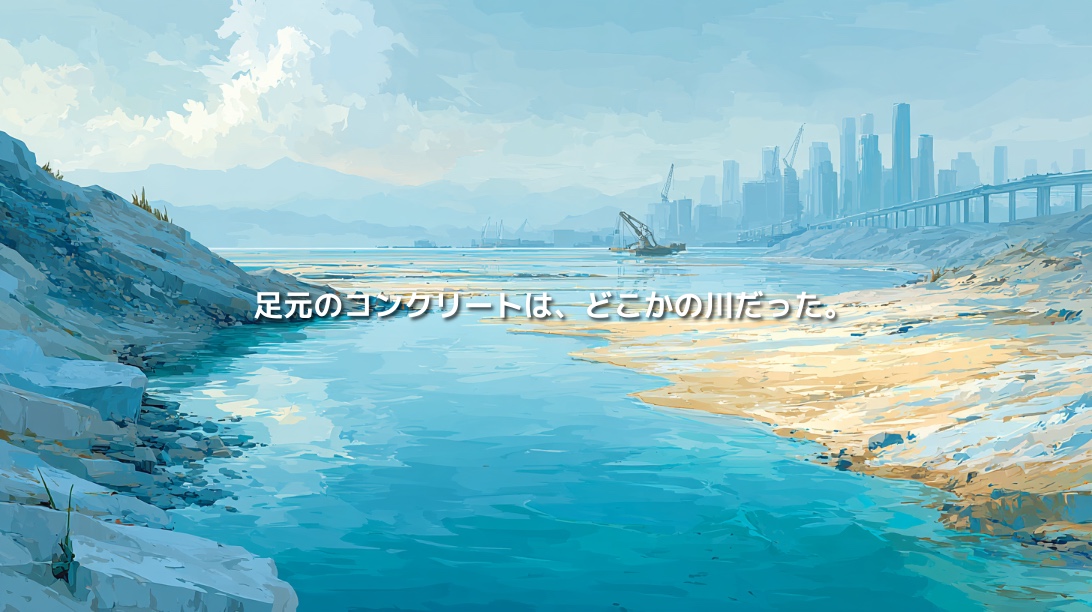
The concrete beneath a city was once part of a mountain, a river, a seabed, or a beach.
Imagining that history is the first step toward seeing sand not as a cheap and limitless material, but as a finite resource supporting both nature and society.
References
- UNEP: Sand—Wanted Dead and Alive. Use It Wisely
- UNEP: Sand and Sustainability—10 Strategic Recommendations to Avert a Crisis
- UNEP: Marine Sand Watch Reveals Massive Extraction in the World’s Oceans
- OECD: Global Material Resources Outlook to 2060
- Ministry of Land, Infrastructure, Transport and Tourism, Japan: Monitoring Sediment Transport in Sediment Systems
- Ministry of Land, Infrastructure, Transport and Tourism, Japan: Key Considerations for Coastal Conservation