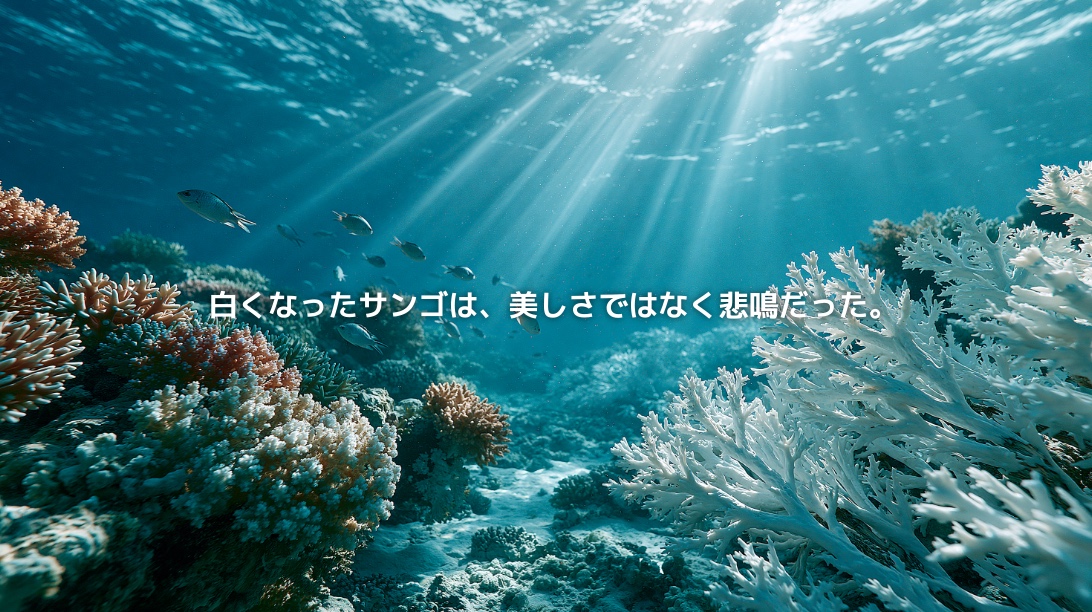
Beneath the surface of the ocean lies a place much like a forest.
Fish gather there. Shellfish make their homes. Crustaceans hide among its structures, while countless forms of life overlap and coexist.
This is a coral reef.
Coral reefs are more than beautiful tourist attractions. They are three-dimensional habitats that sustain marine ecosystems, nurseries where fish grow, and natural breakwaters that soften the force of waves.
Yet coral reefs around the world are turning white.
At first glance, bleached coral can appear strangely beautiful.
But this is not a sign of health.
Coral bleaching is a warning that the coral is under severe stress.
The water becomes warmer.
The coral experiences heat stress.
The microscopic algae living inside it are expelled.
Its color disappears, revealing the white skeleton beneath.
This is coral bleaching.
The U.S. National Oceanic and Atmospheric Administration explains that heat stress caused by rising ocean temperatures can lead to coral bleaching and increase the risk of infectious disease. NOAA Ocean Service
A bleached coral is not necessarily dead.
However, if bleaching continues for too long or occurs repeatedly, the coral can lose its energy reserves and eventually die.
The beauty of white coral is also a warning from the sea.
Corals Are Animals
Corals may look like plants.
They can also resemble rocks, fixed to the seafloor and slowly expanding into shapes that sometimes look like flowers.
But corals are animals.
A coral colony is made up of many tiny organisms called polyps. Within their tissues live microscopic algae commonly known as zooxanthellae.
This relationship supports the entire coral reef ecosystem.
The algae produce nutrients through photosynthesis, which are then shared with the coral. In return, the coral provides the algae with a protected place to live.
Much of a coral’s color also comes from these algae.
The vivid colors of a coral reef are therefore created through a partnership between coral and algae.
But when seawater becomes too warm, this partnership begins to break down.
The coral experiences stress and expels the algae living inside it.
Its color fades.
Its white skeleton becomes visible.
Bleaching is the moment when the relationship between coral and its symbiotic algae begins to unravel.
Bleaching Is Not Death—but It Is Dangerous
When a coral turns white, it does not die immediately.
If ocean temperatures fall and environmental conditions improve, the coral may regain its algae and recover.
During bleaching, however, the coral is placed under enormous strain.
It receives less energy.
Its growth slows.
It becomes more vulnerable to disease.
Its ability to reproduce declines.
If bleaching lasts only a short time, recovery may still be possible.
But if unusually warm water persists, the coral can run out of energy.
An even greater danger is repeated bleaching.
A coral may survive one bleaching event, only to face another marine heatwave soon afterward.
It bleaches again before it has fully recovered.
Under such conditions, coral reefs struggle to endure.
NOAA explains that while corals can sometimes recover from bleaching, repeated events weaken their health and may ultimately lead to death. NOAA Coral Reef Conservation Program
Bleaching is a sign that coral reefs are approaching their limits.
What Is a Marine Heatwave?
One of the main causes of coral bleaching is the marine heatwave.
Just as extreme heat can persist over land, unusually high temperatures can also remain in the ocean.
This is known as a marine heatwave.
A marine heatwave may last for several days, several weeks, several months, or sometimes even longer.
According to NOAA, marine heatwaves can affect not only surface waters but also the seafloor. They have been linked to mass mortality among fish, seabirds, and marine mammals, as well as widespread coral bleaching. NOAA Climate.gov
Ocean temperatures may seem to change more slowly than air temperatures.
But once the ocean absorbs heat, that heat does not disappear easily.
For coral, even a relatively small rise in water temperature can create intense stress. The greatest danger comes when temperatures remain above their normal range for an extended period.
Marine heatwaves are difficult to see.
Standing on the shore, we may not immediately notice that the ocean temperature has become abnormal.
The sea remains blue.
The waves appear unchanged.
Yet beneath the surface, coral reefs are struggling to survive the heat.
Coral Bleaching Is Happening Around the World
Coral bleaching is not a local problem.
It has been observed across coral reef regions throughout the world.
In 2024, NOAA and the International Coral Reef Initiative confirmed that the world was experiencing its fourth global coral bleaching event—the fourth on record and the second within a decade. NOAA NESDIS
This indicates that extreme ocean temperatures are no longer isolated anomalies.
They are becoming recurring conditions.
Coral reefs stretch across the beautiful tropical and subtropical waters of the planet:
The Great Barrier Reef in Australia.
The Caribbean Sea.
The Indian Ocean.
The Pacific Islands.
Southeast Asia.
The waters surrounding Okinawa and Amami in Japan.
Every region has its own reefs, marine species, communities, and ways of life connected to the sea.
Bleaching is therefore not simply a change in the color of coral.
It threatens the foundations of:
Tourism.
Fisheries.
Food cultures.
Coastal protection.
Island communities.
Marine biodiversity.
Coral Reefs Are Cities Beneath the Sea
A coral reef is like a city beneath the ocean.
There are branching corals, table-shaped corals, and massive corals that spread across the seafloor like rock formations.
Fish swim through the gaps. Shrimp and crabs hide inside them. Countless smaller organisms make their homes within the reef.
Unlike a flat seabed, a coral reef has a complex three-dimensional structure.
That structure becomes habitat.
Juvenile fish hide there from predators.
Adult fish use the reef as a feeding ground.
Many species gather around it to survive.
When a coral reef weakens, this structure gradually disappears.
The coral dies.
Its skeleton becomes fragile.
Waves and storms break it apart.
Algae cover the remains.
Fish lose their habitat.
Coral bleaching is not merely a problem of fading color.
It is the weakening of the foundations of an entire underwater city.
Coral Reefs Are Also Natural Breakwaters
Coral reefs are habitats for marine life, but they also help protect coastlines.
Offshore reefs reduce the force of incoming waves. Before powerful waves and storm surges reach the coast, the reef absorbs and disperses part of their energy.
In this sense, a coral reef functions as a natural breakwater.
Healthy reefs can help reduce the risks of coastal erosion and storm surges.
But when reefs weaken and their physical structures collapse, their ability to protect the coast also declines.
Climate change raises sea levels.
Typhoons and severe storms become more damaging.
Ocean temperatures rise.
Corals bleach.
Reefs weaken.
Coastal protection is reduced.
The crisis facing coral reefs does not end beneath the ocean surface.
It also affects the safety of people living on islands and along coastlines.
The Fragility Behind the Beauty
Coral reef seas are beautiful.
Clear water.
Colorful fish.
White sand.
Blue skies.
Divers and snorkelers visiting from around the world.
Coral reefs attract people and support regional tourism economies.
But their beauty is extremely fragile.
Tourism can sustain local communities while also placing additional pressure on reefs.
Boat anchors.
People stepping on coral.
Overcrowding.
Coastal development.
Wastewater discharge.
Runoff carrying red soil and sediment.
Tourism itself is not necessarily the problem.
Responsible tourism can communicate the value of coral reefs and help finance conservation.
What matters is that we do more than consume the beauty of the sea. We must also understand the threats hidden beneath that beauty.
A coral reef is not merely a background for photographs.
It is a living ecosystem.
Coral Bleaching and Ocean Acidification Are Overlapping
The ocean absorbs carbon dioxide from the atmosphere, contributing to the growing problem of ocean acidification.
Coral bleaching is primarily caused by heat stress associated with rising water temperatures.
Ocean acidification occurs when absorbed carbon dioxide changes the chemical balance of seawater.
These are different processes, but for coral reefs, they become overlapping sources of stress.
Ocean temperatures rise.
Corals become more vulnerable to bleaching.
Carbon dioxide dissolves into seawater.
Ocean pH declines.
Corals find it more difficult to build their skeletons.
Their ability to recover weakens.
Coral reefs are not being damaged by one problem alone.
Global warming.
Ocean acidification.
Marine heatwaves.
Coastal development.
Declining water quality.
Sediment runoff.
Overfishing.
Tourism pressure.
These pressures overlap, making the future of coral reefs increasingly uncertain.
For that reason, no single solution will be enough.
Globally, greenhouse gas emissions must be reduced.
Locally, coastal water quality must be protected, soil runoff must be prevented, and physical damage to reefs must be minimized.
Tourism must avoid stepping on, touching, or breaking coral.
Governments, researchers, fishers, tourism operators, and residents must share knowledge about changes taking place in the sea.
Protecting coral reefs requires us to look at the atmosphere, the ocean, and the land at the same time.
What Is White Coral Trying to Tell Us?
Bleached coral is silent.
It does not scream.
It does not move.
It simply turns white.
That whiteness may even appear beautiful.
But it is the color of a living relationship beginning to come apart.
Coral and algae.
Water temperature and sunlight.
Fish and habitat.
Islands and natural breakwaters.
Tourism and local economies.
The ocean and the Earth’s climate.
Everything is connected.
Bleached coral tells us that part of this network is beginning to break.
We must not look at white coral and see only beauty.
We must see the heat behind the whiteness.
The heat accumulating beneath the ocean surface.
The climate being altered by human activity.
The burden the ocean has continued to absorb.
Coral bleaching is one of the visible signs of climate change emerging from the sea.
What Can We Do?
There are actions we can take to protect coral reefs.
At the global level, reducing greenhouse gas emissions is essential.
We must slow the rise in ocean temperatures, reduce the risk of marine heatwaves, and limit the progression of ocean acidification.
These are the fundamental measures needed to protect coral reefs.
At the same time, action can also be taken locally.
Protect coastal water quality.
Reduce runoff carrying soil and sediment.
Use mooring buoys instead of dropping anchors onto reefs.
Avoid touching coral while diving or snorkeling.
Consider the environmental effects of sunscreen and other chemicals.
Support coral monitoring and conservation programs.
Observe local waters and record environmental changes.
Research from NOAA Fisheries also indicates that reducing local human pressures from both land and sea can increase the chances that coral reefs will persist as the ocean continues to warm. NOAA Fisheries
Local action may seem small compared with a problem as vast as climate change.
But coral reefs are already under stress.
That is precisely why reducing every avoidable local pressure matters.
When the next wave of bleaching arrives, corals need the strength to recover.
Reducing everyday pressures can help give them that chance.
How Should We See a Forest Beneath the Sea That Has Turned White?
Coral reefs are the forests of the ocean.
They nurture fish.
They sustain life.
They soften waves.
They support tourism and local communities.
And these underwater forests are turning white.
Bleached coral may still recover.
But recovery takes time.
It also requires a period of relief before the next marine heatwave arrives.
Today, changes in the ocean are accelerating.
Water temperatures rise.
Marine heatwaves occur.
Corals bleach.
Another wave of stress arrives before recovery is complete.
Unless this cycle is broken, coral reefs will gradually lose their strength.
This is not merely a story about distant tropical seas.
It is a story about the Earth’s climate, marine biodiversity, coastal protection, tourism, fisheries, and food cultures.
White coral is not simply beautiful.
It is a sign that the ocean is carrying too much heat.
We must not overlook that whiteness.
Beneath the surface, a city of life is quietly beginning to tremble.
When coral reefs turn white,
the ocean is showing us the heat of the planet.
References
- NOAA Ocean Service — How Does Climate Change Affect Coral Reefs?
- NOAA Coral Reef Conservation Program — Water Temperature and Coral Bleaching
- NOAA Climate.gov — In Hot Water: Exploring Marine Heatwaves
- NOAA NESDIS — NOAA Confirms Fourth Global Coral Bleaching Event
- NOAA Fisheries — Coral Reefs Benefit From Reduced Land-Sea Impacts Under Ocean Warming
Coral bleaching may seem like a distant event when viewed from the shore.
Yet it is also a visible sign of overlapping global environmental pressures: rising ocean temperatures, marine heatwaves, ocean acidification, and changes to coastal environments.
NEOTERRAIN Journal will continue exploring the changes taking place behind the world’s beautiful landscapes—and what those changes mean for the future of the planet.
If this article gave you a new perspective, please bookmark it and return as we continue to examine the relationship between the ocean, the land, and our shared future.