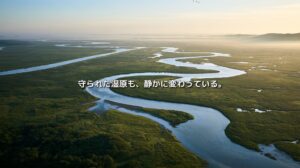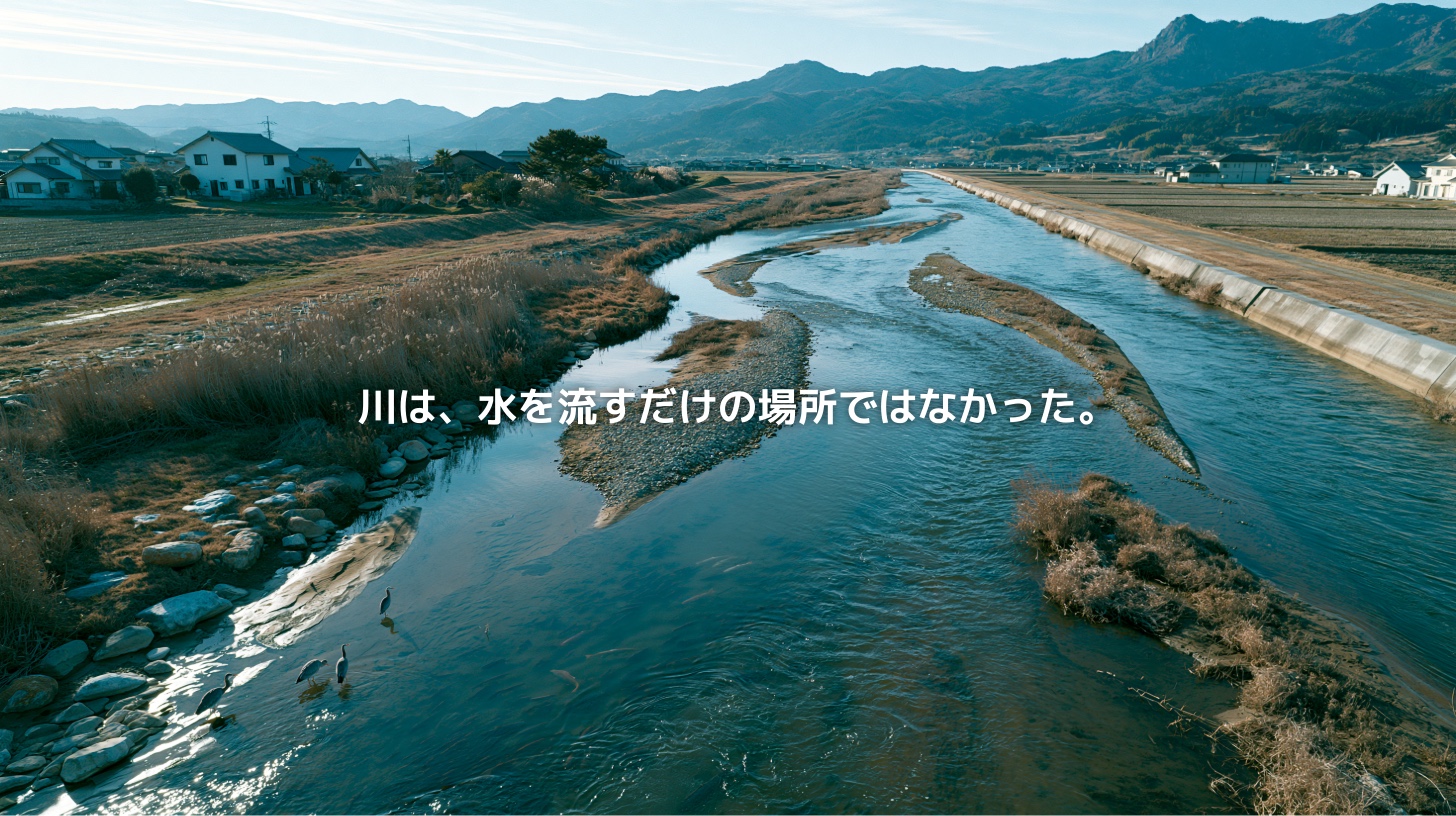
After looking at rice paddies, irrigation channels, and agricultural ponds, we now turn to rivers.
Water held in rice paddies.
Water flowing through irrigation channels.
Water stored in ponds.
Eventually, all of it finds its way into a river.
A river is a place where water flows.
That is certainly true.
It carries excess water away during heavy rain.
It protects towns from flooding.
Together with bridges and levees, it helps safeguard people’s lives.
Rivers in Japan have long been deeply intertwined with human life. At the same time, they have repeatedly threatened it.
That is why rivers have been engineered.
Winding channels have been straightened.
Banks have been reinforced with concrete.
Levees have been raised.
Water has been made to flow more quickly toward the sea.
These measures were developed to protect towns from floods. They are also part of a long history in which people have fought rivers and tried to bring them under control.
Yet as a river is straightened, lined with concrete, and transformed into something closer to a structure designed simply to convey water, other things begin to disappear.
Shallows.
Deep pools.
Sandbars.
Reed beds.
Wetlands.
Spaces between stones.
Grassy edges along the water.
Places where fish can hide.
Places where birds can land.
Places where children can touch the water.
A river was never merely a channel for moving water.
It was a habitat for living things, a vessel for human memory, and part of the landscape that defined a community.
Rivers Were Meant to Move
By nature, rivers move.
Rain raises the water level.
A stronger current erodes the banks.
The river carries sediment and forms sandbars.
It meanders, creating shallow riffles and deep pools.
A river was never a fixed line. It was a living presence whose shape changed over time.
Those changes created a wide range of environments:
Places where the current was fast.
Places where it was slow.
Deep water.
Shallow water.
Sandy beds.
Rocky stretches.
Vegetated banks.
Areas submerged only during floods.
This environmental variety allowed many forms of life to coexist.
Fish.
Crabs.
Shrimp.
Shellfish.
Aquatic insects.
Waterbirds.
Reeds and aquatic plants.
Plants rooted in the riverbed and on gravel bars.
A river was both a single flow of water and an ecosystem composed of many small, overlapping habitats.
Japan’s Ministry of Land, Infrastructure, Transport and Tourism describes nature-oriented river management as an approach that considers the natural processes of the entire river system while conserving or creating habitats for feeding, growth, and reproduction, preserving diverse river landscapes, and maintaining harmony with local life, history, and culture.
This idea reminds us that a river does more than convey water. It also nurtures life and shapes the landscape.
Why Were Rivers Straightened?
There is no single reason rivers were straightened and their banks reinforced.
To prevent flooding.
To make land easier to use.
To expand towns.
To protect farmland.
To build roads and bridges.
To move water downstream more quickly.
Japan is a mountainous country, and many of its rivers descend steeply. When heavy rain falls, water can rush downstream in a short period of time. Typhoons and torrential rain have repeatedly caused serious damage to people’s lives and communities.
River engineering was therefore necessary.
Levees were built.
Banks were reinforced.
Channels were widened.
Water was given a clearer path downstream.
These works have protected lives, homes, and livelihoods.
It would be too simplistic to describe all river engineering as nothing more than environmental destruction.
There are reasons for reinforcing riverbanks.
There are historical and social circumstances behind channel straightening.
Flood control has the urgent purpose of protecting human life.
Yet when we look at rivers too narrowly—as devices designed to move water as efficiently as possible—their complexity begins to disappear.
A straight, deep river enclosed by concrete may be easier for people to manage.
For other living things, however, it may be a far more difficult place to survive.
What Concrete Revetments Took Away
Concrete revetments protect riverbanks.
They prevent erosion and help protect roads, homes, and farmland. They withstand powerful flood currents and strengthen levees.
In that sense, revetments are essential infrastructure.
But they can also erase important elements of the waterside.
Earthen banks.
Plant roots.
Gently sloping edges.
Small holes and crevices.
The gradual boundary between shallow water and dry land.
Places where animals can climb out of the water.
Places where fish can hide.
The water’s edge is crucial to river life.
Juvenile fish shelter near banks where the current is gentle.
Aquatic insects live among stones and plants.
Frogs and crabs move between water and land.
Waterbirds land in shallows and on sandbars.
When the water’s edge becomes a vertical concrete wall, the gradual connection between river and land is severed.
Japan’s Biodiversity Center has noted that major alterations—including dam construction, riverbank reinforcement, the infilling of urban rivers, and the routing of rivers underground—have contributed to an impoverishment of biological communities and the loss of waterside spaces where residents once found recreation and respite.
When a river becomes too orderly, the space into which life can enter grows smaller.
Such a river may look clean and well maintained.
The water flows in a straight line. The banks are neatly engineered. The vegetation has been cut back.
But if there are few signs of life, can we truly call it a rich river?
The River’s “Inefficiency” Sustained Life
A natural river contains places that may appear wasteful or inefficient.
Backwaters where water gathers.
Bends in the current.
Places where sand accumulates.
Banks overgrown with vegetation.
Floodplains that are submerged only when the river rises.
Rocky ground that is difficult to walk across.
These places are hard for people to manage. If the sole objective is to move water downstream quickly, they seem inefficient.
For living things, however, that apparent “waste” was essential.
Slow water offers refuge to juvenile fish.
Shallows provide habitat for birds and aquatic insects.
Sandbars give plants somewhere to take root.
Reed beds shelter fish and birds.
Spaces between stones become living quarters for small organisms.
The complexity of a river was the source of its ecological richness.
A straight river moves water quickly.
But a current that is too fast can become a harsh environment for life.
A deeply excavated channel can hold more water.
But it can also reduce the number of places where people and animals can approach the water.
An engineered river may improve safety.
But it may also increase the distance between people and the river itself.
How can we preserve some of the river’s “inefficiency”?
That is an important question for the future of river design.
As People Drift Away From the Waterside
Concrete-lined rivers can make it difficult for people to touch the water.
High levees.
Fences.
Vertical concrete banks.
Deep channels.
Signs prohibiting entry.
Many of these measures are necessary for safety. Preventing drowning and other accidents sometimes requires structures that keep people from approaching the water carelessly.
But if people are kept away from every waterside, rivers gradually disappear from everyday life.
Rivers were once places to play.
They were places to wash, fish, walk, and feel the changing seasons.
People saw fish in the water.
They threw stones from the bank.
They knew the coldness of the current.
They understood the danger of a swollen river.
Such experiences make a river feel close and real.
When people become detached from rivers, it also becomes harder to notice how those rivers are changing.
That fish have declined.
That aquatic plants have disappeared.
That birds no longer visit.
That the vegetation along the banks has changed.
When our points of contact with the waterside vanish, environmental problems become even harder to see.
Making a river safe is not the same as separating people from it completely.
How can we preserve places where people can experience the waterside while still respecting the risks?
This, too, is a central question in river design.
Nature-Oriented River Management
In recent years, Japan has placed greater emphasis on nature-oriented river management: an approach that treats rivers not merely as drainage channels, but as places where natural processes, ecosystems, and community life must coexist.
The Ministry of Land, Infrastructure, Transport and Tourism defines this approach as river management that considers the natural workings of the entire river, maintains harmony with local life, history, and culture, and conserves or creates habitats and diverse river landscapes.
This does not mean returning every river to some untouched state of the past.
Flood control remains necessary.
Protecting human life must come first.
In an age of increasingly intense rainfall disasters, river safety cannot be treated lightly.
But within that requirement, we can still preserve habitats.
We can create greater variety along the water’s edge.
We can allow fish to move through the river.
We can restore wetlands and reed beds.
We can create places where local people can reconnect with the waterside.
The question is not whether we must choose safety or nature.
It is how the two can be layered together.
That is the direction proposed by nature-oriented river management.
The ministry’s guidance on assessing river environments likewise calls for conserving habitats that are already in good condition and improving degraded river environments as far as possible.
River design is not simply the construction of structures.
It is also the design of a community’s relationship with a living ecosystem.
Forests, Satoyama, Rivers, and the Sea Are Connected
A river does not exist in isolation.
Rain falling in the mountains gathers into streams, becomes a river, passes through rice paddies and irrigation channels, and eventually reaches the sea.
Forests retain water.
Satoyama landscapes receive and slow it.
Rice paddies hold it.
Irrigation channels carry it.
Rivers transport water and sediment to the sea.
In coastal waters, seagrass beds, seaweed forests, and tidal flats nurture life.
The movement of water connects the ecosystems of an entire region.
Japan’s Ministry of the Environment has also emphasized the importance of maintaining connections among forests, rural landscapes, rivers, and the sea. Efforts are underway to form broad ecological networks around rivers by conserving and creating wetlands and installing fish passages, among other measures.
Rice paddies, channels, agricultural ponds, rivers, and the sea.
When viewed separately, each problem can seem small.
Seen through the movement of water, however, they are all connected.
When a river is straightened and the diversity of its banks disappears, the effects are not confined to the river channel.
They reach the movement of fish.
The transport of sediment.
The formation of wetlands.
The supply of sand to coastlines.
The ecosystems of estuaries.
A river is also an artery connecting forests and the sea.
Should that artery be treated merely as a pipe for moving water as quickly as possible?
This is not only a question about rivers. It concerns the future of the entire watershed.
What Does It Mean to “Manage” a River?
A river is not a form of nature that can simply be left alone.
In many parts of Japan, people live close to rivers. There are homes, roads, farms, schools, and factories along their banks.
Rivers therefore need to be managed.
Levees must be inspected.
Sediment must sometimes be removed.
Vegetation must be cut.
Bridges must be protected.
Communities must prepare for flooding.
Water quality must be monitored.
Without management, human life can be placed at risk.
But management does not have to mean making every part of a river uniform.
Cut too much vegetation, and habitats for birds and insects disappear.
Remove too much sediment, and shallows and sandbars vanish.
Reinforce too much of the bank, and life at the water’s edge is lost.
Excavate the channel too deeply, and people can no longer approach the water.
Management and nature are not opposites.
Depending on how a river is managed, nature can either be lost or allowed to recover.
The way a community manages its river reflects what that community values.
Is the only priority to move water downstream quickly?
Can safety be secured while habitats and landscapes are also preserved?
Can places be created where children can experience the river?
Can the river be reconnected with local history and culture?
River management is also an expression of a community’s values.
When Rivers Become Straight, So Do Our Memories
A straight river is easy to understand.
Water flows from upstream to downstream.
The banks are reinforced, the levees continue in a clean line, and the river appears on a map as a single corridor.
But rivers were once far more complex.
They bent, overflowed, carried sand, reshaped their banks, and changed their expression with the seasons.
People lived with rivers by learning their particular habits.
Where was the water deep?
Where was it dangerous?
Where could fish be found?
Where could children play?
How high could the water rise before it was time to evacuate?
Memories of the river were also memories of the community.
River engineering reduced danger.
That matters.
But when the complexity of a river disappears, our memories of it can become simplified as well.
The river becomes a dangerous place people should avoid.
A drainage channel beyond a fence.
Something seen only from a bridge.
When that happens, the river recedes from everyday life.
Environmental loss is not only the decline of other species.
It is also the loss of our own relationship with nature.
Looking Again at the Waterside
Straightening rivers has protected many things.
Homes.
Farmland.
Roads.
Lives.
Livelihoods.
We must not forget that.
At the same time, other things have been lost.
Shallows.
Deep pools.
Sandbars.
Reed beds.
Habitats for living things.
Places to play beside the water.
Community memory.
The complex character that made a river a river.
The future of river design is not about returning blindly to the past.
It is about asking how river diversity can be restored while safety is maintained.
How flood control and ecosystems can coexist.
How places can be created where people can once again touch the waterside.
How rivers can be understood as part of an entire watershed.
Rice paddies, irrigation channels, agricultural ponds, rivers, and the sea.
Water connects them all.
When we lose sight of those connections, we begin to see a river as nothing more than a drainage channel.
But a river is not merely a place where water flows.
It carries life.
It carries sediment.
It carries the seasons.
And it carries the memories of a community.
What is lost when a river is straightened?
That question is not directed at rivers alone.
It asks how far we should control nature, how much room we should leave for it, and how we might live alongside it.
It is a question about the future we choose to create.
References
- Ministry of Land, Infrastructure, Transport and Tourism, What Is Nature-Oriented River Management?
- Ministry of Land, Infrastructure, Transport and Tourism, Guidance on Environmental Assessment Using River Environment Management Sheets
- Ministry of Land, Infrastructure, Transport and Tourism, Technical Information on Nature-Oriented River Management
- Biodiversity Center of Japan, Ministry of the Environment, River Survey
- Ministry of the Environment, Annual Report on the Environment, the Sound Material-Cycle Society and Biodiversity in Japan 2025
A river is more than a channel for water. It is a waterside ecosystem that nurtures life and carries the memories of a community.
NEOTERRAIN Journal will continue to explore the connections between nature and society that lie beneath the landscapes around us.
If this article gave you a new way to look at your local river, please bookmark it and return whenever you want to think again about the nature beneath your feet.