High concentrations of PFAS have been detected in groundwater.
When people hear such news, the first question that comes to mind is usually simple:
“Where did it come from?”
There may be a factory nearby.
There may be an airport or military base.
There may be a fire station, waste-treatment facility, or another site where products or chemicals containing PFAS were once used.
Under such circumstances, it is natural to suspect that the nearby facility may be the source.
However, the detection of PFAS in groundwater alone is not enough to conclude that a particular facility caused the contamination.
Water seeps from the surface into the soil and travels slowly through multiple geological layers. PFAS released decades ago may be moving through groundwater pathways that differ from those observed today.
There may be more than one source.
Historical records may no longer exist.
Landowners and facility operators may have changed.
Connecting contamination discovered today with a release that occurred in the past is extremely difficult.
The real complexity of PFAS contamination lies in this invisible chain of cause and effect.
How Does PFAS Enter the Environment?
PFAS have been used for decades in a wide range of products and industries because they repel water and oil and resist heat and chemicals.
Common applications include:
- Firefighting foam
- Semiconductor and electronic component manufacturing
- Metal plating
- Fluoropolymer manufacturing and processing
- Water- and stain-resistant treatments for textiles and paper
- Surfactants
- Food packaging
- Industrial cleaning agents and other chemicals
PFOS and PFOA, which have received particular attention in the aquatic environment, are now subject to international agreements and domestic regulations. Their manufacture and import are prohibited in principle in Japan.
Before these restrictions were introduced, however, the chemicals were used in many different locations.
Industrial wastewater is only one possible release route. PFAS may also have entered the environment through product washing, chemical storage, firefighting or training exercises, waste disposal, landfill operations, and leaks from storage equipment.
Because PFAS do not break down easily, they may remain in soil and groundwater long after their use has ended.
This is why examining only the current use of a property may reveal little about the original source.
Why Firefighting Foam Attracts Attention
Firefighting foam is frequently examined as a potential source of PFAS contamination.
In fires involving petroleum and other fuels, water alone may not be effective because the fuel floats on the surface. Foam was therefore used to cover the fuel, block oxygen, extinguish the fire, and prevent reignition.
Such firefighting agents have been stored and used at airports, military bases, fire stations, petrochemical complexes, and factories handling hazardous materials.
Nationwide inventory surveys conducted by Japan’s Ministry of the Environment found that some facilities were still in the process of replacing or disposing of firefighting foam containing PFOS and related substances even after regulatory restrictions had been introduced.
Japan’s Ministry of Defense has also investigated and disposed of PFOS-containing foam formerly stored at Self-Defense Forces facilities, as well as water in firefighting-system tanks contaminated with PFOS or PFOA.
In a survey published by the Ministry of Defense in 2022, 125 of 229 tanks nationwide that may previously have contained PFOS-based firefighting foam exceeded a combined PFOS and PFOA concentration of 50 nanograms per liter.
The ministry subsequently replaced and disposed of the chemicals. It also announced that treatment of contaminated tank water had been completed by the end of February 2025.
However, confirming PFAS inside a facility’s storage tank is not the same as proving that the surrounding groundwater contamination originated from that facility.
Determining causation requires a combined examination of PFAS concentrations inside and outside the facility, groundwater direction, and historical records of chemical use, spills, and leakage.
Groundwater Does Not Follow Simple Arrows on a Map
In a river, upstream and downstream directions can usually be seen from the surface.
Groundwater is different.
Its direction cannot be determined solely from the slope of the land.
Underground formations may include permeable layers of sand and gravel, impermeable layers of clay, and solid bedrock. Several aquifers may exist at different depths, with each carrying water in a different direction.
Groundwater movement may also be affected by:
- Rainfall and seasonal changes
- Connections with rivers and drainage channels
- Groundwater pumping
- Underground construction and land development
- Fractures in geological formations
- Well depth
- Historical topography and land use
Even when a contaminated well is located close to a suspected facility, groundwater may not be flowing from the facility toward the well.
Conversely, PFAS may travel along highly permeable geological layers and be detected at high concentrations far from the original source.
The concentration patterns seen today are the result of groundwater movement over long periods.
Surface distance alone cannot explain the route of contamination.
One Well Cannot Reveal the Source
Investigating the source requires more than measuring a single location.
Japan’s Ministry of the Environment published the third edition of its Guidelines for Responding to PFOS and PFOA in June 2026. The guidelines state that when groundwater exceeding the target value is confirmed, authorities should prevent exposure through drinking water and conduct surrounding investigations where necessary.
Investigators may begin by identifying wells around the detection point and comparing groundwater from hydraulically upstream and downstream locations.
They must also determine whether the contamination forms a narrow plume or has spread across a broader area.
When aquifers at different depths may be contaminated, the extent of contamination should ideally be assessed separately for each aquifer.
If existing wells leave large gaps in the monitoring network, new observation wells may need to be installed.
What is required, therefore, is not simply the measurement of isolated points.
Investigators must combine concentration data from multiple locations with depth measurements and changes over time to construct a three-dimensional picture of how PFAS is distributed underground.
The Highest Concentration Does Not Necessarily Indicate the Source
It may seem reasonable to assume that PFAS concentrations will be highest near the source and decrease with distance.
The underground environment, however, is rarely that simple.
When PFAS attach to soil particles, their movement may slow. PFAS dissolved in water, meanwhile, may travel with groundwater. Their behavior varies according to the particular compound and the surrounding geology.
During periods of heavy rainfall, PFAS remaining near the surface may seep deeper underground.
Large-scale groundwater extraction may also alter the direction and speed of groundwater flow.
If a high-concentration release occurred in the past and later stopped, the center of the contamination plume may already have moved downstream from the original discharge point.
The place with the highest concentration today is not necessarily the place where the PFAS originally entered the environment.
The Difficulty of Reconstructing Historical Use
Identifying a source requires more than water-quality testing. It also requires the history of the land and the industries that occupied it.
Investigators need to ask:
- When and where were PFAS-containing products used?
- Which PFAS compounds did those products contain?
- Where was wastewater discharged?
- Were there leaks, fires, or firefighting exercises?
- Where was the waste transported and treated?
If such records have been preserved over long periods, they can provide essential clues.
Yet when PFAS were widely used, neither regulations nor public awareness adequately anticipated that records might one day be needed to investigate groundwater contamination.
A product name may be known while its chemical composition at the time of use remains unclear.
Information may also have disappeared because of business closures, corporate mergers, property sales, or building demolitions.
PFAS may remain in the environment for decades, while corporate and government records are retained only for limited periods.
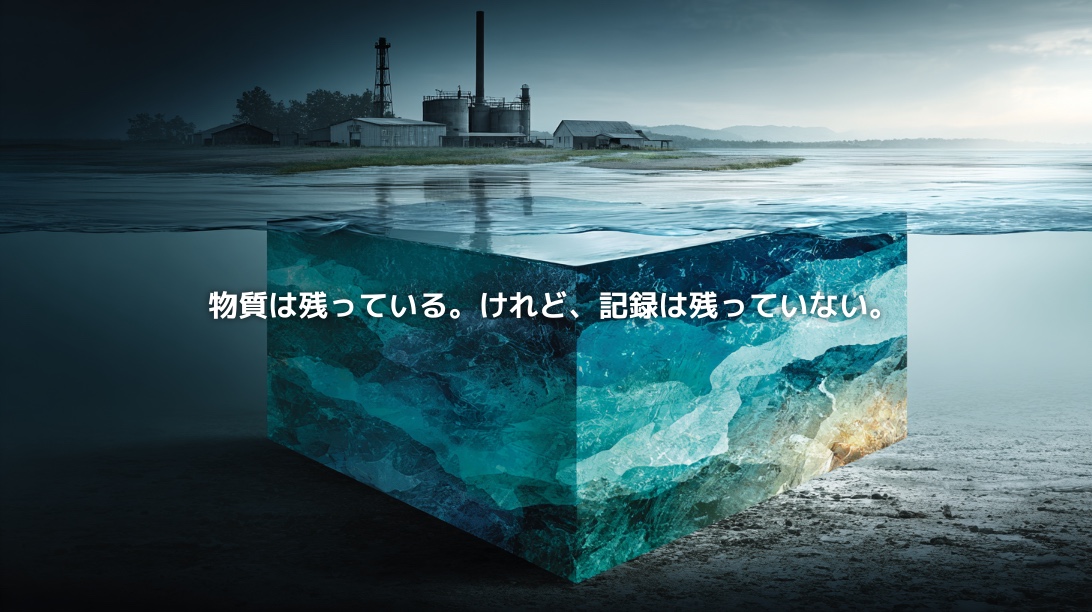
The chemicals remain.
The records do not.
This gap in time makes it much harder to determine the cause.
There May Be More Than One Source
A single region may contain several potential sources.
A factory may be located upstream, while a fire station or waste-treatment facility stands elsewhere. Land that is now residential may previously have been farmland, vacant property, or an industrial site.
PFAS may have entered the environment from different places at different times and later mixed underground.
The ratio between PFOS and PFOA—and the broader composition of other PFAS compounds—may provide clues about the source.
However, chemical formulations differ according to product, purpose, and period. Their composition may also change as the compounds move through the environment.
A high concentration of a particular compound cannot automatically be linked to a specific use or facility.
Chemical analysis is one form of evidence that can help narrow the possibilities. By itself, however, it may not be sufficient to identify the responsible party.
Current Accidents Can Be Addressed, but Past Releases Are Harder to Trace
In February 2023, PFOS and PFOA were added to the list of “designated substances” under Japan’s Water Pollution Control Act.
If an accident occurs at a facility that manufactures, stores, uses, or treats these substances—and water containing PFOS or PFOA may enter a public water body or seep underground—the operator is required to implement emergency measures and notify the prefectural governor.
This is an important system for preventing new contamination.
Some groundwater pollution being discovered today, however, may originate from releases that occurred before these regulations existed.
The date of release may be unknown.
The amount discharged may be unknown.
The company responsible at the time may no longer exist.
Several causes may overlap.
Under these conditions, a regulatory system designed to respond to present-day accidents cannot easily reconstruct contamination that began decades ago.
How Should the Missing Link of Soil Be Investigated?
Soil investigation is essential when tracing the path of groundwater contamination.
When PFAS are used or spilled on the surface, some may travel underground with rainwater while some remain attached to soil.
Soil can therefore form the link between a historical release and present-day groundwater contamination.
In Japan, the monitoring of PFOS and PFOA in groundwater and public water bodies has progressed faster than research into their distribution and movement through soil.
Knowledge in this area is still being accumulated.
The Ministry of the Environment has informed local governments about provisional measurement methods for PFOS, PFOA, and PFHxS in soil and continues to gather information on appropriate investigation techniques.
Groundwater testing alone may not reveal where PFAS originally entered the ground.
Water, soil, geology, and land-use history must be investigated together before the underground path of contamination can become visible.
Drinking-Water Protection Cannot Wait for the Source to Be Identified
Determining the source can take a long time.
If residents are drinking well water, however, authorities cannot wait until the source has been conclusively identified before taking action.
The Ministry of the Environment’s response guidelines emphasize preventing exposure through drinking water when the target value is exceeded.
Information should be shared with the regional water utility. People using drinking-water wells should be encouraged to switch to public tap water or another safe source.
Nearby drinking-water wells should be investigated as a priority to determine the extent of contamination. Continuous monitoring and source investigations can then proceed.
This sequence is important.
An unknown source does not mean that no protective action can be taken.
Efforts to identify the source and measures to protect residents must proceed in parallel.
Who Pays When the Responsible Party Cannot Be Identified?
Responding to PFAS contamination is expensive.
Costs may include:
- Water-quality testing
- Installation of observation wells
- Groundwater-flow analysis
- Soil investigation
- Alternative water supplies
- Water treatment using activated carbon or other technologies
- Proper disposal of used adsorbent materials
The wider the investigation becomes, the greater the financial burden.
If the responsible company can be clearly identified through scientific and legal evidence, it may be possible to require that company to bear the cost of remediation.
When the source remains unknown, local governments and water utilities may have to finance the response through public funds or water charges.
Owners of private wells may also be forced to pay for testing and secure alternative water supplies themselves.
The question extends beyond ordinary water-quality management.
Who should investigate, remove, and pay for environmental burdens left by past industrial activity?
The inability to identify the source also means an inability to assign responsibility.
Suspicion and Proof Must Be Kept Separate
Public concern about PFAS contamination must be taken seriously.
At the same time, authorities and the media must distinguish between what has been scientifically confirmed and what remains a hypothesis.
The following statements describe different facts:
- A nearby facility may once have used PFAS
- PFAS has been confirmed inside that facility
- PFAS has been detected in surrounding groundwater
- The facility is the source of the groundwater contamination
These statements are not interchangeable.
Declaring a facility responsible based only on its presence may interfere with an accurate investigation.
Yet repeatedly stating that “causation has not been confirmed” cannot be used as an excuse to delay disclosure or necessary investigation.
A responsible approach must do both: investigate plausible sources and avoid drawing conclusions before sufficient evidence has been collected.
Searching for the Source Means Recovering the Memory of the Land
A PFAS source investigation cannot be completed by examining a present-day map.
Investigators may need to:
- Analyze groundwater movement
- Test multiple wells
- Examine the soil
- Review historical aerial photographs and residential maps
- Trace the operating history of factories and other facilities
- Search for chemical-purchasing and accident records
- Interview people who formerly worked at the site
This is an effort to reconstruct how the land was used, which substances were brought there, and where those substances were eventually discharged.
Facilities above ground change over time.
Factories close and become vacant land, housing developments, or commercial properties. Company names change. Landowners change. The roles of administrative organizations also change.
Groundwater, however, can preserve traces of the past.
PFAS reveals what society used in pursuit of convenience, what it failed to document, and what it left beneath the ground.
The Responsibility to Find—and the Responsibility to Record
Preventing PFAS contamination from becoming a burden for future generations requires more than responding after a source has been identified.
Society must:
- Identify locations where PFAS are currently stored or used
- Record accidents and leaks and share that information promptly
- Preserve chemical-use histories even when land use or facility ownership changes
- Share water and soil investigation results across municipal and prefectural boundaries
Contamination does not disappear when the records are lost.
Instead, the chemicals remain while the evidence needed to determine responsibility disappears.
Where did the PFAS come from?
Answering that question requires more than measuring the movement of water.
We must preserve the history of the land, investigate both inside and outside potential source facilities, connect information held by governments and businesses, and patiently reconstruct causal relationships over long periods.
Finding invisible contamination is one responsibility.
Preserving today’s information so that future generations do not have to repeat the same search is another.
That, too, is part of society’s responsibility in confronting the PFAS problem.
References
- Ministry of the Environment, Japan: Information on Per- and Polyfluoroalkyl Substances (PFAS)
- Ministry of the Environment, Japan: Guidelines for Responding to PFOS and PFOA, Third Edition
- Ministry of the Environment, Japan: PFAS Handbook
- Ministry of the Environment, Japan: Future Policy Direction for PFAS
- Ministry of the Environment, Japan: Cabinet Order Partially Revising the Enforcement Order of the Water Pollution Control Act
- Ministry of Defense, Japan: Results of Water-Quality Surveys of Dedicated Firefighting-System Tanks at Self-Defense Forces Facilities
- Ministry of Defense, Japan: Completion of Treatment of Water in Dedicated Firefighting-System Tanks at Self-Defense Forces Facilities
This article is based on information publicly available as of July 2026.