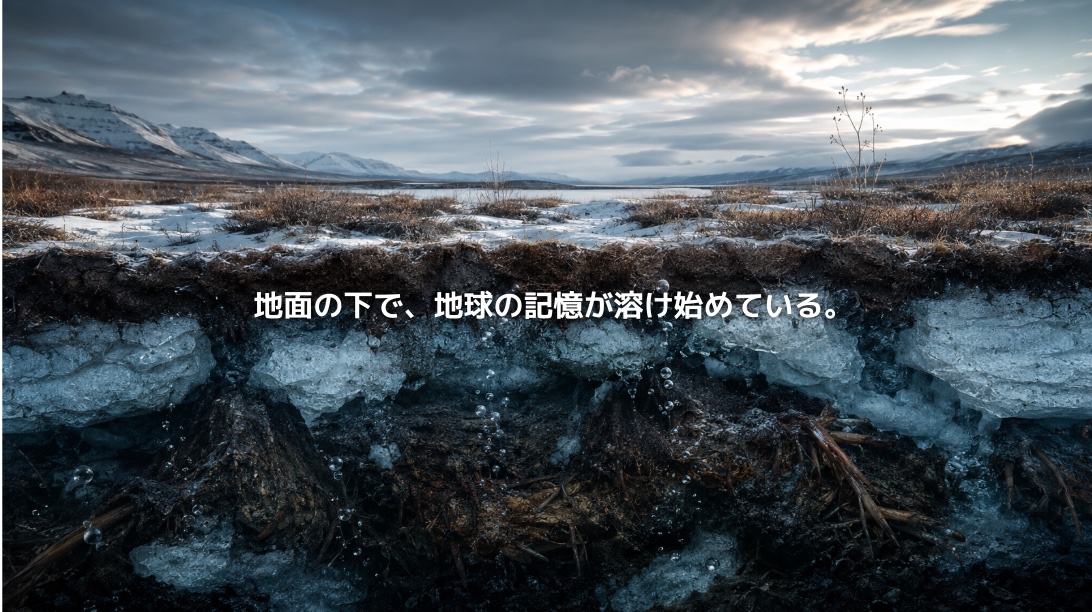
The Arctic ground lies silently frozen.
Snow and ice.
Tundra grasslands.
A low, expansive sky.
A white horizon stretching into the distance.
It appears to be a world of extreme cold, far removed from human life.
Yet beneath that frozen ground lies an immense archive—one that is deeply connected to the Earth’s climate.
It is called permafrost.
Permafrost is ground that remains frozen for an extended period of time. It is found across the Arctic and in other cold regions, including high mountain areas.
Locked inside it are the remains of plants, animals, and other organic matter that froze thousands or even tens of thousands of years ago.
In other words, permafrost is not simply frozen soil.
It is also an enormous reservoir of carbon accumulated from past life.
NASA explains that Arctic permafrost contains vast amounts of carbon, some of which could be released into the atmosphere as carbon dioxide and methane.
As the planet warms, this frozen ground is beginning to thaw.
When it does, previously trapped organic matter begins to decompose, releasing carbon dioxide and methane into the atmosphere. Methane remains in the atmosphere for less time than carbon dioxide, but it has a much stronger warming effect over shorter timescales.
The process creates a dangerous cycle:
Global warming thaws permafrost.
Thawing permafrost releases more greenhouse gases.
Those gases intensify warming.
It is almost as though the Earth has begun to warm itself further.
The thawing of permafrost is not only a story about the distant Arctic.
It is a problem that concerns the climate system of the entire planet.
What Is Permafrost?
Permafrost refers to ground that remains frozen for a long period of time.
Even where there is no visible snow or ice at the surface, the soil beneath may still be frozen.
Permafrost is widespread across the Arctic tundra, Siberia, Alaska, northern Canada, and high-altitude regions.
It contains more than ice. It is a mixture of soil, sand, rock, organic matter, and microorganisms.
At first glance, it may seem like a world suspended in time.
But permafrost is also a place where earlier ecosystems have been preserved.
In cold environments, dead plants and animals do not always decompose completely. Their remains stay within the frozen soil, allowing carbon to accumulate over long periods.
Permafrost is like the Earth’s freezer.
But the power to that freezer is beginning to fail.
Temperatures rise.
Surface snow and ice change.
The layer that thaws each summer grows deeper.
The ground subsides.
Lakes and wetlands form.
Carbon dioxide and methane are released.
Carbon from the past, once held beneath the ground, returns to the atmosphere of the present.
That is the central danger of permafrost thaw.
Why Is Thawing Permafrost a Problem?
The thawing of permafrost can be difficult to recognize by sight.
Compared with images of collapsing icebergs or cities flooded by rising seas, changes in frozen soil appear less dramatic.
Yet the transformation proceeds quietly.
The ground gradually softens.
Roads buckle.
Building foundations become unstable.
Lakes expand.
Wetlands spread.
Carbon once trapped underground begins to move.
NASA has also warned that thawing permafrost may release microorganisms and chemical substances into the surrounding environment. Permafrost is not merely ice; it is a complex environment that has stored many different materials over long periods of time.
Even more important is the climate feedback it may create.
Efforts to slow global warming generally focus on reducing carbon dioxide and methane produced by human activity.
Coal, oil, and natural gas.
Cars.
Power generation.
Factories.
Agriculture.
Waste.
Reducing these human-caused emissions remains essential.
But when permafrost thaws, additional greenhouse gases may be released by natural systems, even though humans are not emitting them directly at that moment.
The warmer the planet becomes, the easier it may be for the Earth itself to release more greenhouse gases.
That is what makes the problem so alarming.
Environmental crises are difficult not only because of what humans do, but also because of the natural responses our actions can set in motion.
Methane: An Invisible Gas
Methane is one of the gases receiving particular attention in discussions of permafrost thaw.
It has a shorter atmospheric lifetime than carbon dioxide. Over shorter timescales, however, its warming effect is far more powerful.
Methane is especially likely to form when organic matter decomposes in oxygen-poor environments, such as the bottoms of wetlands and lakes.
Permafrost thaws.
The ground subsides and water collects.
Wetlands and lakes form.
Microorganisms break down the organic matter that had been frozen.
Methane is produced.
NASA has reported that northern permafrost regions are already affecting near-term global warming, with methane playing an important role in that process.
Methane cannot be seen.
It does not appear before us like smoke rising from a chimney.
But satellites, aircraft, and ground-based instruments can detect its release.
An invisible gas emerges from beneath ground that is itself hidden from view.
The permafrost crisis is, in many ways, a convergence of unseen processes.
When Frozen Ground Collapses
As permafrost thaws, the ground itself changes.
Frozen soil contains ice. When that ice melts, the land can sink, collapse, and take on a different shape.
This affects infrastructure as well.
Roads.
Homes.
Pipelines.
Airports.
Communications facilities.
Entire settlements.
Life in cold regions has, in part, been built upon frozen ground. When that foundation becomes unstable, maintaining buildings and roads becomes increasingly difficult.
Permafrost thaw is therefore not only a climate-system issue. It directly affects the lives of people who live across the Arctic.
Changes to the land also reshape ecosystems.
Sunken ground becomes wetland.
Lakes expand.
Water flows in new directions.
Plant communities change.
Animals alter their migration routes and feeding grounds.
When frozen ground thaws, more than the scenery changes.
The basic conditions that have supported local communities, ecosystems, and infrastructure begin to shift as well.
The Arctic Is Not So Far Away
For those of us living in Japan, permafrost may seem like a distant concern.
Siberia.
Alaska.
Northern Canada.
The Arctic Circle.
On a map, these places are far away.
But the climate is connected.
Greenhouse gases released in the Arctic mix into the atmosphere of the entire planet. Arctic warming is also linked to changes in sea ice, ocean currents, atmospheric circulation, and extreme weather.
In a broader sense, it is connected to Japan’s extreme summer heat, heavy rainfall, rising sea temperatures, and the pressures facing agriculture and fisheries.
Environmental problems may appear to belong to separate places. In reality, they exist within one vast planetary cycle.
Forests store water.
Rivers carry sediment to the sea.
Oceans absorb heat.
Ice reflects sunlight.
Soil stores carbon.
The atmosphere transports heat.
Within this cycle, permafrost has helped keep carbon locked away.
That seal is now beginning to weaken.
When Arctic ground thaws, the Earth’s climate memory begins to move.
When a Result of Warming Becomes a Cause of Warming
The danger of permafrost thaw lies in the fact that it is both a result of global warming and a potential cause of further warming.
Temperatures rise.
Permafrost thaws.
Carbon dioxide and methane are released.
The greenhouse effect intensifies.
Temperatures rise further.
This type of cycle is known as a climate feedback.
NASA has warned that carbon released from permafrost could accelerate future warming.
Of course, not all the carbon stored in permafrost will be released at once the moment the ground begins to thaw.
There is uncertainty about both the amount and the speed of future emissions. Conditions also vary from one region to another. Some places become wetter, while others become drier. Carbon may be released as carbon dioxide in one setting and as methane in another.
That is why scientific research and continued observation matter.
Fear alone does not help us understand the problem.
Permafrost should not be reduced to a simplistic image of a “climate time bomb.” It must be studied carefully as part of the Earth’s complex carbon cycle.
Uncertainty is not a reason to ignore the danger.
It is precisely why we must observe it closely and work to limit further warming.
Time Beneath the Ground
A great span of time sleeps within permafrost.
Plants from centuries ago.
Organic matter from thousands of years ago.
Traces of ecosystems dating back to the end of the Ice Age.
Carbon accumulated across frozen landscapes.
These things survived because the ground remained frozen.
Soil holds memory.
Forest soils, rice paddies, wetland mud, and seabed sediments all contain the remains of earlier life.
Permafrost is one of the largest archives of that memory.
As the planet warms, that memory begins to return to the atmosphere.
This is not merely a scientific matter.
The energy we use.
The way we travel.
The design of our cities.
Food production.
Mass consumption.
The speed of the economy.
Together, these forces warm the planet and awaken carbon that had been locked beneath the ground.
The environmental crisis is also a crisis in which human actions in the present disturb the memories of the Earth’s distant past.
How Do We Imagine What We Cannot See?
Permafrost is largely invisible in our everyday lives.
We cannot pick it up like litter on a beach.
We cannot easily see it like a concrete riverbank.
Nor do we often encounter it in news footage the way we might see a bear wandering into a town.
That is why imagination matters.
We must imagine carbon beneath the ground.
Frozen soil beginning to thaw.
Microorganisms decomposing organic matter.
Invisible gases entering the atmosphere.
And those changes connecting to the climate of the entire planet.
Problems that cannot be seen are easily left unnoticed.
Yet many of the Earth’s environmental changes are unfolding beyond our immediate view.
Rising ocean temperatures.
Soil degradation.
Groundwater depletion.
Greenhouse gases in the atmosphere.
Ocean acidification.
Thawing permafrost.
How can we give visible language to invisible change?
That is one of the central challenges of communicating environmental issues.
It is also what NEOTERRAIN Journal seeks to explore:
The systems hidden behind beautiful landscapes.
The dangers contained within quiet change.
The paths that connect distant problems to our everyday lives.
Permafrost lies at the heart of all three.
Can We Cool the Earth’s Failing Freezer Again?
Completely stopping permafrost thaw will not be easy.
Warming is already underway.
The Arctic is already changing.
In some regions, the ground is thawing and the landscape is being transformed.
But that does not mean nothing can be done.
We can reduce greenhouse gas emissions.
We can reduce our dependence on fossil fuels.
We can protect forests and wetlands.
We can cut methane emissions.
We can continue monitoring the Arctic.
We can strengthen adaptation measures for communities affected by climate change.
Reducing human-caused greenhouse gas emissions can limit the additional pressure placed on permafrost.
Once thawed, permafrost cannot quickly return to its former state.
That is why preventing further thaw matters.
The Earth’s freezer becomes far more difficult to repair after it begins to fail.
Frozen ground teaches us that environmental change often comes with a delay.
The full impact of the greenhouse gases emitted today will not appear immediately. Over time, however, their effects accumulate in the atmosphere, the oceans, the ice, and the soil.
Then, one day, a response emerges from a place we could not see.
Protecting the Memory of the Earth
Permafrost lies beneath the distant Arctic.
But it is part of the vast system that supports the Earth’s climate.
Past life sleeps within the frozen soil.
Its carbon has remained locked away.
As the planet warms, that carbon is beginning to return to the atmosphere as carbon dioxide and methane.
It is as though the Earth’s memory itself is beginning to thaw.
The day permafrost thaws is not a problem for the Arctic alone.
It is a day when carbon beneath the ground begins to move, invisible gases mix into the atmosphere, and the planet may be pushed toward still greater warming.
We cannot hear the ice melting beneath the soil.
We cannot hear microorganisms breaking down carbon underground.
We cannot see methane rising into the sky.
But precisely because these changes are invisible, we must learn to imagine them.
To think about environmental problems is not only to look at the landscape before us.
It is also to translate unseen changes into the language of everyday life.
Permafrost has preserved the Earth’s past.
To keep its seal from weakening further, we must reconsider how we live in the present.
The carbon sleeping beneath the ground is not merely a story from the distant Arctic.
It is the memory of the Earth—and it is connected to the climate of our future.
References
- NASA, “Thawing Permafrost Could Leach Microbes, Chemicals Into Environment”
- NASA, “NASA Helps Find Thawing Permafrost Adds to Near-Term Global Warming”
- NASA Science, “Far Northern Permafrost May Unleash Carbon Within Decades”
- NASA Science, “Unexpected Future Boost of Methane Possible from Arctic Permafrost”
- NASA, “Arctic Shifts to a Carbon Source Due to Winter Soil Emissions”
Permafrost thaw is not only a problem of the distant Arctic.
When carbon that has slept beneath the ground begins to move, it affects the planet’s climate, oceans, forests, and ultimately our own lives.
NEOTERRAIN Journal will continue to explore the environmental changes hidden behind beautiful landscapes.
If this article gave you a new perspective on the Earth’s future, please bookmark it and return whenever you want to think about the connections beneath the surface.