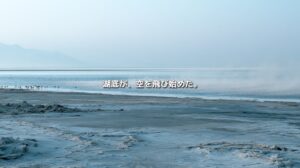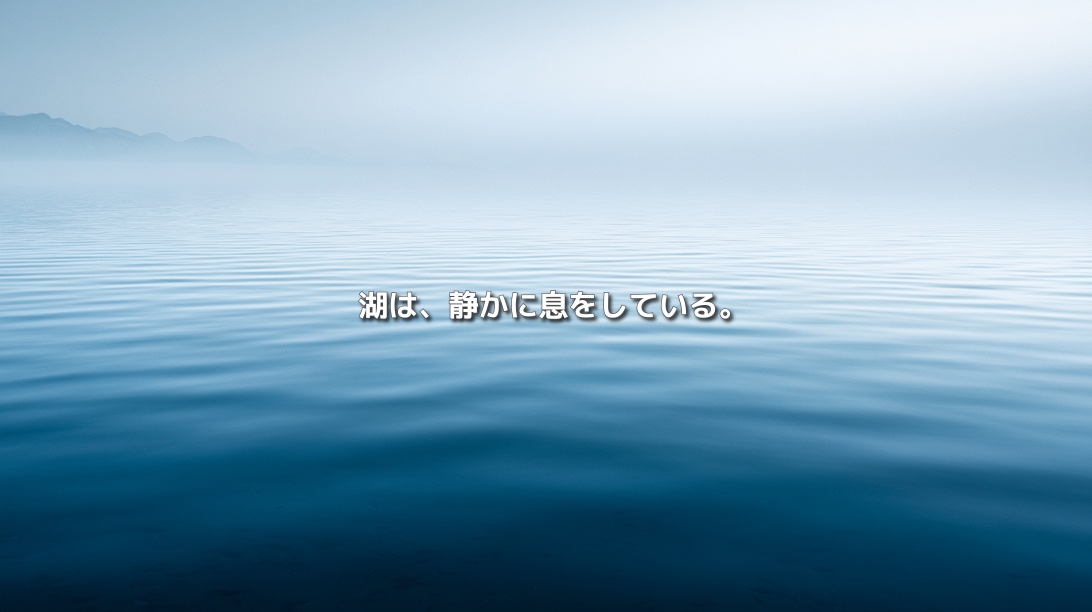
On a winter morning, mist settles over the shore of Lake Biwa. The distant mountains fade into white, and the still water seems almost asleep.
Beneath the surface, however, a movement vital to the lake’s life is beginning.
Cold air cools the surface water. As it becomes denser, it sinks, helping water from different depths mix. Oxygen carried from the surface can then reach the lakebed. This process is known as full-depth circulation—sometimes described as the lake’s “deep breath.”
But if winters grow warmer and the surface does not cool enough, that breath may weaken. The lake can look unchanged from the shore while oxygen declines in its deepest waters.
A lake divided by the seasons
From spring into summer, sunlight warms Lake Biwa’s surface. Warm water remains above colder, denser water, creating a boundary called a thermocline, where temperature changes sharply with depth.
In the lake’s northern basin, surface temperatures can approach 30°C in midsummer while water below a depth of 20 metres remains around 10°C. The upper and lower layers then mix only with difficulty.
Oxygen enters the surface water through contact with the air and through photosynthesis. Below the thermocline, that supply is limited. Meanwhile, microorganisms break down organic matter sinking to the lakebed, and fish and other organisms continue to breathe. Through summer and autumn, oxygen in the deep water is gradually consumed.
Winter changes the balance. Surface water cools and sinks; wind helps stir the lake. When the temperature difference between the layers becomes small enough, water can mix down to the lakebed, about 90 metres below the surface in the deepest areas. This carries oxygen to places that have been cut off for months.
Why a cold winter matters beneath the surface
We often think of severe winter weather as something to endure. For Lake Biwa, winter cold helps deliver oxygen to life on the lakebed.
If surface water does not cool sufficiently, it is less able to sink and mix with deep water. Full-depth circulation may occur late or fail to reach the bottom. The lake can then enter spring without replenishing oxygen in its deepest waters.
As the water separates into layers again during warmer months, the deep layer may remain isolated for an extended period. Oxygen consumption continues, adding to any shortage left from the previous year.
Climate change does more than raise the lake’s temperature. It can alter when the water moves and how strongly the surface and lakebed remain connected.
When Lake Biwa’s deep breath failed
Full-depth circulation was not confirmed in Lake Biwa’s northern basin in 2019 or 2020. These were the first recorded years in which the process did not complete, followed by a second consecutive year without completion.
In 2020, water near the deep lakebed remained without oxygen for approximately three months. Effects were observed among creatures living near the bottom, including isaza gobies and amphipods.
Lake Biwa is an ancient lake with a history stretching back roughly four million years. Its ecosystems include species found nowhere else. Some live in the dark, deep waters that people rarely see.
A failure of full-depth circulation does not mean the entire lake immediately loses its ability to support life. For organisms near the lakebed, however, losing an annual supply of oxygen changes the conditions on which their survival depends.
What happens when oxygen disappears?
Low oxygen affects more than respiration. It can also change the chemical reactions between lakebed sediment and the water above it.
If oxygen-free conditions persist, substances such as phosphorus and manganese may be more readily released from the sediment. Phosphorus is a nutrient for phytoplankton. If nutrients accumulated in deep water later reach the surface, they may affect the lake’s biological productivity and water quality.
A change in circulation therefore does not remain a problem confined to the lakebed. Oxygen, aquatic life, nutrients and water quality are connected through the movement of water.
A return of circulation does not end the concern
Full-depth circulation does not fail every year. On 10 February 2026, a survey confirmed that it had completed in the first basin of northern Lake Biwa. Dissolved oxygen near the lakebed recovered to around 10 milligrams per litre. Cold weather and strong winds from January to early February are thought to have helped mix the water.
Yet low oxygen had persisted near the lakebed since the previous September. Later surveys found dead isaza gobies and freshwater shrimp, while an underwater robot also observed living individuals. Shiga Prefecture assessed the observed impact as limited.
A single winter cannot establish that the lake is permanently safe or permanently at risk. Air and water temperatures, wind, precipitation and organic matter entering the lake all influence oxygen conditions at depth. The recovery observed in 2026 was welcome. The earlier failures remain a warning that incomplete circulation is already an observed reality.
Clean water alone cannot protect the lake
Discussions about lake health often focus on pollutants and nutrients entering from factories, households and farmland. Reducing those pressures remains essential.
But a changing climate also affects what happens inside the lake. Even if the same amount of organic matter enters the water, warmer temperatures and a longer period of seasonal layering can extend the time during which oxygen is consumed in the deep layer. A milder winter may then provide less opportunity to replenish it.
Protecting Lake Biwa requires continued efforts to reduce greenhouse gas emissions, alongside monitoring of water temperature, full-depth circulation, dissolved oxygen, aquatic life and substances released from lakebed sediment. These observations help reveal changes that cannot be seen from the shore.
The quiet surface tells only part of the story
A lake does not announce change like a rushing river. In years when its water mixes fully, and in years when it does not, the surface may reflect the same sky.
That is why the change is easy to miss. Stillness does not necessarily mean stability.
Winter air cools the water. Wind helps it mix. Oxygen reaches the dark lakebed, supporting life far below the view from shore. Lake Biwa’s “deep breath” is a reminder that climate, water, seasons and living things are bound together.
To protect the beauty we can see, we must keep watching what happens beneath the surface.
English adaptation of the original NEOTERRAIN Journal article. The original article cites observations and assessments by the Lake Biwa Environmental Research Institute and Shiga Prefecture. (neoterrainjournal.com)