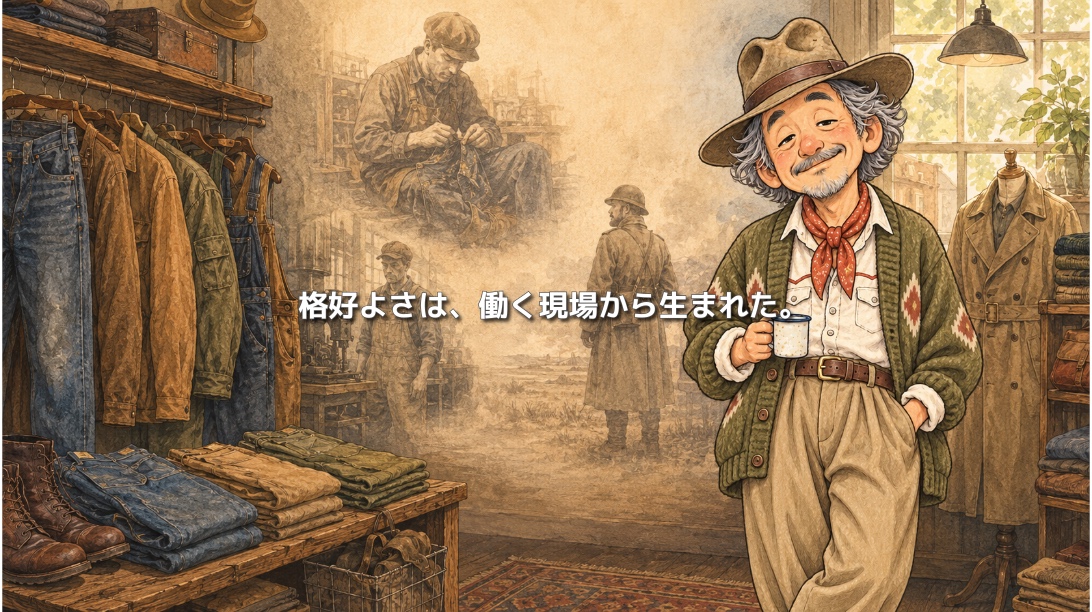
Walk through any city today, and you will encounter clothing that originated as workwear.
Faded denim. Cargo pants with oversized pockets. Heavy work jackets. Jumpsuits reminiscent of industrial coveralls. Trench coats originally designed to protect the body from wind and rain.
None of these garments looks unusual as fashion today.
Yet they were not originally created to make people look stylish.
They were designed to resist tearing, carry tools, protect the body from rain and mud, and make physical work safer and easier.
Their origins lie not in trends, but in the urgent needs of people working in factories, mines, farms, railways, ports, and military environments.
So why do we continue to wear clothes designed for labor—even after leaving the workplace behind?
Before Style, There Was Necessity
When we think about clothing as fashion, we tend to focus on color, shape, brands, and styling.
In workwear, however, every detail has a reason.
Heavy fabric protects the body from friction and dirt. Large pockets provide immediate access to tools. Metal buttons and rivets reinforce areas exposed to repeated strain.
Even the length of a sleeve, the position of a seam, and the shape of a fastening reflect careful consideration of how the body moves while working.
In other words, workwear was not born from decoration.
It emerged from the relationship between the worker’s body and the place where the work was performed.
Factories, mines, farms, railways, ports, and military sites all demanded different functions. Those needs gradually determined the forms that the clothing would take.
Denim Began with Pockets That Kept Tearing
Blue jeans, now worn around the world, were originally clothing for workers.
In 1873, tailor Jacob Davis and merchant Levi Strauss received a patent for reinforcing high-stress areas of trousers—particularly pocket openings—with metal rivets.
The idea arose from the need to make stronger trousers for laborers.
Workers crouched, lifted, pulled, and carried tools in their pockets. Repeated physical strain caused fabric to tear at the seams. Small pieces of metal were therefore added to vulnerable areas, strengthening the garment itself.
Today, rivets may appear to be decorative details. Originally, however, they were components designed to solve a practical problem in the workplace.
The fading of denim was not initially a calculated fashion effect either.
As people worked, washed their clothes, and exposed them to sunlight, distinctive marks appeared on each pair. Knees turned pale, lines developed across the thighs, and the outlines of objects carried in pockets became visible.
Time spent working was recorded on the surface of the fabric.
Because these textures could not be reproduced by a completely new garment, denim became more than simply a durable material. It became clothing that reflected the life of the person wearing it.
How Military Uniforms Entered the City
Many garments also moved from military use into everyday life.
The trench coat is one of the best-known examples.
Weather-resistant fabrics and coats developed in the late nineteenth century became widely used as military clothing during the First World War. Their design centered on allowing movement while protecting the wearer from rain and wind.
Shoulder straps, waist belts, and double-breasted front panels are now recognized as characteristic design features. Yet each originated from a functional requirement.
Clothing once needed on the battlefield later entered everyday life through cinema and urban culture.
The same is true of cargo pants, flight jackets, and field jackets.
They were designed to carry equipment, identify personnel, protect the body, and adapt to changing weather conditions.
Clothing originally intended to show membership in an organization eventually became a means of expressing individual style in the city.
There is a curious reversal here.
Uniforms were created to suppress individuality and indicate belonging. Once those same forms entered everyday fashion, they began to communicate the wearer’s personality and values.
The garment remained the same, but its meaning changed with the place in which it was worn.
When “Clothes for Work” Became a Symbol of Rebellion
Youth culture also played an important role in transforming denim from workwear into fashion.
By the mid-twentieth century, young people in films and music were wearing jeans. Their appearance suggested distance from formal dress codes and the values of the adult world.
Young people deliberately chose clothing that society associated with labor.
That decision contained a subtle rejection of formality, class expectations, and established social norms.
The garment itself had not suddenly changed.
What changed was the person wearing it—and the place where it was worn.
Trousers once worn in mines and on farms appeared on cinema screens, were adopted by musicians and young people, and eventually became part of urban life.
Clothing designed for function became clothing that expressed an attitude.
Why Does Function Look So Good?
Workwear usually contains little unnecessary decoration.
Every form has a purpose, and every material performs a role. Its design is determined by the movement of the body and its relationship with tools—not by ornament whose function is unclear.
This sense of purpose is part of what makes workwear look compelling.
Objects made to be used tend to contain little hesitation.
Heavy fabric. Straight seams. Reinforced pockets. Scratches from use. Faded surfaces.
These elements possess a different kind of persuasiveness from that of more decorative clothing.
When workwear becomes fashion, some of its original functions may disappear. Pockets that are never used remain in place. Metal fittings that are no longer necessary become ornament.
Even so, the memory of the workplace remains embedded in the form.
Perhaps people wear not only the garment itself, but also the durability, rationality, and history that its design represents.
Workwear Also Carries an Idealized Image of Labor
Wearing workwear as fashion is not the same as performing the labor for which it was originally designed.
A new work jacket displayed in a shop and a jacket worn for years on a job site do not carry the same history.
Through workwear, we may perceive qualities such as durability, honesty, ruggedness, and independence. Yet behind that image lie sweat, dirt, danger, and physical strain.
Fashion sometimes removes the hardship of labor and presents only its attractive surface.
That is why, when looking at workwear, we should consider more than the beauty of its form.
Who wore it? Where was it worn? What purpose did it serve?
Understanding the history behind clothing also means recognizing the people who worked in it.
Clothing Born in the Workplace Lives On Beyond It
Workwear was created with a purpose.
To resist tearing.
To keep the body dry.
To carry tools.
To make labor safer.
But when those garments left the workplace, they acquired new meanings.
Workers’ clothing became a symbol of youthful rebellion. Military clothing became urban style. Factory coveralls appeared on runways as relaxed, contemporary silhouettes.
The original meanings did not disappear.
New generations simply layered their own meanings over them.
Perhaps workwear looks good not only because its shapes are well designed.
It looks good because it was born in response to someone’s genuine need. Because the memory of the working body remains in its form. And because each new era has found a different way to interpret it.
Style does not emerge from nowhere.
Behind every piece of workwear worn in the city, there is still a workplace somewhere.
“You know, style usually begins with something somebody genuinely needed.”
— Uncle Patch
Frequently Asked Questions
What is workwear?
Workwear is clothing designed primarily for physical labor or professional tasks. It often features durable materials, freedom of movement, pockets for carrying tools, and reinforcement in areas exposed to heavy wear.
Why were jeans originally created as workwear?
Workers in mines, farms, and other physically demanding environments needed highly durable trousers. In 1873, Jacob Davis and Levi Strauss patented a method of reinforcing pocket openings and other stress points with metal rivets. This innovation contributed to the development of the durable work trousers that became modern blue jeans.
Was the trench coat really a military garment?
Weather-resistant coats that led to the modern trench coat were developed in the late nineteenth century and used as military clothing during the First World War. Designed to protect soldiers from wind and rain while allowing movement, the coat later spread into civilian life through cinema and fashion.
Why is military clothing incorporated into fashion?
Military garments are designed with clear practical purposes, including durability, storage, warmth, protection, and identification. Their rational construction and materials are often interpreted in everyday fashion as strength and functional beauty. Designers and cultural movements have repeatedly reimagined these forms.
What does it mean to wear workwear as fashion?
Wearing workwear as fashion means embracing not only its durability and functional beauty, but also the cultural ideas associated with labor, independence, rebellion, and practicality. At the same time, it is worth remembering that these garments emerged from the history of real work and the people who performed it.
References
- Levi Strauss & Co., “The History of Denim”
- Levi Strauss & Co., “Pockets Full of History”
- Imperial War Museums, “Trench Coat: From Field to Fashion”
- Museum at FIT, “Beyond Utility”
- Victoria and Albert Museum, “7 Fashion Designs That Changed the World”