Alpine Water, a Historic Castle, and Generations of Learning, Craft, and Music
NEOTERRAIN Journal | Intellectual Travel #08 | Matsumoto, Nagano
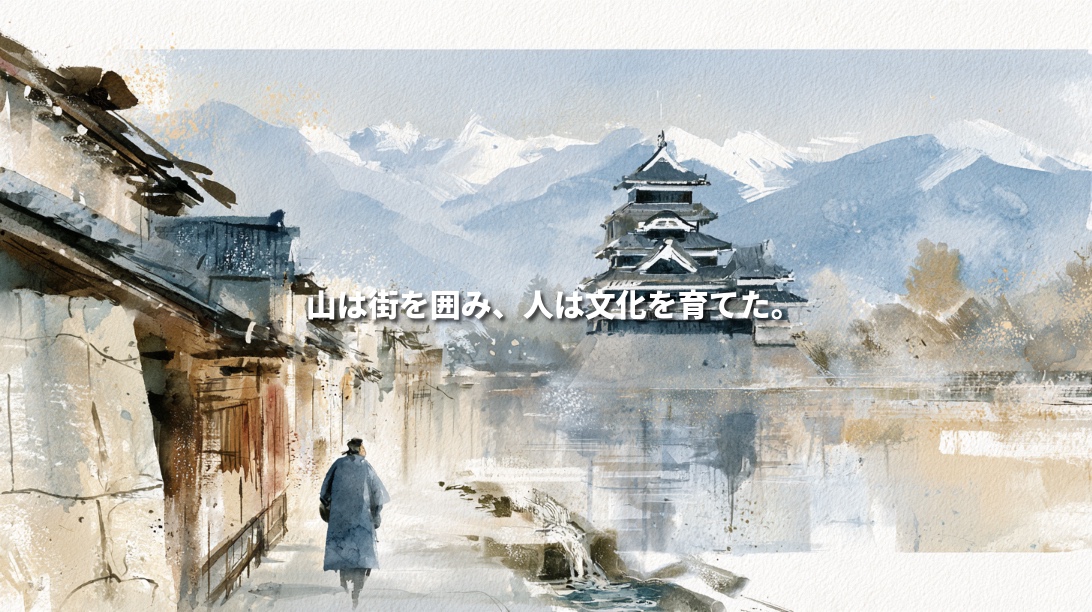
Morning light falls on the black castle keep.
The sky reflects in the moat. Beyond it, mountain ridges still carrying snow stretch into the distance.
Matsumoto Castle.
Looking up, the castle and the Northern Japan Alps behind it seem to belong to one continuous landscape.
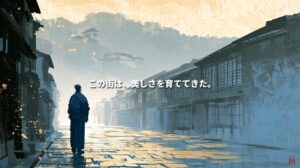
Walk into town, and you find streets lined with old storehouse buildings. Down a lane, clear water flows quietly from a well.
A little farther away stands a school whose architecture recalls Japan’s first encounters with Western building styles.
In summer, musicians arrive from around the world.
A castle. Water. Education. Crafts. Music.
These seemingly separate things share a life within this city.
How did Matsumoto develop such varied cultural traditions?
The mountain scenery alone cannot explain it.
Living among mountains has always brought difficulties, including the movement of people and supplies.
Yet people built a town here, developed businesses, established schools, and sustained the arts.
Following Matsumoto’s history reveals how geography shapes everyday life—and how people, through that life, create culture. neoterrainjournal.com
01 | Did the Mountains Keep Matsumoto Apart?
Matsumoto lies in the Matsumoto Basin, near the center of Nagano Prefecture.
The Northern Japan Alps rise to the west. To the east, mountain country extends toward the Utsukushigahara Highlands.
Seen on a map, the city might appear enclosed.
Its history tells a more connected story.
People traveled through valleys, crossed passes, and established roads.
Matsumoto became an important point within the routes linking different parts of Shinano, the historical province that largely corresponds to present-day Nagano.
The Zenkōji Kaidō passed through the castle town, supporting local commerce.
Mountains make travel difficult. They also influence where people can travel.
Where routes converge, people and goods may gather.
Geographical constraints can therefore help give a place its role, depending on how people respond to them.
Matsumoto developed through the routes people found between the mountains.
02 | Why Was a Castle Built in This Basin?
Matsumoto Castle is the city’s defining landmark.
The contrast of black and white across its keep. Stone walls reflected in water. Mountains rising behind it.
Today, these elements form a celebrated view.
The castle’s origins, however, lie in political conflict and defense.
During the Sengoku period, this region became a setting for struggles over control of Shinano.
Fukashi Castle, the predecessor of Matsumoto Castle, served as an important stronghold.
Later, under Toyotomi rule, Ishikawa Kazumasa and his son Yasunaga developed the castle and its surrounding town.
The principal sections of the surviving keep are generally understood to date from this period.
Moats, samurai residences, merchant neighborhoods, and roads connecting with regional routes formed an urban structure serving government, defense, and commerce.
The castle helped organize the city around it.
People gathered. Supplies arrived. Work developed.
Daily life expanded through those relationships.
Parts of central Matsumoto still carry traces of the castle town’s street patterns and divisions.
Looking beyond the keep, we begin to see the framework of a place where people lived and worked.
03 | Mountain Water Runs Through Everyday Life
Walking through Matsumoto, you become aware of water.
Wells and springs appear along ordinary streets and quiet lanes.
The surrounding mountains enter the city’s daily life through its water.
Rain and snow infiltrate the ground, replenishing groundwater that has long supported communities in the basin.
These waters follow different paths through the local terrain and geology. They do not all originate from a single mountain or underground source.
Together, they reveal the close relationship between the basin’s water cycle and its inhabitants.
For earlier generations, securing water was an essential part of living.
Drinking. Cooking. Washing. Working.
People used these water sources, cared for them, and passed responsibility for them to others.
A well makes the relationship between mountains and town tangible.
The mountains belong to more than the distant view. Their water is part of the household, the workshop, and the street.
Travel often draws our attention toward grand buildings and expansive scenery.
A city’s history also survives in smaller places.
The edge of a well. A hand drawing water. People stopping briefly before continuing on their way.
04 | Merchant Lives Behind Black-and-White Walls
A short walk from Matsumoto Castle brings you to Nakamachi Street.
Substantial storehouse buildings line the road. Their namako-kabe walls combine dark tiles with raised white plaster joints.
Pottery and craft objects appear in shopfronts.
Here, the commercial history of the castle town becomes visible.
Merchants and artisans lived alongside the samurai population, supporting the circulation of goods.
Commerce developed through the Edo period and into modern times.
The buildings also carry a history of fire and reconstruction.
Storehouse construction helped protect merchandise and property.
The walls we admire today embody practical knowledge developed by people who had experienced destruction and wanted to keep their businesses alive.
There is an interesting connection with Kurashiki.
In both towns, architecture serving commerce gradually acquired cultural significance.
Yet their industries and urban histories differ.
Similar-looking buildings can hold very different stories.
Learning to recognize those differences is part of the pleasure of travel.
Sometimes the beauty of a building includes the time people spent responding to hardship.
05 | Why Did Learning Matter to Matsumoto?
North of the castle stands another National Treasure: the former Kaichi School building.
Completed in 1876, it is an example of giyōfū architecture, a style in which Japanese builders interpreted Western architectural forms through local skills.
An octagonal tower rises above the roof.
Windows recall Western buildings, while distinctive ornament reflects Japanese carpentry.
The building records an attempt to understand an unfamiliar culture and give it form.
Its designer and builder was the local master carpenter Seijū Tateishi.
He drew on Western architectural ideas while working through Japanese building techniques.
In 2019, the former Kaichi School became the first modern school building in Japan to receive National Treasure designation.
Matsumoto thus holds two striking architectural expressions of different periods.
A castle associated with military power and government.
A school associated with education and modernization.
The city’s history did not move neatly from one to the other.
Even so, the buildings allow us to consider how social priorities changed.
The castle expressed authority.
The school expressed expectations for the future.
Both remain within Matsumoto’s landscape.
Buildings can help us understand what a community chose to value.
06 | Finding Beauty in the Things People Use
Another important part of Matsumoto’s cultural life is mingei, often translated as folk crafts.
The Matsumoto Folkcraft Museum holds vessels, furniture, and tools connected with everyday living.
The mingei movement encouraged people to recognize beauty in ordinary objects made for use.
A chair made for someone to sit on.
A bowl placed on a daily table.
A tool shaped by repeated handling.
Some qualities become apparent through living with an object: its balance, its texture, the way it fits the hand.
In Matsumoto, appreciation for such things has developed alongside crafts and local commerce.
Tarō Maruyama, who founded the Matsumoto Folkcraft Museum, helped establish that appreciation within the community.
Mingei invites us to consider value through an object’s relationship with daily life.
Why do we so often want to pick up a craft object while traveling?
Its appearance attracts us. It may be unfamiliar. It can hold the memory of a place.
Perhaps its weight and texture also offer a small encounter with the lives of people who made and used things here.
Culture lives quietly within the objects that accompany an ordinary day.
07 | Why Do Musicians from Around the World Gather Here?
Matsumoto is also known as a city of music.
One important expression of that identity is the Seiji Ozawa Matsumoto Festival.
The international festival began in 1992 under Seiji Ozawa and fellow musicians, originally as the Saito Kinen Festival Matsumoto.
Through orchestral concerts, opera, and related activities, it established a connection between this regional city and the wider world of classical music.
Geography alone cannot account for that development.
Behind a festival lie sustained decisions and work.
People organize performances.
Musicians rehearse and play.
Staff and supporters prepare venues.
Audiences come to listen.
Children encounter sounds that may remain with them for years.
Culture continues through those who make it possible and those who receive it.
The festival has created opportunities for internationally renowned artistry to meet local life.
A regional city can become a place people travel to for culture.
It can create its own reasons for the world to gather.
08 | What Does It Mean to Build an Identity Around the Mountains?
People come to Matsumoto for different reasons.
To visit the castle.
To climb in the Northern Japan Alps.
To travel toward Kamikōchi or the Norikura Highlands.
To browse small shops and discover crafts.
To listen to music.
These interests overlap within the same region.
Describing them simply as an abundance of tourism attractions can obscure the work needed to sustain them.
Mountain environments require care.
Historic buildings need maintenance and funding.
Cultural programs depend on organizers, participants, and continuing support.
Residents also need a city in which everyday life remains practical and fulfilling.
Matsumoto’s future therefore involves more than presenting its mountains beautifully.
It involves caring for the landscapes and lives that give the city its character.
A place’s identity develops through the ways its values are carried into another generation.
09 | After Walking Through Matsumoto, the Mountains Look Different
Return to the castle toward evening.
Beyond the black keep, the mountain outlines gradually soften.
Somewhere in the town, water is flowing.
Inside an old storehouse, someone is still doing business.
The school building holds traces of the children who once learned there.
At the Folkcraft Museum, objects made for daily life wait quietly.
When the festival season comes, music connects the city with places far beyond the basin.
The mountains have stood here through centuries.
Within their surroundings, people made choices.
They established roads, built a castle, used water, conducted trade, founded schools, and sustained the arts.
What can people create within the conditions a landscape gives them?
Matsumoto has been answering that question over generations.
On your next visit, look again at the mountains beyond the castle.
The view holds the history of a castle town, the lives of merchants, and memories of learning and art.
The mountains surrounded the city. Within them, people cultivated culture.
Understanding changes what we see.
Editor’s Note — NEOTERRAIN
Thinking about Matsumoto brought a question to mind.
Where does culture begin?
In a populous city?
In a wealthy region?
Where people and information gather easily?
Those conditions certainly influence cultural development.
Yet Matsumoto’s history reveals something more.
People chose to care for a castle.
They built a school and invested hope in education.
They recognized beauty in everyday objects.
They worked to bring world-class music to a regional city.
Each activity involved a decision about what mattered.
I think culture also grows through choices repeated in ordinary life.
Keeping an old building in use.
Taking care of water.
Making a tool that can serve someone for years.
Giving children an opportunity to encounter art.
Over time, such decisions become part of a place’s cultural character.
Matsumoto’s mountain setting is beautiful.
Within that beauty are generations of people who learned to live with their surroundings—and people who continue to sustain the city’s cultural life today.
Matsumoto stands among mountains.
Its cultural connections reach far beyond them.
The richness of a place also depends on what its people choose to nurture, and what they hope to leave.
NEOTERRAIN — Intellectual Travel
Engaging with complexity, without simplifying it away.
References and Further Reading
- Matsumoto City — History of Matsumoto Castle
- Matsumoto Castle — Exploring the Castle Town
- Visit Matsumoto — Wells and Springs
- Matsumoto City — Former Kaichi School National Treasure Designation
- Visit Matsumoto — History and Cultural Attractions
- Seiji Ozawa Matsumoto Festival
- Matsumoto Tourism and Convention Association