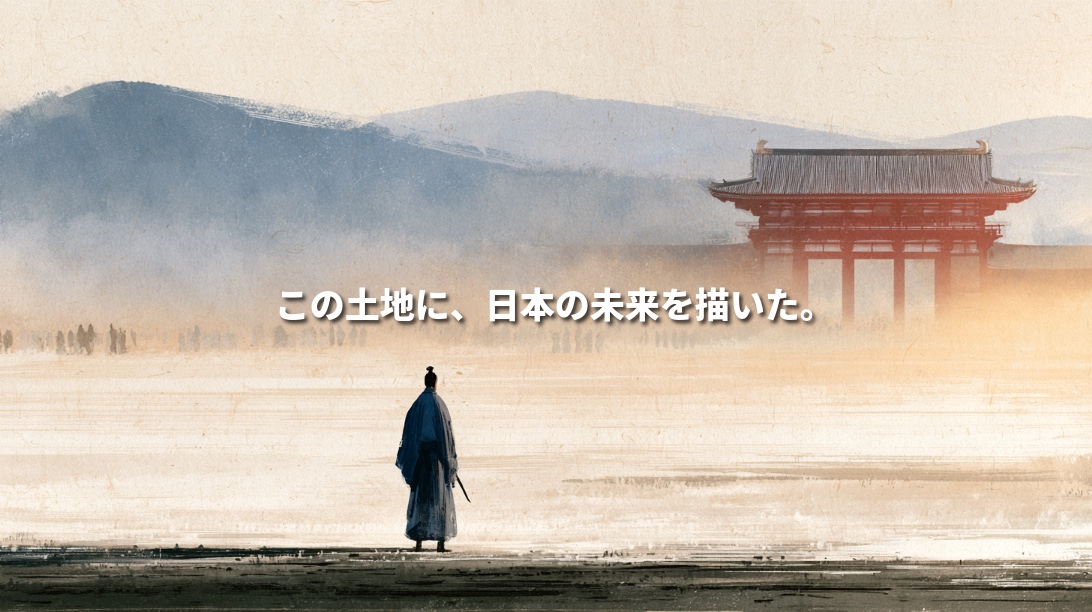
In a Basin Ringed by Mountains, a Nation Began to Take Shape
NEOTERRAIN Journal | Intellectual Travel #03 | Nara, Japan
Mornings in Nara are quiet.
Deer cross the streets before the crowds arrive. Temple roofs appear between the trees, with blue mountain ridges rising in the distance.
The wind passes through the leaves.
It feels as though more than a thousand years have settled gently into this city.
Yet Nara thirteen centuries ago was anything but quiet.
Earth was being dug. Timber was being hauled. Roads were taking shape. Officials hurried between offices, monks offered prayers, and knowledge and culture arrived from distant lands.
Here, people were trying to give physical form to a nation still being made.
In 710, Japan’s capital moved to Heijō-kyō, in present-day Nara.
This was more than a change in the emperor’s residence. It was an attempt to make answers to fundamental questions visible through the design of a city.
How should a country be governed?
What institutions could hold its people together?
And why was Nara chosen?
Walk through the city with that question in mind, and its deer, temples, and wide skies begin to mean something different. neoterrainjournal.com
01 | The Nara Basin: Where Geography Met Political History
The Nara Basin is an inland plain framed by the Yamato Highlands to the east, the Ikoma and Kongō ranges to the west, and mountains toward Yoshino to the south.
Rivers belonging to the Yamato River system run through it.
On a map, the basin appears as a distinct space held within the surrounding mountains.
For centuries, this region had been a center of political activity in Yamato, the heartland of Japan’s early state. Its plains supported agriculture, while rivers and routes through mountain passes connected it to neighboring regions.
Being surrounded by mountains did not mean being cut off from the world.
People and goods moved along waterways and across the passes. The basin was both an enclosed landscape and a place of connection.
Geography alone, however, cannot explain why a capital developed here.
Political authority had already taken root in Yamato, first around Asuka and later at Fujiwara-kyō. Networks of power, ritual, and influential families had accumulated over generations.
A place is shaped by more than its natural conditions. It also holds the time people have invested in it.
Heijō-kyō was built upon both.
02 | The Year 710: Designing a Capital, Imagining a Nation
In 710, under Empress Genmei, the capital moved from Fujiwara-kyō to Heijō-kyō, marking the beginning of the Nara period.
The new city reflected the influence of Chinese capital planning.
Suzaku Avenue ran north to south. Streets formed an orderly grid. The imperial palace occupied the northern part of the city.
Within this arrangement, we can read an ambition: to express the authority of the state through an ordered urban landscape.
Japan did not simply reproduce a Chinese city. Institutions and ideas from the continent were selected and adapted to local politics, geography, and society.
The result reflected deliberate choices about how the country should develop.
A state is made tangible through more than laws and government offices. Where people gather, how they move, and what stands at the center of their lives are also political questions.
Today, the sky above the Heijō Palace Site feels remarkably wide.
Grassland stretches across spaces where the machinery of government once operated. The reconstructed Suzaku Gate and Former Imperial Audience Hall stand within that openness.
People once converged here from across the country, drawn toward its political center.
Building a city meant giving an anticipated future a place on the ground.
The open space of the palace site quietly conveys the scale of that ambition.
03 | Suzaku Avenue: The Order Written into a Road
Suzaku Avenue extended south from Suzaku Gate, forming the central axis of Heijō-kyō.
It is thought to have been more than seventy meters wide.
Its purpose went beyond moving people and goods. The avenue made the city’s organization visible, directing attention toward the seat of government.
At the end of the road stood the political center.
The arrangement itself expressed authority.
Consider how this compares with Kyoto and Kamakura.
Heian-kyō, the capital established in what is now Kyoto, also adopted a planned urban structure organized around a central Suzaku Avenue.
In Kamakura, Wakamiya Ōji became an axis of the warrior city, leading toward Tsurugaoka Hachimangū Shrine.
A single road may run through each city, yet the political and religious worlds behind those roads differ.
Streets tell us what a society placed at its center.
Stand at Nara’s Suzaku Gate and look south. Beneath the peaceful landscape, it becomes possible to imagine the intention that once organized an entire capital.
04 | Why Build the Great Buddha? Where Prayer and Politics Met
Many visitors come to Nara to see the Great Buddha at Tōdai-ji.
Inside the immense Great Buddha Hall sits Vairocana Buddha, known in Japanese as Rushana-butsu.
Looking up, the human body feels very small.
Yet to see this only as an enormous religious monument is to miss the urgency of the world that produced it.
Eighth-century Japan experienced epidemics, social anxiety, and political upheaval.
Seeking stability through Buddhism, Emperor Shōmu promoted a nationwide network of provincial monasteries and convents. In 743, he issued an edict calling for the creation of a Great Buddha.
The undertaking required vast quantities of materials, specialized knowledge, and human labor.
Copper had to be gathered. Metal had to be cast. Buildings had to be constructed. Workers and supplies had to travel from distant regions.
The project brought together religious devotion, technical expertise, and the state’s ability to mobilize resources.
The Great Buddha embodied both a prayer and the collective capacities of its society.
But such an undertaking could hardly have meant hope alone for everyone involved.
Grand state projects also impose burdens.
Public faith and political intention, aspiration and hardship—all belong to the history of this statue.
When we stand before the Great Buddha, what are we looking up at?
An immense figure in bronze?
Or the human desire to hold a society together in an age of uncertainty?
05 | At the Far End of the Silk Roads: Nara’s Connections to the World
Nara is an inland city surrounded by mountains.
Its culture, however, developed through connections reaching far beyond them.
The treasures preserved in the Shōsō-in repository reveal influences from Tang China and, in their forms and decorative patterns, from regions farther west.
Musical instruments, textiles, vessels, and ornaments carry traces of exchange across great distances.
This does not mean that every treasure traveled directly to Nara from a distant country.
Some were made in Japan. Others incorporated designs and techniques that had arrived through wider cultural networks.
What matters is how Nara received those influences and gave them new forms.
Culture moves with people, objects, and skills. As it travels, it changes.
The beauty preserved in Nara’s temples and crafts grew within those exchanges.
Nara is sometimes described as the eastern end of the Silk Road.
The phrase is symbolic, but it captures something meaningful: cultural currents from across a vast world found new expression in this basin.
The mountains enclosed the landscape. They did not contain its imagination.
06 | After the Capital Moved, What Remained?
In 784, the capital moved to Nagaoka-kyō. Ten years later, in 794, it moved again to Heian-kyō.
Nara lost its position as the political center.
Its life as a city continued.
Tōdai-ji, Kōfuku-ji, Kasuga Taisha, and other religious institutions remained important centers of faith and culture.
Buildings were lost to fire and conflict. Others were repaired or rebuilt, sometimes repeatedly.
The landscape we see today is therefore not an untouched survival of the eighth century.
It is a landscape that has endured through loss, care, and reconstruction.
This is another part of Nara’s story.
What remains in a place after political power moves elsewhere?
Faith. Skills. Festivals. Buildings. Memory.
As people pass these things to the next generation, a city can acquire a different purpose.
Nara continued to sustain cultural life long after it ceased to be the capital.
07 | A Landscape with Deer: Faith, Wildlife, and Everyday Life
There is something unusual about seeing deer in Nara Park.
They graze beside paths used by residents and visitors. For a moment, the boundary between the city and the natural world seems less distinct.
Nara’s deer have long been associated with the beliefs surrounding Kasuga Taisha. Their historical protection as messengers of the deities helped shape the landscape visitors encounter today.
Yet the relationship between people and deer contains difficulties as well as beauty.
Feeding, close encounters, traffic accidents, and agricultural damage in surrounding areas all raise questions about coexistence.
Living close to wild animals requires continuing care.
The deer have a historical place within the faith and daily life of this region. Their presence carries a meaning that reaches beyond tourism.
As visitors, we briefly enter that relationship.
Our responsibility includes keeping an appropriate distance and respecting local guidance, alongside taking photographs.
Intellectual travel asks us to understand the background of a landscape—and to consider how we should behave within it.
08 | Walking Through Nara Again
On your next visit to Nara, try changing the way you look.
At the Heijō Palace Site, let the open ground help you imagine the scale of the former capital.
At Suzaku Gate, consider how a single avenue could express a vision of political order.
At Tōdai-ji, look beyond the Great Buddha’s size to the prayers and anxieties that brought it into being.
Learning about the Shōsō-in treasures reveals a city connected to distant cultures.
Around Kasuga Taisha and its forests, consider the relationships that people, faith, and the natural world have sustained over generations.
Then find a place from which to look across the Nara Basin.
Within this mountain-framed landscape, people built institutions, cultivated culture, and lived through repeated changes of era.
What lies before you is a place where the future imagined thirteen centuries ago overlaps with everything later generations chose to preserve.
Nara’s landscape is quiet.
Within that quiet lie countless human intentions.
Understanding changes what we see.
Editor’s Note — NEOTERRAIN
Kyoto, Kamakura, and Nara.
Thinking about these three ancient capitals brings one idea into focus.
A city records the kind of society people hoped to create.
In Nara, people worked to establish the institutions of a state.
In Kyoto, generations sustained and reshaped courtly culture and urban life.
In Kamakura, warriors built a new center of political authority.
Each age had its aspirations.
None fulfilled them completely.
There were conflicts, uncertainties, and losses beyond counting. Still, people continued to build, repair, and pass things on.
Looking up into Nara’s wide sky, it becomes easier to feel affection for those imperfect human efforts.
Today, we travel through a place where people once imagined the future of their country.
The distance between their time and ours invites another question.
How will travelers thirteen centuries from now see the cities we are creating today?
What will they recognize in our choices?
Perhaps a landscape is a letter, passed from the people of the past to those who have yet to arrive.
NEOTERRAIN — Intellectual Travel
Let complexity remain complex.
Related Reading
- Kyoto: The Geography and History Behind Japan’s Ancient Capital
- Why Did Kamakura Become the City of the Samurai?
References and Further Information
- Cultural Heritage Online — Agency for Cultural Affairs
- Nara National Research Institute for Cultural Properties
- Heijō Palace Site Historical Park
- Tōdai-ji Temple
- Shōsō-in — Imperial Household Agency
- Kasuga Taisha
- Nara Prefecture Official Tourism Website
These links, carried over from the Japanese article, provide starting points for further reading. They do not represent a separate verification of every historical statement in this English edition.