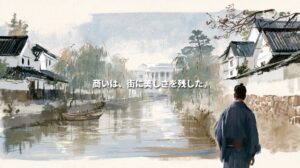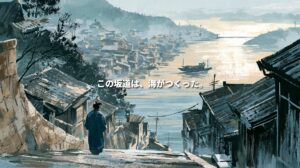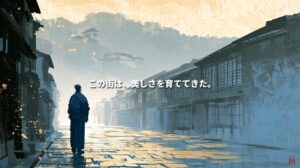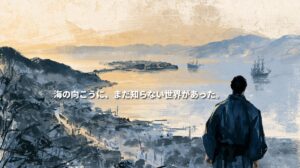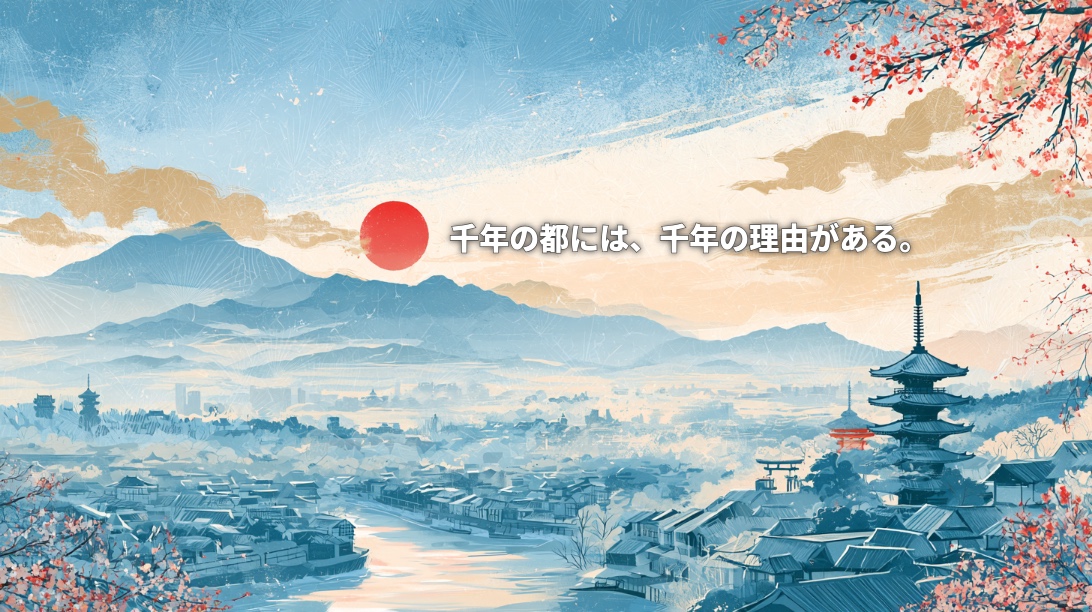
How geography, water, power, and a cultivated sense of beauty shaped a city that continues to draw people in
Kyoto is quiet in the morning.
Before visitors fill the stone-paved lanes, the sound of a broom carries through the street. Water has been sprinkled outside the houses. Soft light reaches past the eaves of old wooden buildings.
Time seems to move differently here.
We look toward mountain ridges that people saw more than a thousand years ago. People still cross ground where earlier generations walked.
Yet Kyoto’s story extends far beyond its age.
The city has endured warfare, lost its position as Japan’s political center, and faced the upheavals of modernization. Through those changes, it has continued to create new forms of value.
Why Kyoto?
Why was a capital established here? And why do people still travel from around the world to visit?
To explore those questions, we need to look beyond the names of temples and famous sights.
We need to begin with the mountains surrounding the city.
1 | Geography Helped Shape the Capital
Seen from above, Kyoto’s setting becomes clear.
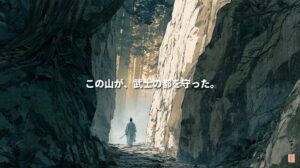
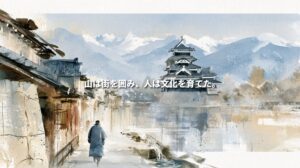
Higashiyama rises to the east, Kitayama to the north, and Nishiyama to the west. The city spreads across a basin enclosed by mountains on three sides.
In 794, Emperor Kanmu moved the imperial capital to Heian-kyō, the city that became Kyoto.
The decision had political foundations. The imperial court had moved from Heijō-kyō in Nara to Nagaoka-kyō before establishing its new seat here.
But political ambition alone could not sustain a capital.
People needed water. Supplies needed routes into the city. Urban life depended on relationships with surrounding forests and farmland.
The basin’s river systems—including the Kamo, Takano, and Katsura—supported daily life and production.
The setting also brought constraints: summer heat, winter cold, and river flooding.
Kyoto developed through an ongoing relationship with both the opportunities and the difficulties of its environment.
People built the capital. The land helped determine its form.
2 | Water Shaped Everyday Life—and Culture
Walking through Kyoto, you begin to notice water everywhere.
The current of the Kamo River. A garden pond. A purification basin at a shrine or temple. A well tucked behind the houses along a narrow lane.
Water has long been one of the resources that makes the city work.
From the days of Heian-kyō, securing drinking water, managing drainage, and responding to floods were essential urban concerns. As Kyoto developed, water became closely connected with agriculture, craft production, and garden design.
Consider a Japanese garden.
A mountain reflected in a pond. A narrow stream passing between stones. A single leaf settling on the surface.
Such details express a way of seeing nature, carefully composed within a limited space.
Then came the Meiji era.
As the emperor and the center of government moved to Tokyo, Kyoto faced the challenge of finding a new direction.
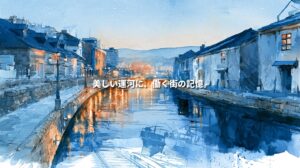
The Lake Biwa Canal became one expression of that ambition. Bringing water from Lake Biwa into Kyoto, the project supported modernization through transport, irrigation, and hydroelectric power.
Water that had sustained an imperial city also helped it develop a new industrial future.
The water kept flowing.
Its changing uses connected one period of Kyoto’s history with the next.
3 | How Did So Much Culture Take Root Here?
Visitors encounter Kyoto through temples, gardens, wooden townhouses, kimono, tea ceremony, and traditional sweets.
These practices and places emerged within daily life, faith, politics, and social relationships long before they became reasons to travel.
Across different periods, the imperial court, aristocratic households, religious institutions, and warrior elites concentrated wealth and influence in the city.
Their presence created demand.
Someone had to build the halls, make the clothing, fire the vessels, tend the gardens, and prepare the food.
Through that work, skills developed and cultural knowledge accumulated.
Nishijin weaving, Kyō-yūzen textile dyeing, and Kyō-yaki and Kiyomizu-yaki ceramics each have distinct histories. Their development nevertheless reflects the relationship between Kyoto’s cultural demand and the expertise of its craftspeople.
Culture continued through use.
An object could be refined because someone needed it. A technique could change because expectations changed.
New materials, customers, and markets required craftspeople to make choices about what to adapt and what to carry forward.
Kyoto’s traditions bear the marks of those decisions.
Part of the city’s strength lies in that continuing work of selection.
4 | The Thousand-Year Capital Has Been Rebuilt Many Times
Calling Kyoto an “ancient capital” can suggest an uninterrupted passage of time.
Its history has been far more turbulent.
The Ōnin War and other conflicts, repeated fires, and successive rebuilding efforts transformed the city.
The Kyoto we see today does not consist entirely of buildings preserved unchanged since the Heian period.
Some temples and shrines have been reconstructed. Streetscapes have changed. Cultural practices have been lost.
Even so, people returned to these places to rebuild temples, continue festivals, and pass on their work.
Why?
Perhaps the city’s value also lived in things that could not be reduced to its buildings.
Memories attached to a place. Religious devotion. Communities that held practical knowledge. Activities repeated with the turning seasons.
Those relationships may help explain how Kyoto retained a recognizable identity through disruption.
Its continuity includes the work of rebuilding.
5 | Why Does Kyoto Draw People from Around the World?
Kiyomizu-dera. Fushimi Inari Taisha. Kinkaku-ji. Arashiyama.
Each offers a scene that people want to photograph.
But visual beauty explains only part of Kyoto’s appeal.
Consider the experience of sitting beside a temple garden.
Wind passes through. Leaves move. A bird calls somewhere beyond the trees.
Little happens, yet the time feels valuable.
Travel in Kyoto often centers on experiencing a place and a moment. From a marketing perspective, that raises questions about the value of experience.
Here, understanding can deepen the experience itself.
The more we learn about the city’s history and culture, the more we notice in the same view.
A garden becomes an expression of how people understand nature.
A machiya, Kyoto’s traditional urban townhouse, reveals ways of adapting architecture to city life.
Behind the spectacle of a festival, we begin to recognize the work and responsibility carried by local communities.
Knowledge brings a landscape into sharper focus.
Kyoto makes that relationship tangible.
6 | Can Kyoto Sustain the Life That Makes It Worth Visiting?
As more people value Kyoto’s culture and scenery, demand for travel grows.
Tourism supports employment and local income. It also places pressure on streets, transport, and residential life.
A lane that is part of someone’s daily routine becomes a memorable destination for someone else.
Those two experiences occupy the same space.
Recognition of a city’s culture does not automatically secure the lives of the people who sustain it. Kyoto’s own surveys of residents’ attitudes toward tourism examine these benefits and pressures.
Can craftspeople continue their work?
Will enough people remain to organize neighborhood festivals?
Can younger generations afford and choose to keep living here?
Kyoto’s future depends on more than visitor numbers.
It also depends on how residents and visitors share the city—and how tourism supports the conditions that allow its culture to continue.
7 | When You Visit, Look for the Reasons Behind the View
A journey through Kyoto can become richer with a small shift in attention.
The Kamo River | Read the Relationship Between Water and City Life
Watch the current and the ways people use the riverbanks.
Consider how a river becomes part of the everyday life of a city.
Nanzen-ji and the Suirokaku Aqueduct | Notice the Infrastructure of Reinvention
Within a historic temple precinct stands a brick aqueduct.
The meeting of these structures makes Kyoto’s transition into a modern city visible. The Lake Biwa Canal belongs to the city’s history of reinvention as well as its engineering history.
Nishijin | Look for the Work Behind Cultural Beauty
Beyond a finished textile lies a network of specialized tasks and skills.
Imagine the people, workshops, and relationships needed to produce what you see.
Gion | Notice Where Travel Meets Everyday Life
A beautiful streetscape is also a place where people live and work.
Consider how preserving its appearance relates to sustaining the lives within it.
Connect these places through geography, history, industry, and daily life.
A visit then becomes a way of reading a city: following the relationships that give its familiar sights their meaning.
EDITOR’S NOTE — NEOTERRAIN
What do people seek when they visit Kyoto?
Beautiful views? Historic buildings? A quiet interval outside their usual routines?
Perhaps some of the city’s deepest richness lies in the lives behind those experiences.
People chose this mountain-framed basin.
People brought water into the city.
People wove cloth, fired pottery, and made gardens.
After warfare and destruction, people decided to build again.
Their individual efforts helped create the Kyoto we encounter today.
Travel offers a chance to meet the time accumulated in a place, to learn about lives and values different from our own, and to notice what we could not see before arriving.
Kyoto’s beauty has been reconsidered, remade, and passed on for more than a thousand years.
Perhaps that is what we feel when we walk its streets.
And perhaps travel begins whenever the world we thought we knew takes on a new meaning.
NEOTERRAIN — Engaging with complexity, without simplifying it away.
References and Sources
The following sources are in Japanese.
- Kyoto City Water Supply and Sewerage Bureau — History of the Lake Biwa Canal, Part 1
- Lake Biwa Canal — The Japan Heritage Story
- Kyoto City Water Supply and Sewerage Bureau — History of the Lake Biwa Canal, Part 3: The Branch Canal
- Kyoto City — Results of the 2025 Survey of Residents’ Attitudes Toward Tourism