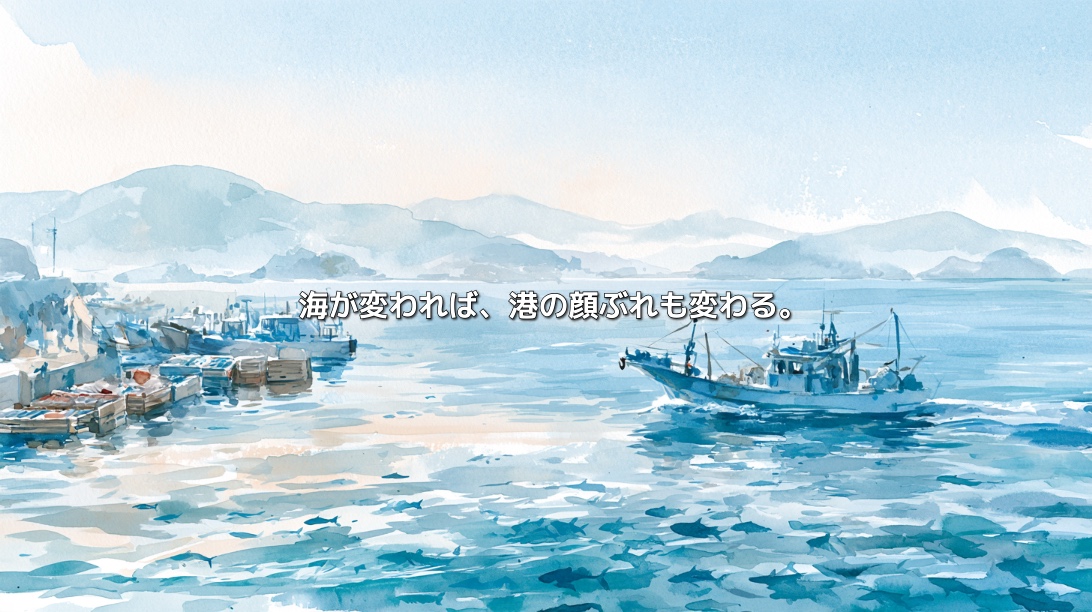
Reading Marine Ecosystem Change Through Fish Landings
“This fish used to arrive every year around this time.”
Words like these are becoming more common at fishing ports.
Fish once landed in abundance have become scarcer. Species rarely seen before are appearing in nets. Fishing seasons arrive earlier or later, and a sea once understood through years of experience is gradually becoming harder to read.
Is this simply a fluctuation in catches?
The fish laid out at the harbor carry changes from offshore onto land. Looking closely at landings can reveal shifts in seawater temperature, currents, oxygen, food availability, spawning grounds, and seaweed habitats.
A fishing port receives more than fish.
It is also a place where changes in the sea are first recorded. neoterrainjournal.com
Fish Landings Are Observations Arriving from the Sea
The fish brought ashore vary from day to day and season to season.
Wind, waves, the number of boats going out, fisheries management, and market prices all influence landings. A small catch of one species cannot immediately be attributed to environmental change.
Yet when years of records from the same port are brought together—species, catch volumes, fishing seasons, fish sizes, and fishing locations—longer-term patterns can emerge from daily variation.
Fish appearing earlier in the year.
Fish increasingly caught farther north.
Fish moving away from the coast or into deeper water.
Fish whose spawning and growth schedules are beginning to shift.
These changes do not occur in isolation.
Fish live within a combination of conditions: suitable temperatures, sufficient oxygen, available prey, and places where they can spawn and their young can grow.
Behind changing landings, the conditions supporting the ecosystem itself may be shifting.
The Sea Surrounding the Fish Is Changing
Sea-surface temperatures around Japan have risen over the long term.
According to the Japan Meteorological Agency figures cited in the original article, annual mean sea-surface temperatures around Japan increased at a rate of 1.36°C per century through 2025—faster than the global average.
The difference may sound small.
For marine organisms, however, temperature helps determine where they can live, how their metabolism functions, when they spawn, how they grow, and where their food can be found.
Extreme events such as marine heatwaves can add further pressure to these changes in average conditions.
Warm-water species may expand northward, while species dependent on cooler conditions may move farther north or into deeper waters.
But moving into a suitable temperature range does not resolve every problem.
Without appropriate food and spawning habitat, populations may struggle to sustain themselves. Where seaweed nursery habitats have disappeared, adult fish may arrive without the next generation successfully establishing.
Warming can also strengthen the separation between water layers, making it harder for oxygen to reach deeper waters.
The previous articles in this series explored oxygen loss, marine heatwaves and fish movements, river-borne nutrients and coastal hypoxia, and seaweed habitat decline.
These processes meet within the same sea.
Changes in the fish arriving at a port can reflect their combined effects.
When Fishing Grounds Move, an Industry Must Adjust
As fish distributions shift, fishers may find it difficult to continue working in the same places, at the same times, with the same equipment.
Fishing grounds farther offshore mean longer journeys and higher fuel costs. Different species may require different gear or fishing methods.
Even when unfamiliar fish become available, a community may lack the sorting and processing facilities needed to bring them to market at a worthwhile price.
Changing target species involves much more than replacing one fish with another.
The seafood industry connects boats, fishing gear, ice production, refrigeration, processing, markets, transport, retailers, and restaurants.
When landings change, adjustments may be needed throughout that chain.
Japan’s Fisheries Agency has emphasized the growing importance of gathering current survey data and landing information to assess fish stocks promptly as marine conditions change. It has also promoted more adaptable fishing operations, including diversification and changes in fishing methods and target species.
Past success alone offers an uncertain guide to the future.
Protecting local fisheries requires understanding what is happening at sea, how it appears in landings, and where the resulting pressures fall within the community.
Changing Fish Also Change Local Food Culture
The consequences extend beyond the people who catch fish.
Regional food cultures have developed alongside species caught locally over generations.
Seasonal dishes, preservation techniques, processed foods, festivals, market scenes, and family recipes often assume that certain fish will arrive at certain times.
When fishing seasons shift, familiar species decline, and others become more abundant, the meaning of “in season” begins to move.
Some communities are responding by developing recipes and processing methods for newly landed species. Fish that previously attracted little market value are being turned into products and, in some cases, new regional brands.
Such efforts can carry local skills and food traditions into changing circumstances.
But finding a market for newly arriving fish does not settle every concern.
If demand concentrates on a particular species before its stock status is well understood, fishing pressure may rise too quickly.
Use needs to develop alongside knowledge of distribution, growth, spawning, and abundance.
The balance between harvesting and conservation must remain part of the conversation.
Connecting Fishers’ Experience with Scientific Data
Satellites, research vessels, and ocean buoys are essential for understanding marine change.
Some changes, however, are difficult to capture through these systems alone.
“The fish in the nets are a different size.”
“Spawning seems earlier this year.”
“They no longer gather in that particular place.”
“The seabed mud and seaweed look different.”
People who return to the same waters day after day can notice subtle differences before they become formal measurements.
Their observations gain further value when the circumstances are documented and records are maintained consistently. They can then complement scientific surveys.
Landing records can be examined alongside temperature, salinity, dissolved oxygen, fishing locations, and fishing effort.
Fishers’ practical knowledge can be compared with research observations. Changes in one area can be shared and assessed against those in neighboring waters.
This helps move the inquiry beyond “there are fewer fish” toward more specific questions.
Which conditions changed? When did they change? How might those changes be connected?
Recognizing the signs earlier can also allow earlier adjustments to fishing seasons, equipment, stock management, processing capacity, and sales channels.
A Harbor Can Help Us Read the Sea’s Future
No single coastal community can halt changes in the marine environment.
But communities can observe, record, share, and respond in ways suited to their own waters.
At a fishing port, people head out to sea each day. Others sort the catch, process it, sell it, prepare it, and eat it.
Few places bring together so much information connecting the sea with society.
Seen this way, a harbor can serve as a local center for observing marine ecosystems as well as a landing and distribution hub.
Recording species, fishing seasons, fish sizes, and sea conditions over time gives context to the day’s catch.
These accumulated observations can become a community’s early warning system.
When unfamiliar fish appear at the harbor, our attention naturally turns toward them.
Yet each fish also invites us to consider the conditions that brought it there.
Oxygen, temperature, currents, nutrients, seaweed habitats, food webs, and livelihoods are connected. As they change, the relationship between the sea and its coastal communities changes with them.
A single fish brought ashore carries a record of that movement.
The harbor receives today’s catch—and, within it, clues to the sea that is taking shape.