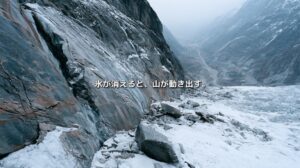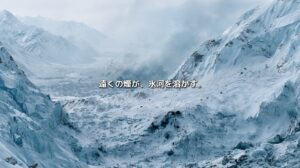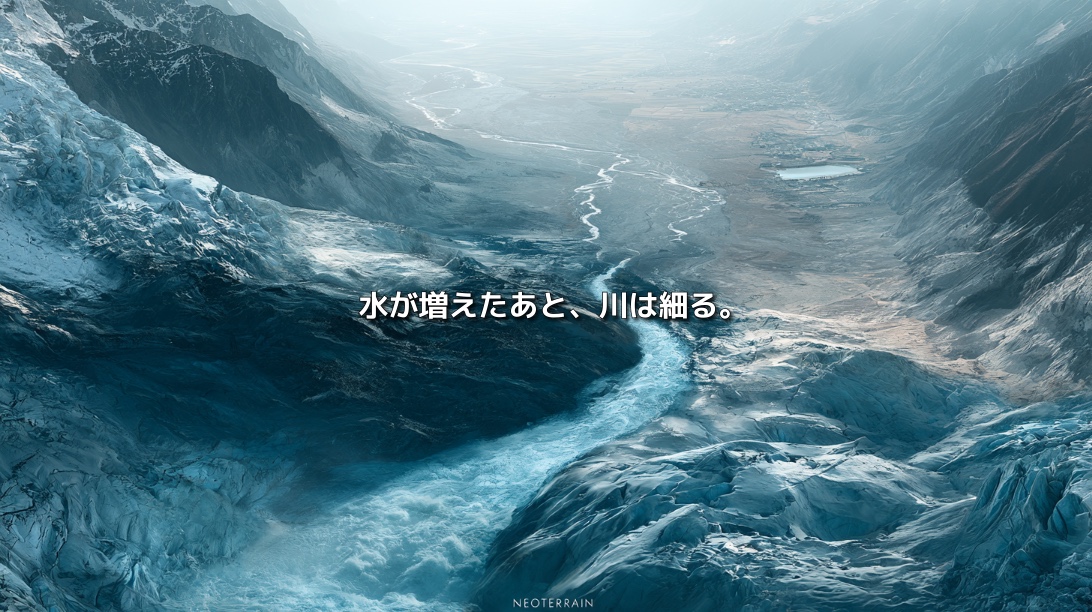
When glaciers melt, rivers can carry more water.
As temperatures rise and snow and ice melt faster, more water may flow down from the mountains. At first glance, glacier retreat might seem to ease water shortages.
But that extra water has not been newly created. It has been stored in glacier ice over many years and is now being released faster than before. A glacier is like a savings account: higher withdrawals can provide more water today, but the reserve is finite.
The point at which glacier runoff stops increasing and begins to decline is called peak water. What looks like an abundance of water may be the beginning of a long-term decrease. neoterrainjournal.com
Glaciers store water across seasons
Snow accumulates in mountain regions during cold seasons and gradually melts in spring and summer. At high elevations, some snow survives year after year. Compressed over time, it becomes glacier ice.
Glaciers move slowly under their own weight and release water into rivers. That contribution can help sustain river flow when precipitation is low. It is especially valuable during hot or dry periods, when farms and cities may need the most water.
In this way, snow and glaciers help moderate seasonal differences in water supply. A glacier, however, cannot be operated like a dam. People cannot choose when it releases water, and lost ice cannot be restored quickly.
When warming causes a glacier to lose more ice in summer than it gains through snowfall, it gradually becomes thinner and smaller. That change can produce two successive phases in its contribution to rivers.
First more water, then less
During the first phase, warming increases melting while the glacier still contains substantial ice. Glacier runoff rises.
As melting continues, the glacier loses area and volume. Eventually, there is less ice available to melt. Glacier runoff then begins to fall, even if temperatures remain high.
That transition is peak water:
Warming → faster melting → a temporary rise in glacier runoff → a smaller glacier → less ice available to melt → declining glacier runoff.
Peak water does not arrive everywhere in the same year. Its timing depends on glacier size, elevation, temperature, snowfall, slope orientation, and the characteristics of each watershed. Smaller glaciers in warmer settings may reach it earlier than large glaciers at high elevations.
There is no single peak shared by every glacier-fed river. Each watershed has its own trajectory. Research assessing glaciers worldwide has examined how the timing and scale of runoff changes vary across regions. Nature Climate Change
Some regions have already passed peak water
Peak water is not solely a future concern.
The IPCC’s Special Report on the Ocean and Cryosphere in a Changing Climate assessed evidence that, by the time of its publication, glaciers representing substantial shares of the glacier area in regions such as the tropical Andes, Central Europe, and western Canada and the United States may already have passed their peak runoff. UNESCO’s 2025 World Water Development Report also points to strong evidence of peak water having passed in glacier-fed catchments in the tropical Andes, western Canada, and the Swiss Alps. ipcc.ch
A retreating glacier is visible in photographs. Whether its runoff has passed its peak is harder to see.
Rainfall, seasonal snow, groundwater, reservoir operations, and agricultural withdrawals also affect river flow. Long-term measurements are needed to distinguish the glacier’s changing contribution from these other influences.
A river can still look full while the sources sustaining its flow are quietly changing.
The tropical Andes: ice that supports the dry season
In the tropical Andes, including parts of Peru, Bolivia, Ecuador, and Colombia, glacier meltwater can be an important source of water during the dry season.
Rainfall raises river levels during the wet season. When rain is scarce, water from glaciers helps support urban supplies, farming, wetlands, ecosystems, and hydropower.
Many small glaciers have shrunk. In catchments that have passed peak water, the dry-season contribution from glaciers can decline. The effects can extend well beyond settlements near the ice: Andean rivers also supply farms and cities farther down the mountains. Population growth and rising demand can make a shrinking supply more difficult to manage.
Research published in 2025 projects that glaciers in the Southern Andes, across Chile and Argentina, may provide less water during future prolonged droughts. Glaciers have helped buffer some past periods without rain. As they shrink, that protection may weaken when it is most needed. Scientific Reports
The Himalayas: rivers depend on different sources
Snow and ice in the Hindu Kush Himalayan region feed major rivers, including the Indus, Ganges, Brahmaputra, and Mekong. Their watersheds support communities, agriculture, power generation, industry, and ecosystems.
But those rivers do not depend on glaciers to the same degree. Snow and glacier melt are especially important in parts of the upper Indus basin, while monsoon rainfall accounts for much of the annual flow farther downstream in the Ganges and Brahmaputra basins.
The importance of glacier water also changes with the season. Even where its share of annual river flow is modest, it may matter greatly during a dry period.
The first consequence of glacier retreat may therefore be a change in when water arrives: less flow in a critical season or a larger gap between floods and dry periods. A river does not have to disappear for its water supply to become less reliable. lib.icimod.org
Central Asia: upstream ice and downstream farmland
Glaciers in the Tien Shan and Pamir mountains feed rivers that cross Central Asia’s dry landscapes. Water originating in mountainous areas such as Kyrgyzstan and Tajikistan reaches farms and cities farther downstream.
Summer irrigation demand is high. Fields producing crops such as cotton, wheat, and fruit depend on mountain water. Studies suggest that glacier runoff in some Central Asian watersheds may continue to rise for a time before declining later this century, although the timing varies.
A temporary increase can create a planning trap. If farms and cities expand on the assumption that today’s higher flows will continue, water demand may keep growing after glacier supply begins to fall.
The risk comes from the interaction between a changing natural supply and choices that increase demand.
The timing of water matters as much as its volume
Glacier retreat changes more than annual totals.
Earlier snowmelt may raise spring flows while leaving less water for late summer. A period of rapid melt may bring flooding, yet the same watershed can face scarcity months later.
For farmers, river flow may rise at the wrong time for crops. For hydropower operators, seasonal output may become less predictable. For river ecosystems, warmer water and reduced flow can threaten species that depend on cold conditions. Cities may face rising demand as the reliability of their sources declines.
During periods of stronger melting, sediment and substances stored in glacier ice or surrounding rock may also move with runoff. More water and less water each bring different management challenges.
Peak water is therefore more than the highest point on a runoff graph. It marks a change in how a watershed must plan for its future.
Can reservoirs solve the problem?
Dams and reservoirs can store water from wet periods or snowmelt and release it during dry periods. They can take over part of the seasonal buffering role that snow and glaciers have provided.
Their usefulness comes with limits. In mountain regions, earthquakes, landslides, sediment, and glacial lake floods can complicate construction and maintenance. Dams can also alter sediment movement, fish migration, wetlands, and river deltas. On rivers crossing borders, upstream storage and withdrawals affect downstream users.
Adaptation calls for a combination of measures suited to each watershed: smaller reservoirs where appropriate, groundwater recharge, wetland conservation, healthier forests and soils, more efficient irrigation, leak reduction, changes in crops, and management of water demand.
It also requires monitoring snow, glaciers, precipitation, river flow, and groundwater together. A watershed needs to understand both how much water it receives and where that water comes from.
Planning must begin while the river is still full
Peak water is difficult to recognize because its first phase can look like growing abundance. More river water may allow farms to expand, hydropower production to increase, or cities to extend their supply systems.
If that increase comes from the loss of glacier ice, it cannot safely be projected into the future.
The time to investigate is while flows are still rising. Are rivers carrying more water because precipitation has increased, because a glacier is losing stored ice, or because several sources have changed at once? Water plans should be built around that answer, with enough flexibility to adjust as the glacier shrinks.
Glaciers have stored water over long periods. Communities need to prepare the next way of managing that water before the reserve is depleted.
Think ahead while the river still flows
Images of collapsing ice or a dried-up river make glacier loss easy to recognize. Peak water often arrives more quietly.
At first, the river carries more water. Only later does the glacier become small enough for its contribution to diminish. What seemed like a lasting supply was, in part, water drawn from ice accumulated in the past.
A glacier does not produce water without limit. It receives snowfall, stores some of it, and releases water later. When losses continue to exceed what snowfall replaces, its reserve falls.
Peak water is the point at which that changing balance begins to show in glacier runoff. While rivers are still flowing, there is time to understand what sustains them and prepare for what comes next.
References
- IPCC, Special Report on the Ocean and Cryosphere in a Changing Climate, Chapter 2: High Mountain Areas
- IPCC, Climate Change 2022: Impacts, Adaptation and Vulnerability, Chapter 4: Water
- UNESCO, The United Nations World Water Development Report 2025: Mountains and Glaciers – Water Towers
- ICIMOD, Water, Ice, Society, and Ecosystems in the Hindu Kush Himalaya
- Huss and Hock, “Global-scale hydrological response to future glacier mass loss,” Nature Climate Change (2018)
- Caro et al., “Future glacio-hydrological changes in the Andes,” Scientific Reports (2025)
- Ayala et al., “Less water from glaciers during future megadroughts in the Southern Andes,” Communications Earth & Environment (2025)