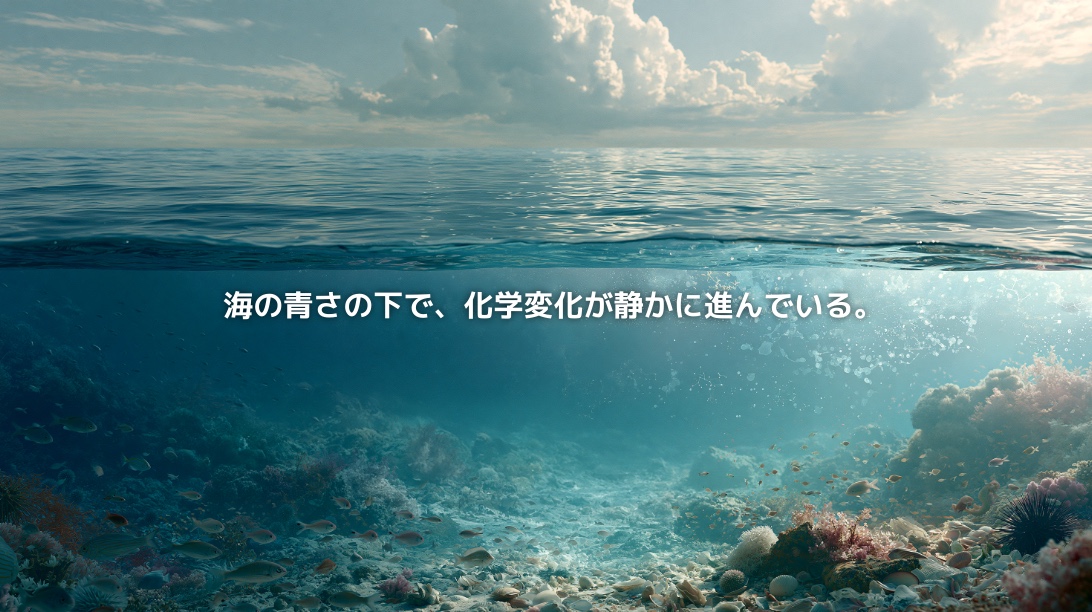
The ocean is blue.
Blue stretching all the way to the horizon.
Light reflected on the waves.
The smell of salt.
A ship moving in the distance.
Standing on the shore, the ocean seems vast, quiet, and unchanging.
But beneath that blue surface, it is slowly being transformed.
The ocean has absorbed carbon dioxide from the atmosphere.
Humans burn fossil fuels, operate factories, drive cars, and consume electricity. As a result, the ocean has taken in some of the additional carbon dioxide released into the air.
By absorbing carbon dioxide, the ocean has also helped slow global warming.
Without this absorption, atmospheric carbon dioxide concentrations would be even higher, and warming might have progressed more rapidly.
Yet as the ocean continues to take in carbon dioxide, another problem is emerging.
It is called ocean acidification.
Ocean acidification is the long-term shift of seawater toward greater acidity. The U.S. National Oceanic and Atmospheric Administration (NOAA) describes it as a sustained reduction in ocean pH, caused mainly by the ocean’s absorption of carbon dioxide from the atmosphere.
The ocean absorbs the planet’s heat.
It absorbs carbon dioxide as well.
And the burden is quietly spreading through marine life.
Beneath the beauty of the blue sea, a chemical transformation is underway.
What Is Ocean Acidification?
The term ocean acidification may sound as though the ocean is rapidly turning into a strongly acidic liquid.
That is not what is happening.
Seawater is naturally slightly alkaline. Ocean acidification does not mean that it suddenly becomes neutral or acidic. It means that its pH gradually declines, shifting it closer to the acidic end of the scale.
The deeper concern is that this shift alters the ocean’s chemical balance.
Carbon dioxide from the atmosphere dissolves into seawater.
Chemical reactions occur.
The concentration of hydrogen ions increases.
The pH of seawater falls.
The availability of carbonate ions decreases.
Carbonate ions are closely connected to the ability of corals, shellfish, sea urchins, and some plankton to build their shells and skeletons.
NOAA explains that when carbon dioxide is absorbed by seawater, a series of chemical reactions increases the concentration of hydrogen ions. These changes can affect organisms that form calcium carbonate shells and skeletons, including corals, oysters, clams, and mussels.
Ocean acidification is difficult to see.
The color of the sea does not suddenly change.
The waves do not become cloudy.
From the shore, there may be almost nothing unusual to notice.
Yet within the seawater, a chemical change affecting the foundations of marine life is progressing.
The Ocean Has Been the Planet’s Cushion
The ocean acts like an enormous cushion for the Earth’s climate.
It absorbs heat.
It absorbs carbon dioxide.
It produces water vapor, forms clouds, and helps bring rain.
Ocean currents carry heat around the planet.
Plankton, seagrass meadows, seaweed forests, wetlands, and tidal flats all take part in the carbon cycle.
We tend to focus on carbon dioxide in the atmosphere, but the ocean is also a crucial part of the global carbon system.
NOAA Fisheries states that over approximately the past 200 years, the world’s oceans have absorbed more than 150 billion metric tons of carbon dioxide produced by human activities. The U.S. Integrated Ocean Observing System also explains that since the Industrial Revolution, the ocean has absorbed roughly 30 percent of human-generated carbon dioxide emissions.
In other words, the ocean has taken on part of the carbon burden created by human society.
In doing so, it has helped slow the pace of global warming.
But every cushion has a limit.
If it continues absorbing pressure, the cushion itself begins to deform.
The ocean is no different.
As it absorbs more carbon dioxide, the chemical balance of seawater changes.
Those changes affect marine organisms.
Changes in marine life can then spread through food webs, fisheries, and local food cultures.
The ocean is not simply making our emissions disappear.
For everything it absorbs, something changes within it.
The Impact on Shell-Building Organisms
Among the organisms of greatest concern are those that build shells or skeletons.
Corals.
Oysters.
Clams.
Scallops.
Mussels.
Sea urchins.
Pteropods, a group of tiny marine snails.
Plankton with calcium carbonate structures.
These organisms use calcium carbonate to construct their shells and skeletons.
As ocean acidification reduces the availability of carbonate ions, obtaining the materials needed for this process becomes more difficult. In some cases, larval development and early shell formation may be affected.
NOAA Fisheries explains that ocean acidification can create conditions that alter the minerals used by oysters, clams, lobsters, shrimp, coral reefs, and other organisms to build shells and skeletons.
Coral reefs provide habitat for countless fish and other marine species.
Shellfish support fisheries and food traditions.
Tiny plankton form the base of marine food webs.
The effects on shell-building organisms are therefore not confined to those organisms alone.
When corals weaken, the fish and other species that depend on reefs may also be affected.
When shellfish struggle to grow, the consequences can reach fisheries, aquaculture, and regional food cultures.
When plankton communities change, the entire marine food web may change with them.
A small chemical shift can lead to a much larger ecological transformation.
Coral Reefs and Ocean Acidification
Coral reefs are like cities beneath the sea.
Their complex structures create three-dimensional spaces where fish, crustaceans, shellfish, algae, and many other organisms live.
They are centers of biodiversity. They support tourism and fisheries. They also act as natural breakwaters, helping protect coastlines from waves.
But coral reefs face multiple, overlapping pressures.
Bleaching caused by rising seawater temperatures.
Ocean acidification.
Coastal development.
Sediment runoff and excessive nutrients.
Typhoons and marine heatwaves.
Pressure from tourism.
Ocean acidification may reduce the ability of corals to build their skeletons. NOAA explains that as the ocean absorbs carbon dioxide, carbonate becomes less available for corals and shellfish to construct their hard outer structures, potentially affecting entire reef ecosystems.
Bleached coral is visible.
Ocean acidification is not.
It does not immediately change a coral’s color.
The pH of seawater cannot be seen from the beach.
Yet when ocean chemistry changes, the growth and resilience of coral reefs may also be weakened.
Change in the ocean does not always arrive dramatically.
Sometimes it begins quietly, at the foundation.
Ocean Acidification Is Also a Fisheries Issue
Ocean acidification is not a concern for scientists alone.
It also matters to fishers, aquaculture producers, and coastal communities.
Shellfish larvae may struggle to develop.
Shell formation in shellfish and crustaceans may be disrupted.
The plankton eaten by fish may change.
Coral reef, seagrass, and tidal-flat ecosystems may be altered.
The species and quantities caught by fisheries may also change.
Of course, ocean acidification alone cannot explain every change in fisheries.
Rising seawater temperatures.
Changes in the Kuroshio Current and other ocean currents.
Overfishing.
Coastal development.
Changes in nutrient levels.
The loss of seaweed beds.
Harmful algal blooms.
Marine plastic pollution.
Many pressures overlap in the ocean.
Ocean acidification, however, is among the least visible and most gradual of them.
NOAA Fisheries notes that jobs and economies around the world depend on seafood, making ocean acidification a threat to the foundations of many coastal livelihoods.
The fish and shellfish on our tables are not separate from the chemistry of the sea.
Ocean pH changes.
Shell-building organisms are affected.
Food webs shift.
Fisheries change.
Regional food cultures change.
Ocean acidification may be an invisible chemical process, but eventually it can become an issue at the dinner table.
Multiple Pressures Converge in Coastal Waters
Ocean acidification is not only an open-ocean problem.
In coastal waters, the situation is even more complex.
Nutrients carried by rivers.
Domestic wastewater.
Runoff from agricultural land.
Harmful algal blooms and excessive phytoplankton growth.
Oxygen depletion caused by the decomposition of organic matter.
Rising seawater temperatures.
Coastal development.
NOAA explains that although the absorption of atmospheric carbon dioxide is the primary global driver of ocean acidification, local factors such as nutrient runoff can intensify acidification in coastal waters.
This is an important perspective.
The global carbon dioxide problem cannot be separated from local water-quality issues.
What flows into the ocean from rivers?
How does runoff from farms and cities affect coastal waters?
How might warmer seas alter harmful algal blooms and low-oxygen conditions?
Ocean acidification is both a global climate issue and a regional challenge involving water quality, coastlines, and entire watersheds.
Forests, rivers, rice fields, waterways, cities, and the sea.
The waterside issues we encounter upstream are ultimately connected to the ocean.
The sea is also where the consequences of the watershed accumulate.
The Ocean’s Blue Color Conceals Its Transformation
The difficulty of ocean acidification lies in its invisibility.
The ocean is still blue today.
The waves are still beautiful.
The setting sun still reflects on the surface.
Tourists still take photographs.
Fishing boats still leave the harbor.
To the eye, nothing may appear to have changed.
But beneath the surface, the chemical balance of seawater is shifting.
pH.
Carbonate ions.
Calcium carbonate saturation states.
Dissolved carbon dioxide.
These are not things we usually notice in everyday life.
That is why ocean acidification struggles to attract public attention.
Plastic waste washed onto a beach is visible.
Coral bleaching is visible.
Harmful algal blooms are visible.
Ocean acidification is not.
And because it is invisible, we need words to make it perceptible.
The ocean is more than blue.
It is absorbing carbon dioxide.
Its chemistry is changing.
It is quietly carrying a growing burden.
Looking beyond a beautiful landscape to understand the structures beneath it is the first step toward confronting ocean acidification.
Should We See the Ocean Only as a Carbon Sink?
In discussions of climate action, the ocean is often described as a carbon sink.
Blue carbon.
Seaweed forests.
Tidal flats.
Mangroves.
Seagrass meadows.
The ocean’s absorption of carbon dioxide.
Its capacity to store carbon is important.
But it is dangerous to regard the ocean only as a place that absorbs carbon dioxide for us.
The ocean has ecosystems of its own.
It has a chemical balance of its own.
It contains the lives of fish, shellfish, and corals.
It supports fisheries, food cultures, and the memories of coastal communities.
The ocean is not a machine for processing the carbon emitted by human society.
Its ability to absorb carbon does not mean that its capacity is infinite.
Ocean uptake of carbon dioxide helps slow global warming.
But it also changes the chemical environment beneath the surface.
We must recognize both sides of that reality.
The ocean is the planet’s cushion.
But if we continue pressing our burden into it, the cushion itself will change.
What Can We Do?
The fundamental response to ocean acidification is to reduce carbon dioxide emissions.
Use fewer fossil fuels.
Expand renewable energy.
Improve energy efficiency.
Protect forests, wetlands, seagrass meadows, and seaweed forests.
Reduce other greenhouse gases, including methane.
Continue monitoring the ocean.
At the same time, coastal regions need responses tailored to local conditions.
Improve water quality.
Reduce nutrient and pollution loads flowing into the sea from rivers.
Protect and restore seagrass meadows and tidal flats.
Monitor impacts on shellfish and coral reefs.
Share information among fishers, researchers, local governments, and citizens.
Ocean acidification cannot be solved overnight.
But invisible change can be made visible.
Observe it.
Communicate it.
Record changes in local waters.
Share what is happening beneath the surface with society.
Protecting the ocean is not only about cleaning beaches.
It also means examining seawater chemistry, marine life, pressures from the watershed, and the planet’s carbon cycle.
Beneath the Blue Surface
The ocean has absorbed carbon dioxide.
In doing so, it has slowed global warming to some extent.
But the chemistry of the sea is changing in return.
The pH of seawater declines.
Carbonate ions become less available.
Organisms that build shells and skeletons are affected.
Food webs and fisheries may change as well.
Ocean acidification is an invisible crisis.
The ocean’s blue color conceals the transformation.
That is precisely why we need to look at the sea again.
The ocean is a beautiful landscape.
It is also an immense part of the Earth’s carbon system.
And it is home to countless forms of life.
We must not see it only as a receptacle for carbon dioxide.
The ocean is habitat for fish, the place where shellfish form their shells, the foundation of coral reefs, and the source of food cultures that sustain coastal communities.
The ocean is absorbing too much carbon dioxide.
Within that quiet transformation, the foundations of marine life are beginning to shift.
What is happening beneath the blue sea?
By holding on to that question, the wider structure of the planet’s environmental crisis gradually comes into view.
References
- NOAA Ocean Service: What Is Ocean Acidification?
- NOAA Ocean Acidification Program: What Is Ocean Acidification?
- NOAA Fisheries: Understanding Ocean Acidification
- NOAA Ocean Exploration: What Is Ocean Acidification?
- NOAA Ocean Service: Corals Tutorial — Ocean Acidification
- U.S. Integrated Ocean Observing System: Ocean Acidification
Ocean acidification is an invisible environmental problem that is difficult to detect simply by looking at the sea from the shore.
As the ocean continues to absorb carbon dioxide, the effects may spread through ocean chemistry, marine life, fisheries, and ultimately our own tables.
NEOTERRAIN Journal will continue looking beneath beautiful landscapes to explore the environmental changes shaping the planet.
If this article gave you a new perspective on the ocean, consider bookmarking or sharing it—and return to the question of what kind of future lies beneath the blue surface.