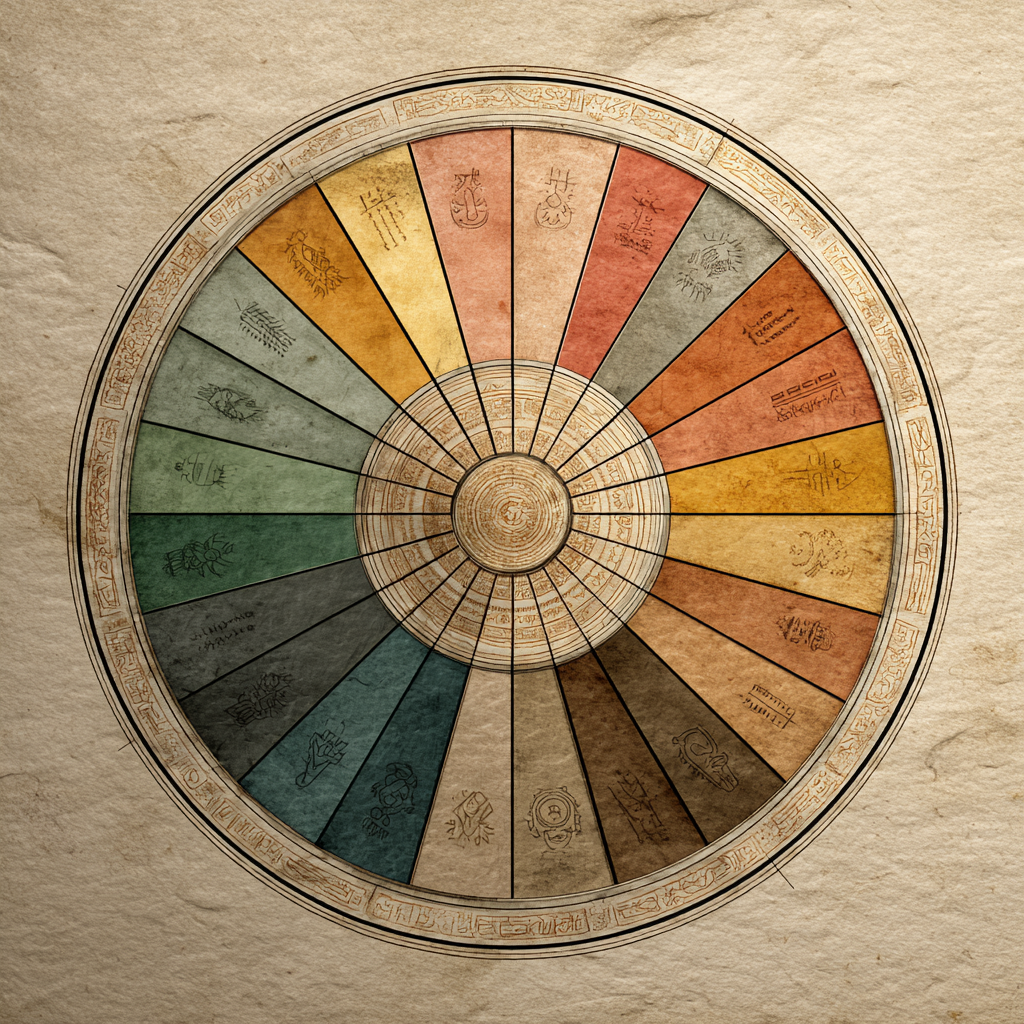
The Space Between Time Preserved in the Ethiopian Calendar
The Ethiopian calendar has a thirteenth month.
And that month lasts for only five days—or six days in a leap year.
This unusual structure is more than a simple difference between calendars.
Embedded within it is a philosophy: a distinctive way of understanding time and deciding how to live within it.
The 13th Month Is Not Made of “Leftover Days”
In the Ethiopian calendar, each of the first twelve months has thirty days.
Together, they make up 360 days.
However, it takes the Earth approximately 365 days to complete one orbit around the Sun.
The thirteenth month was created to account for this difference.
What matters, however, is that these five days are treated as a special period of time—days that do not fully belong to any of the twelve ordinary months.
They are not merely an appendix added to make the calendar’s numbers work.
They form an intentional space placed at the outer edge of the year.
A 13th Month with Its Own Name
The thirteenth month is called Pagume.
The name is associated with the idea of days that remain—time left at the end of the year.
In Ethiopia, this additional time was not erased or hidden.
Instead, it was given a name and made visible.
This suggests an attitude toward time that differs from seeing it merely as something to be measured, controlled, or managed.
Time is also treated as culture.
How Five Days Change the Rhythm of Life
During Pagume, the rhythm of daily life shifts slightly.
In some places, the period is marked by celebrations and religious traditions.
For others, it becomes a quieter time spent with family.
These five days can create distance from the ordinary pressure to produce, achieve, and move forward.
People pause.
They look back on the year, pray, reflect, and speak with one another.
Time is not understood only as something that advances in a straight line.
It can also return, circulate, and restore balance.
Time That Falls Outside Efficiency
In modern society, time is optimized and managed by the minute.
Every hour is expected to serve a purpose.
The Ethiopian calendar quietly asks a different question:
Does all time need to be productive?
The five days of the thirteenth month may be difficult to explain through economic efficiency alone.
Yet it may be precisely this seemingly “inefficient” time that helps preserve the rhythm of individuals and communities.
Not every meaningful moment needs to produce a measurable result.
A Society with Space Built into Time
Pagume also functions as a kind of buffer.
By placing additional space directly within the calendar, the system absorbs the gap between the calendar year and the movement of the Earth around the Sun.
This idea extends beyond calendars.
It can also be applied to institutions, economies, communities, and everyday life.
Systems without space are fragile.
When every moment and every resource is used to its limit, even a small disruption can cause the entire structure to fail.
The Ethiopian calendar leaves flexibility within the design of time itself.
What These Five Days Can Teach Us
There is an astronomical reason why the thirteenth month contains only five days.
But there is also a cultural meaning in the way those days have been preserved.
The world does not have to move at one speed.
Not every form of time needs to be measured according to the same standard of value.
Ethiopia’s five additional days seem to offer a quiet message:
Have the courage to leave space within time.
A Question from NEOTERRAIN
What would happen if our own society had a thirteenth month?
How would we use that time?
Would we use it to work more?
Or would we stop, reflect, reconnect, and prepare ourselves for the year ahead?
The Ethiopian calendar is not simply an unfamiliar system from another culture.
It may also offer a clue for imagining the future.
Around the world, there are structures of time that differ from what many of us consider normal.
Through its thirteen months, the Ethiopian calendar reveals the depth of a culture shaped by history, faith, astronomy, and everyday life.
NEOTERRAIN explores these invisible systems of time in order to discover different ways of seeing the world—and different ways of living within it.
Related Articles
- Vol. 1: Time Is Not Universal
- Vol. 2: Why Does the Ethiopian Calendar Have 13 Months?
If this story resonated with you, please consider bookmarking or sharing it.
NEOTERRAIN Journal continues to explore the cultures, places, and ideas that reveal other possible ways of seeing our world.