We travel along roads to reach our destinations.
We drive to work.
Children take them to school.
Trucks use them to transport goods.
Ambulances follow them to hospitals.
Families cross them to visit distant towns.
Roads form a network designed around human movement.
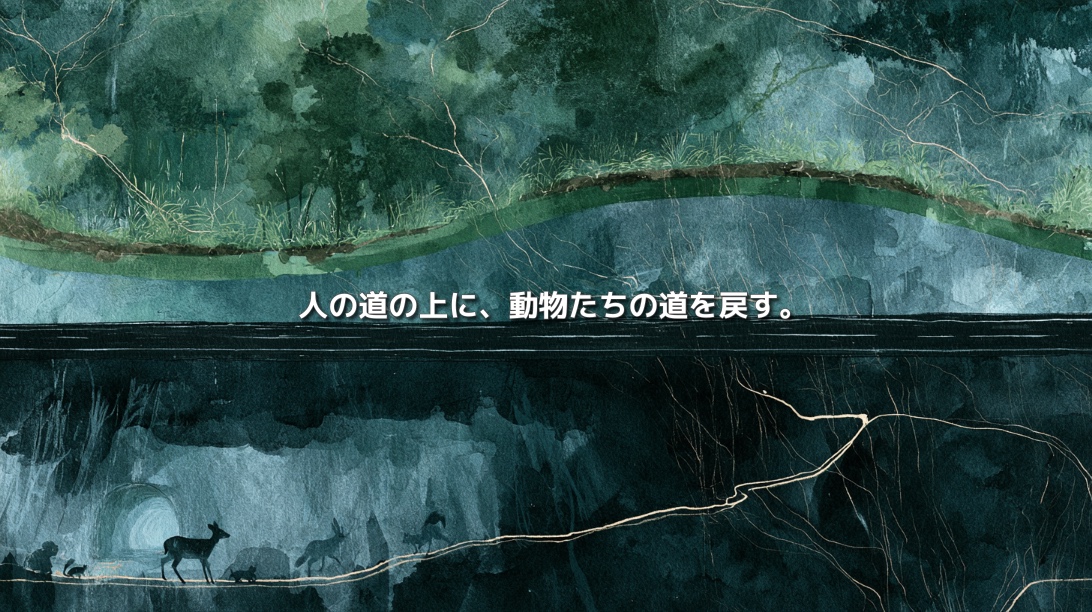
Yet above and below those same roads, other living creatures need routes of their own.
Deer and raccoon dogs move from one forest to another. Frogs and newts travel between woodlands and wetlands. Squirrels and dormice cross the canopy without descending to the ground. Small mammals move between feeding grounds, nesting areas, and breeding habitats.
Their routes rarely appear on human maps.
Long before asphalt divided the landscape, animals followed paths shaped by water, vegetation, topography, food, and the changing seasons. When a road cuts across those paths, an established movement corridor becomes a dangerous boundary.
Wildlife tunnels beneath roads, vegetated bridges above highways, ropes suspended between trees, and narrow passages beside waterways are designed to restore some of that lost connectivity.
In Japan, these structures are sometimes called “animal paths” or “eco-roads.” Internationally, they are more commonly known as wildlife crossings.
But constructing a passage does not automatically reconnect an ecosystem.
The real question is whether animals can find it, recognize it as safe, and continue using it over time.
Where Human Roads and Animal Routes Intersect
Wild animals do not wander onto roads without reason.
They may be moving toward food or water, searching for a mate, changing habitat with the seasons, or leaving their birthplace to establish a new territory.
Every species has movement routes necessary for survival.
Human roads sometimes cut directly across these routes. If an animal attempts to cross, it risks colliding with a vehicle. If it avoids the road, it may lose access to water, food, breeding habitat, or shelter.
The animal is effectively forced to choose between two threats: crossing a dangerous road or abandoning a place essential to its survival.
Roadkill prevention often focuses on keeping wildlife away from vehicles. However, simply preventing animals from entering a road can deepen the separation between habitats.
An effective solution must accomplish two things at once:
- Reduce collisions between vehicles and wildlife
- Preserve safe movement between habitats
This is why wildlife crossings are necessary.
What Is an Animal Path?
An animal path is a passage that allows wildlife to move safely between habitats divided by roads, railways, or other infrastructure.
Its design varies according to the species, terrain, surrounding vegetation, and available space.
| Type of crossing | Main target species | Characteristics |
|---|---|---|
| Vegetated overpass | Deer and other medium-to-large mammals | Soil and native plants create a bridge that resembles an extension of the surrounding habitat |
| Wildlife underpass | Raccoon dogs, foxes, rabbits, and small mammals | Allows animals to pass beneath a road without entering traffic |
| Waterway passage | Frogs, newts, turtles, fish, and wetland species | Maintains water flow and moist conditions while providing a safe route |
| Canopy rope bridge | Squirrels, dormice, and other arboreal animals | Reconnects tree canopies separated by a road |
| Escape structure | Amphibians, reptiles, and small mammals | Helps animals climb out of roadside drains and other artificial traps |
Not every animal will use the same type of crossing.
Some species are comfortable entering dark tunnels, while others avoid confined spaces. Some need dry ground, while others require moisture. Some travel at ground level, while others rarely leave the trees.
A structure that appears spacious and well-designed to people may still feel unsafe to the species it is intended to serve.
A wildlife crossing is therefore more than a piece of road infrastructure. It is a small habitat designed through an understanding of animal behavior.
Location Is the Most Important Decision
A wildlife crossing cannot simply be placed wherever construction is easiest.
If it is far from an established animal route, wildlife may never find or use it. Careful ecological investigation is therefore required before the facility is designed.
Useful information includes:
- Locations with frequent wildlife–vehicle collisions
- Areas where tracks or droppings have been found
- Camera-trap records of animal movement
- Connections between forests and water sources
- Valleys, ridgelines, and other terrain that naturally guides movement
- Seasonal feeding and breeding areas
- Sightings reported by residents and road managers
When these observations are mapped together, the places where human infrastructure intersects with animal movement become visible.
Japan’s Ministry of Land, Infrastructure, Transport and Tourism has begun promoting data-driven roadkill countermeasures, using Hokkaido, Okinawa, and Amami as model regions. The initiative examines collision locations, species, seasons, and road structures to identify where interventions are most urgently needed.
The goal is not to choose a location convenient for construction.
It is to place the crossing where animals actually need to cross.
Fences Alone Can Deepen Habitat Fragmentation
Wildlife exclusion fences are widely used to prevent animals from entering roads.
They can be highly effective in reducing collisions, but a fence without a safe crossing may create a new ecological barrier. Animals may be prevented from reaching feeding grounds, water sources, breeding sites, or seasonal habitats.
There is another risk. If an animal enters the roadway through a broken section or gap in the fence, it may be unable to escape.
Fencing should therefore be designed to guide wildlife toward tunnels, overpasses, or other safe crossing points.
A complete system follows a continuous sequence:
- Keep animals away from traffic.
- Guide them toward a safe passage.
- Allow them to cross the road.
- Connect them to suitable habitat on the other side.
Only when all four functions work together does the intervention become effective.
Guidance from the U.S. Federal Highway Administration also emphasizes the importance of combining fencing with crossing structures. Without a safe place to cross, a fence may stop movement rather than support it.
Keeping animals off roads and reconnecting ecosystems are not the same objective.
A Tunnel Must Contain an Environment
For people, a tunnel becomes a passage as long as it has an entrance and an exit.
For wildlife, the conditions inside are equally important.
Animals may avoid a crossing because of:
- Bare concrete floors
- Traffic noise and vibration
- Bright artificial lighting
- Standing water at the entrance
- Strong human scents
- A lack of hiding places
- Excessively narrow or exposed interiors
The passage must reflect the behavior and habitat requirements of the target species.
Possible improvements include:
- Covering the floor with local soil and leaf litter
- Adding rocks, branches, or logs that provide shelter
- Reducing light, noise, and vibration from the road
- Designing drainage to prevent flooding
- Maintaining moist areas for wetland species
- Planting native vegetation around entrances
- Keeping people and vehicles away from the crossing
A wildlife tunnel is not merely a hole through concrete.
It is an attempt to extend the forest beneath the road.
Animals in the Trees Need Roads in the Sky
Road fragmentation does not occur only at ground level.
For animals that live in trees, the removal of branches and canopy cover can eliminate an entire movement network. Squirrels, dormice, and other arboreal species may face vehicle collisions if they descend onto the road. On the ground, they may also become more vulnerable to predators.
Canopy bridges address this problem by connecting trees or poles on opposite sides of a road with ropes or specially designed structures.
To humans, the crossing may appear to be nothing more than a suspended rope. To an arboreal animal, it can function as a bridge between two forests.
Its design still matters.
The diameter of the rope, its height, movement in the wind, surface texture, and relationship to nearby branches must suit the target species. Trees continue to grow, and ropes can be damaged by typhoons, snow, or falling branches.
Even a small crossing requires ecological knowledge, inspection, and long-term maintenance.
Roads Can Also Divide the Flow of Water
Roads alter more than movement across the land. They can also fragment streams, wetlands, and other aquatic habitats.
Where a road crosses a stream, pipes or concrete culverts are commonly installed to carry water beneath it. If the water flows too quickly or a steep drop forms at the outlet, fish and other aquatic organisms may be unable to move upstream.
For frogs, newts, and other species that travel between forests and wetlands, dry concrete surfaces and deep roadside drains can become serious obstacles.
Wildlife-crossing design must therefore look beyond large mammals.
Water flow.
Moisture in the soil.
Leaf litter.
Small changes in elevation.
Shade and water temperature.
Conditions that seem insignificant to people can determine whether a small animal is able to move through the landscape.
Reconnecting an ecosystem does not mean moving animals through infrastructure one by one. It means preserving continuity among forests, waterways, soils, vegetation, and microhabitats.
Ecological Connectivity Matters More in a Changing Climate
As temperatures and rainfall patterns change, suitable habitats also shift.
If an area becomes too warm, some species may need to move northward or to higher elevations. Changes in water temperature may alter the habitats available to fish and amphibians.
Yet animals cannot reach new environments if roads, housing developments, industrial zones, and agricultural land block the route.
Protecting one isolated nature reserve may therefore be insufficient in a changing climate.
Protected areas must be connected through forests, rivers, parks, farmland, green corridors, and wildlife crossings. Species need enough space and connectivity to adjust their ranges as environmental conditions change.
Animal paths can become more than roadkill-prevention measures. They can form part of the ecological infrastructure that allows biodiversity to adapt to climate change.
Does One Recorded Crossing Mean Success?
Camera traps installed inside wildlife tunnels can record animals using them.
A raccoon dog passes through.
A rabbit appears at night.
A frog is found near the entrance.
These are meaningful results, but a single recorded passage does not prove that ecological connectivity has been restored.
Long-term monitoring should ask:
- Has roadkill decreased?
- Are multiple species using the crossing?
- Is it used throughout different seasons?
- Have feeding and breeding habitats been reconnected?
- Have collisions shifted to another part of the road?
- Are fences damaged or passages blocked?
- Is human activity causing animals to avoid the structure?
- Are animal populations and genetic exchange being maintained?
A crossing being “used” is not necessarily the same as an ecosystem being “reconnected.”
Monitoring must examine not only individual movements but also collision rates, habitat ranges, reproduction, population trends, and—in some cases—genetic diversity.
If results are poor, entrances, fencing, vegetation, flooring, lighting, or drainage may need to be modified.
A wildlife crossing is not a finished product.
It is adaptive infrastructure that must be improved in response to the behavior of living creatures.
Road Management and Nature Conservation Should Not Be Separated
Roads have traditionally been evaluated according to traffic safety, durability, capacity, cost, and ease of maintenance.
Environmental considerations have sometimes been added later in the planning process, after the basic route and structure have already been decided.
But when biodiversity is considered from the beginning, the road itself may be designed differently.
Planners can ask:
- Where should the route pass?
- Should the road use a bridge or an embankment?
- How should it cross a stream?
- Where should wildlife crossings be installed?
- How much artificial lighting is necessary?
- How should vegetation be restored after construction?
Japan’s Ministry of Land, Infrastructure, Transport and Tourism has begun positioning coexistence between people and wildlife as part of a nature-positive approach to road development.
Road management and nature conservation should not be treated as separate tasks.
Maintaining safe transportation and preserving ecological connectivity are parts of the same design challenge.
Roads for Wildlife Also Protect People
Wildlife crossings are not solely conservation facilities.
Collisions with large animals can cause serious injuries and fatalities among drivers and passengers. They can also lead to vehicle damage, emergency braking, secondary accidents, rescue operations, and road closures.
Guiding animals toward safe crossings reduces their exposure to traffic while also improving safety for road users.
According to the U.S. Federal Highway Administration, more than one million wildlife–vehicle collisions occur annually in the United States. These incidents cost billions of dollars and result in tens of thousands of serious injuries and hundreds of human fatalities.
The United States has established a federal Wildlife Crossings Program to reduce collisions while improving habitat connectivity for terrestrial and aquatic species.
Wildlife crossings are places where the interests of people and nature overlap.
Environmental design is not merely an additional cost imposed on road users. It is also an investment in preventing accidents, protecting lives, and improving the resilience of infrastructure.
Small Crossings Can Create a Larger Network
A single wildlife tunnel cannot save an entire forest.
One canopy rope cannot reconnect every habitat.
But when appropriate crossings are placed at critical locations and connected with forests, rivers, agricultural land, parks, and protected areas, they can become part of a regional ecological network.
We must think in lines rather than isolated points—and ultimately protect areas rather than lines alone.
A wildlife overpass loses its purpose if the forest beyond its entrance is later cleared. Animals need suitable habitat after they reach the other side of the road.
Wildlife crossings therefore cannot be completed by transportation agencies alone.
Road managers, local governments, conservation organizations, researchers, landowners, and residents must consider the landscapes on both sides of the road.
A small passage must connect to a larger living environment.
Only then can a fragmented ecosystem begin to function as a network again.
Conclusion: Two Kinds of Movement on the Same Land
Roads have primarily been constructed as routes for people.
But every landscape contains animal paths that existed long before humans drew lines across it.
From forests to wetlands.
From feeding grounds to breeding sites.
From summer habitats to winter habitats.
From a parent’s territory to a new home.
Wildlife crossings cannot perfectly restore the routes that development has erased.
They are, however, an attempt to rebuild connections in places that humans have divided.
The real achievement is not simply completing a tunnel or bridge.
Are animals using it?
Have collisions decreased?
Are living populations moving between habitats again?
The answers must be observed over time, and the design must continue to improve.
When human roads and animal routes can coexist on the same land, a road no longer has to be only a line that cuts through a forest.
People can travel across its surface while animals pass safely above and below.
That landscape offers one possible vision of a future in which infrastructure and nature are designed together.
Frequently Asked Questions
What is an animal path?
An animal path is a crossing that allows wildlife to move safely between habitats divided by roads or railways. Examples include vegetated overpasses, wildlife tunnels, waterway passages, and canopy rope bridges.
Will animals always use a wildlife tunnel?
Not necessarily. Its location, dimensions, light levels, flooring, noise, moisture, surrounding vegetation, and entrance design must suit the target species.
Why are exclusion fences not enough?
Fences can keep animals off roads, but they may also deepen habitat fragmentation. They should be designed to guide wildlife toward safe crossing structures.
How is the effectiveness of a wildlife crossing measured?
Camera traps, tracks, droppings, environmental DNA, and other methods can confirm use. Long-term evaluation should also examine roadkill numbers, population ranges, breeding activity, seasonal use, and habitat connectivity.
Do wildlife crossings benefit people?
Yes. By reducing the number of animals entering roads, crossings can help prevent wildlife–vehicle collisions, injuries, secondary accidents, vehicle damage, and road closures.
References
- Ministry of Land, Infrastructure, Transport and Tourism, Japan: Creating Roads Where People and Animals Can Coexist
- Ministry of the Environment, Japan: Roadkill Prevention Initiatives in Yambaru
- Ministry of the Environment, Japan: Causes of Death among Rare Mammals on Amami Oshima and Tokunoshima in 2025
- U.S. Federal Highway Administration: Wildlife Crossings Program
- U.S. Federal Highway Administration: Wildlife Crossing Structure Handbook
- U.S. Federal Highway Administration: Wildlife Crossing Structures and Fencing
- Ministry of the Environment, Japan: Wildlife Conservation in Iriomote-Ishigaki National Park