In the middle of summer, we switch on the air conditioner.
A short while later, cool, dry air begins to flow into the room.
Our breathing, made shallow by the heat, settles down. At last, we can sleep.
For older adults, children, and people working outdoors, air conditioning is more than an appliance that provides comfort. It can be essential for protecting life.
Yet we rarely consider how that cool air is produced.
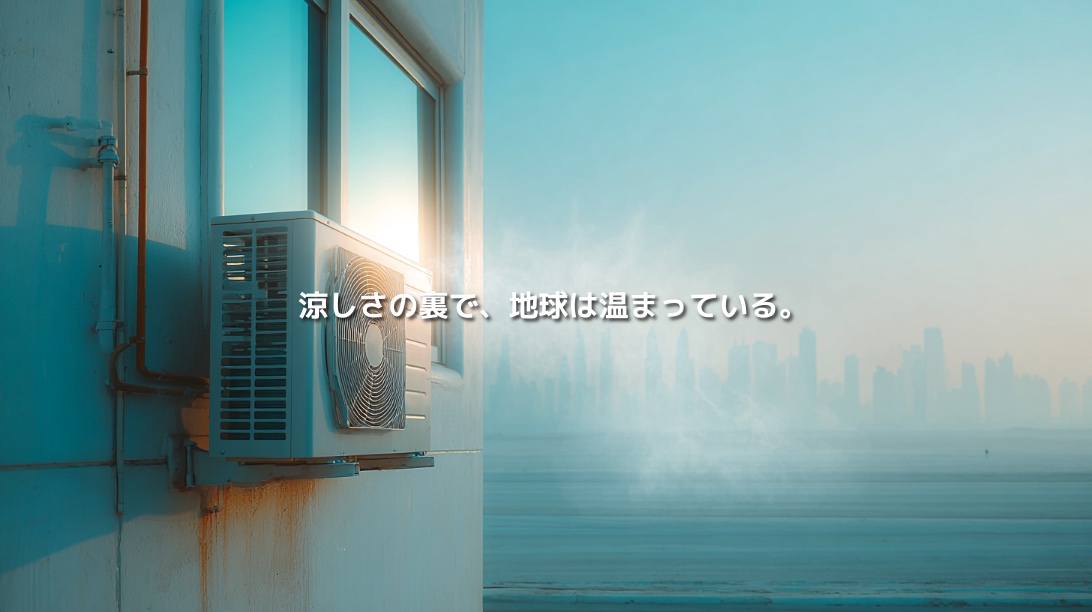
An air conditioner does not create cold air from nothing. It transfers heat from inside a building to a substance known as a refrigerant and carries that heat outdoors.
Many air-conditioning systems have used hydrofluorocarbons, or HFCs, as refrigerants.
HFCs do not destroy the ozone layer.
Depending on the substance, however, they can have a global warming effect hundreds or even thousands of times greater than carbon dioxide.
While the refrigerant remains sealed inside the equipment, it does not directly warm the atmosphere.
But if it leaks from pipes, escapes during repairs, or is not properly recovered when equipment is removed or discarded, it is released into the air.
We use electricity to cool our rooms.
At the same time, the machinery providing that cooling contains substances that can strongly warm the planet if they escape.
The Problem That Emerged After Protecting the Ozone Layer
Chlorofluorocarbons, or CFCs, were once widely used in refrigerators and air conditioners.
They were stable, nonflammable, and easy to handle as refrigerants.
Scientists later discovered that when these substances were released into the atmosphere, they could reach the stratosphere and destroy the ozone layer that protects Earth from ultraviolet radiation.
In 1987, the international community adopted the Montreal Protocol and began phasing down the production and consumption of ozone-depleting substances.
Japan also transitioned from CFCs and hydrochlorofluorocarbons, or HCFCs, to HFCs, which do not damage the ozone layer.
This transition represents one of the major achievements of international environmental cooperation.
But the story did not end there.
Although HFCs do not destroy the ozone layer, many are powerful greenhouse gases.
Japan’s Ministry of the Environment explains that some fluorocarbon substitutes have global warming effects ranging from several dozen to more than 10,000 times that of carbon dioxide.
A substance adopted to protect the ozone layer subsequently emerged as another challenge for the climate.
This does not mean that the earlier decision was simply a mistake.
A technology that solves one environmental problem may create a different burden elsewhere.
Society must therefore continue updating its technologies as new effects become visible.
Japan Emits 31.7 Million Metric Tons of an Invisible Gas
According to materials published by Japan’s Ministry of the Environment and Ministry of Economy, Trade and Industry in March 2026, Japan emitted approximately 31.7 million metric tons of HFCs in CO₂ equivalent in 2023.
Emissions began to decline in 2022, but the 2023 level was still approximately 44 percent higher than in 2013.
Looking at emissions across the equipment life cycle reveals where the problem occurs.
Manufacturing accounted for approximately 0.2 percent of emissions.
By contrast, around 41 percent occurred while equipment was in use, and approximately 48 percent occurred when it was discarded.
By equipment type, commercial air conditioners accounted for around 31 percent, residential air conditioners for approximately 30 percent, and commercial refrigeration and freezing equipment for about 21 percent.
The main problem therefore does not exist only at the moment the refrigerant is manufactured.
It continues for years while the equipment operates in our towns and cities—and remains until the unit is finally removed from a building, shop, or home.
A pipe connection loosens.
Equipment deteriorates.
Refrigerant is added to a malfunctioning cooling system.
An air conditioner is removed during the demolition of a building.
A household unit is handed to an unverified waste collector.
Refrigerants are invisible. When they leak, they do not create piles of waste.
They have no color or noticeable odor, and they leave nothing behind on a road or beach.
Their disappearance into the atmosphere without being seen is what makes the problem so difficult to recognize.
Refrigerant Is Not Something That Should Be “Used Up”
Air-conditioner refrigerant is not consumed during operation in the same way as gasoline.
It is designed to circulate within a sealed system, repeatedly undergoing compression and expansion as it transfers heat from inside the building to the outside.
Under normal conditions, it should not require routine replenishment.
If the amount of refrigerant declines and the system no longer cools effectively, simply adding more is not necessarily the correct response.
A technician must determine whether a leak has occurred and repair its cause.
Otherwise, the newly added refrigerant may also escape into the atmosphere.
Commercial refrigeration and air-conditioning systems often have long, complex piping networks, and many operate 24 hours a day.
Supermarket display cases, restaurant refrigerators, factories, office buildings, and distribution warehouses all depend on cooling systems that quietly support urban life.
In 2024, approximately 2,500 metric tons of HFCs were added during maintenance to commercial equipment still in operation in Japan.
The quantity being replenished illustrates why preventing leaks during use is so important.
The refrigerant problem is not simply a matter of whether we switch off an air conditioner.
It is a management issue involving how equipment is designed, inspected, monitored for abnormalities, repaired, and ultimately decommissioned.
Less Than Half of the Refrigerant Is Recovered at Disposal
Another stage at which refrigerants can readily enter the atmosphere is when equipment is discarded.
A 2024 estimate by Japan’s Ministry of the Environment placed the overall refrigerant recovery rate for residential and commercial air conditioners and commercial refrigeration equipment at approximately 42 percent by refrigerant volume.
The estimated recovery rate was approximately 44 percent for residential air conditioners and about 40 percent for both commercial air conditioners and commercial refrigeration equipment.
The calculation method is scheduled to be reviewed.
Even so, the current estimate suggests that more than half of the refrigerant believed to remain inside discarded equipment is not accounted for in confirmed recovery volumes.
Recovering refrigerant requires specialized equipment and trained technicians.
The process involves equipment owners, installation contractors, refrigerant-recovery operators, demolition companies, and recycling businesses.
If coordination breaks down at any point between building demolition, equipment replacement, appliance collection, and recycling, the refrigerant can be lost.
In Japan, residential air conditioners are covered by the Home Appliance Recycling Act.
When replacing an air conditioner, consumers should generally ask the retailer selling the new unit to collect the old one. When disposing of a unit without buying a replacement, they should contact the retailer from which it was purchased or use another authorized route.
Avoiding unknown collection operators chosen solely for price or convenience is an important first step toward ensuring that the refrigerant is properly recovered.
Removing an appliance from sight is not the same as disposing of it correctly.
An air conditioner continues to carry environmental consequences even after it has been discarded.
The Hotter It Becomes, the More Cooling We Need—and the Greater the Burden May Become
As temperatures rise, people use air conditioning for longer periods.
More homes and facilities install new cooling equipment.
Electricity consumption increases, and so does the total number of machines containing refrigerants.
More equipment also means more repairs, replacements, and disposal in the future.
The climate becomes hotter.
Demand for cooling rises.
Electricity consumption and the volume of refrigerants increase.
Without effective measures, greenhouse gas emissions rise further.
This cycle is not limited to Japan.
The United Nations Environment Programme’s Global Cooling Watch 2025 warns that, under current trends, global cooling demand could more than triple by 2050.
Greenhouse gas emissions associated with cooling could nearly double from 2022 levels.
Yet abandoning air conditioning cannot be the solution.
Japan’s Ministry of the Environment recommends the appropriate use of air conditioning and other cooling measures indoors to prevent heatstroke.
Cooling is an important form of adaptation to the extreme heat created by climate change.
Depending on how that cooling is produced, however, it can also contribute to further climate change.
This is the contradiction at the center of modern heat protection.
The Answer Is Not to Stop Using Air Conditioning, but to Change How Cooling Is Produced
We do not need to endure dangerous heat.
The goal is to secure the cooling necessary to protect life while reducing the environmental burden created in the process.
The first step is to transition from HFCs with high global warming potential, or GWP, to lower-GWP refrigerants and natural refrigerants.
Natural refrigerants include carbon dioxide, ammonia, and hydrocarbons.
They can reduce the climate impact of cooling, but some applications require safety measures to manage high pressure, toxicity, or flammability.
Replacing one refrigerant with another does not solve everything by itself.
Equipment performance, installation conditions, technical skills, and maintenance systems must all be considered to achieve both safety and energy efficiency.
Through the Kigali Amendment to the Montreal Protocol, adopted in 2016, the international community is gradually reducing the production and consumption of HFCs.
The United Nations estimates that full implementation of the amendment could avoid up to 0.5°C of global warming by 2100.
At the same time, we need equipment that is less prone to leakage, systems that continuously monitor for abnormalities, reliable inspections, and the reclamation or destruction of recovered refrigerants.
Buildings and cities must also be designed to reduce the demand for cooling itself.
Improve insulation.
Block direct solar heat through windows.
Reduce heat absorption by roofs and exterior walls.
Create paths for air to move through buildings and streets.
Increase trees and green spaces to reduce the heat stored in urban areas.
If buildings continue accumulating heat, even highly efficient air conditioners must operate longer and work harder.
Refrigerants, equipment, electricity, architecture, and urban design are all connected.
Cooling is not produced by a single appliance alone.
What Can We Do?
At home, the answer is not to tolerate dangerous temperatures through extreme energy conservation.
When replacing an old air conditioner, consider not only the purchase price but also its energy efficiency and the refrigerant it uses.
If cooling performance declines, ask a qualified technician to check for refrigerant leaks instead of simply adding more refrigerant.
Clean filters, keep the area around the outdoor unit unobstructed, and reduce unnecessary strain on the system.
When disposing of an air conditioner, follow the authorized recycling route and use a reliable contractor for removal and collection.
Businesses and facility managers have an even greater responsibility.
They should:
- Identify the type and quantity of refrigerant in each system
- Maintain complete inspection and maintenance records
- Detect leaks as early as possible
- Evaluate both refrigerant climate impact and energy efficiency when replacing equipment
- Include the time and cost of refrigerant recovery in demolition and removal plans from the beginning
Managing an invisible gas requires visible records and uninterrupted responsibility.
Preventing Today’s Cooling from Becoming Tomorrow’s Burden
Air conditioning is no longer a luxury in modern society.
Homes, schools, hospitals, care facilities, shops, factories, and distribution networks all depend on cooling.
If cooling and refrigeration stopped, the effects would extend beyond human health to food supplies, medical services, and industry.
This issue must not be reduced to blaming people for using air conditioners.
The question is not whether we should give up cooling.
It is what technologies and social systems should support that cooling.
Until now, we have tended to assess the environmental impact of air conditioners mainly through their electricity consumption.
But another environmental burden circulates inside the machinery.
It continues from operation and maintenance to removal and disposal.
We can feel the cool air.
But we cannot see where the gas producing it came from or where it goes when it escapes.
Air conditioning is necessary to protect people from dangerous heat.
At the same time, we can reduce the emissions hidden behind that cooling.
As the planet becomes hotter, how can we produce the cooling we increasingly need without warming it further?
This is not a question of abandoning comfort.
It is a question of how to preserve a society in which people can continue to live safely in a warming world.
References
- Ministry of the Environment, Japan: Trends in Fluorocarbon Countermeasures
- Ministry of the Environment and Ministry of Economy, Trade and Industry, Japan: Current Fluorocarbon Emissions and Implementation of the Revised Fluorocarbons Emission Control Act
- Ministry of Economy, Trade and Industry, Japan: Correct Disposal of the Four Home Appliance Categories
- United Nations Environment Programme: Global Cooling Watch 2025
- Ministry of the Environment, Japan: Heatstroke Prevention Information
- Ozone Secretariat, United Nations Environment Programme: The Kigali Amendment to the Montreal Protocol
Article Excerpt
Air conditioning protects people from dangerous heat, but many systems contain HFC refrigerants with global warming effects hundreds or thousands of times greater than carbon dioxide. This article examines refrigerant leakage, low recovery rates, safer alternatives, and how society can provide essential cooling without intensifying climate change.