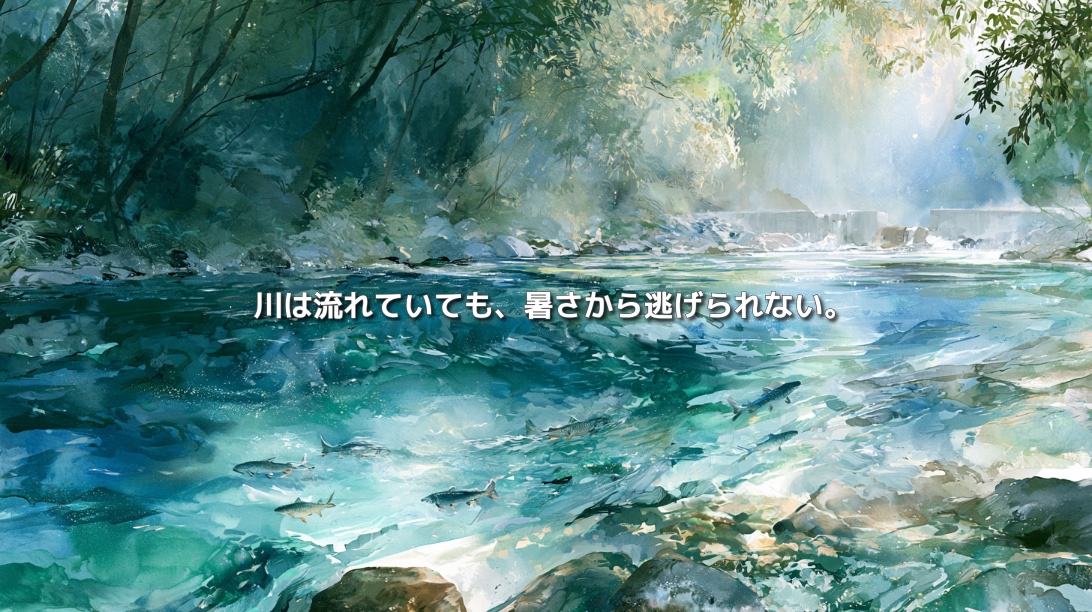
Step into a mountain river in midsummer, and cold water wraps around your feet.
The water has descended from the mountains, passed beneath the shade of forests, flowed between rocks, and mixed with springs and tributaries on its journey downstream.
We tend to imagine rivers as places that remain cool even during the hottest months.
But rivers are beginning to warm.
Rising air temperatures, changing rainfall patterns, reduced flow during droughts, the loss of riverside forests, and altered currents caused by dams and water intake facilities are transforming river temperatures.
When the water remains clear, this change is difficult to see.
There may be no floating waste, visible pollution, unusual color, or chemical odor. Yet a temperature increase of only a few degrees can make an established habitat uninhabitable for the organisms that depend on it.
Rivers experience heatwaves too.
And unlike humans, the animals living in them cannot escape into an air-conditioned building.
What Determines the Temperature of a River?
River temperature is not determined by air temperature alone.
It is shaped by a combination of solar radiation, water volume, depth, current speed, channel width, surrounding vegetation, groundwater inflow, tributaries, and the condition of the riverbed.
In mountain streams, trees often extend over the water and block direct sunlight. Rain and snowmelt that infiltrate forest soil may travel underground before entering a river as relatively cool groundwater.
These processes help some streams remain cool even in summer.
When riparian forests are lost, however, the water surface is exposed to direct sunlight for longer periods, making the river more vulnerable to warming.
The amount of water also matters.
A river with a large flow volume is generally more resistant to short-term heating. When rainfall decreases and water is simultaneously withdrawn for agriculture, industry, or public supply, the remaining river may become shallower and warmer.
River engineering can also alter temperature.
Changes to channel width, water depth, current speed, and the distribution of pools and riffles affect how long water is exposed to sunlight and how it exchanges heat with the riverbed and groundwater.
River temperature is not something imposed only from the sky.
It is created by land use across the watershed, the physical form of the river, and the ways people store, divert, and consume water.
What Happens to Fish When Water Temperatures Rise?
Fish cannot maintain a constant internal body temperature in the way humans can.
Their body temperature changes with the surrounding water. As a result, water temperature directly affects their metabolism, growth, feeding, reproduction, movement, and chances of survival.
As water warms, a fish’s metabolic rate generally increases.
That does not necessarily mean the fish becomes healthier or more active.
A higher metabolic rate requires more energy and oxygen. At the same time, warmer water holds less dissolved oxygen.
The fish needs more oxygen precisely when less oxygen is available.
This double burden can rapidly drain its energy.
Japan’s National Institute for Environmental Studies has reported that extreme high-water-temperature events are becoming more frequent in lakes and rivers. Mass mortality and declining catches of cold-water freshwater fish have also been reported in association with extreme heat.
When elevated temperatures continue, fish may struggle to convert food into growth because more energy is required simply to maintain basic bodily functions. Resistance to disease can decline, while spawning success and juvenile survival may also be affected.
Not every fish species responds in the same way.
Those most vulnerable are often species adapted to cold water.
In Japan, char, masu salmon, yamame trout, amago trout, Dolly Varden, and other salmonids are representative inhabitants of mountain streams and cold-water environments.
For these species, cold water is not simply comfortable.
It is a requirement for survival.
Fish Are Being Pushed Upstream
As the lower reaches of a river become warmer, cold-water fish may attempt to move upstream.
Higher elevations, forested valleys, spring-fed tributaries, and shaded sections may still retain suitable temperatures.
But rivers do not continue upstream forever.
Channels become narrower toward their headwaters, reducing the amount of available habitat. Waterfalls, erosion-control dams, intake weirs, and large dams may also block further movement.
Research by Japan’s National Institute for Environmental Studies warns that warming may shift freshwater fish distributions upstream while dams and other structures prevent that movement and fragment populations among separate tributaries.
Fish cannot simply move northward or upstream whenever conditions change.
They need accessible escape routes.
Even if suitable temperatures remain somewhere within the watershed, that area cannot function as a refuge if fish are unable to reach it.
Japan’s Ministry of the Environment has also emphasized that many freshwater fish need to move among rivers, lakes, rice paddies, irrigation channels, ponds, and spring-fed areas to complete their life cycles.
When rising temperatures and river fragmentation occur together, cold-water habitats can become isolated like small islands.
Isolated populations are more vulnerable to disappearing after a single severe drought, flood, or heatwave.
Cold-Water Refuges Within a River
A river does not warm evenly along its entire length.
Small areas of colder water may remain where:
- A cool tributary joins the main channel
- Spring water enters the river
- Groundwater rises through the riverbed
- Deep pools retain cooler water
- Trees shade the riverbank
- Water flows through narrow or sheltered terrain
These areas can function as cold-water refuges, also known as thermal refugia.
Just as people seek shade or air-conditioned public spaces during extreme heat, fish may move toward cooler patches during the hottest periods of the day.
This is why average river temperature alone does not tell the entire story.
We must identify where cold water remains and whether fish can reach it.
Two rivers may have the same average temperature but provide very different chances of survival. A river containing springs, deep pools, shaded banks, and temperature variation offers more options than a uniformly shallow and exposed channel.
River management has traditionally focused on water quality, flow volume, and flood protection.
In a warming climate, thermal diversity—the presence of different temperatures within the river—must also become an important measure of ecological health.
Do Dams Warm Rivers or Cool Them?
Dams can significantly affect downstream water temperatures.
However, it is too simple to say that dams always warm rivers or always cool them.
Reservoirs can develop thermal stratification, with warmer water near the surface and colder water at greater depths. The temperature downstream depends partly on the depth from which water is released.
If cold water is discharged from deep within a reservoir, the downstream river may become colder than it would naturally be during that season.
If warmer surface water is released, downstream temperatures may rise.
Either change can disrupt the river’s natural seasonal rhythm.
Fish often use temperature as a biological signal. Shifts in temperature can influence spawning, hatching, migration, feeding, and the emergence of aquatic insects.
Dams may also offer opportunities for climate adaptation.
Selective withdrawal systems allow operators to release water from different depths. Depending on reservoir conditions, these systems may help discharge water closer to the natural temperature of the incoming river or suppress extreme downstream warming during summer.
Researchers at the National Institute for Environmental Studies are investigating selective withdrawal as a potential way to reduce the effects of climate change on downstream fish habitats.
Instead of viewing a dam only as an environmental burden, we can also ask how existing infrastructure might be operated to support ecosystems.
Alongside flood control, water supply, and hydropower, managing river temperature may become another important responsibility of dam operation.
Riparian Forests Are Parasols for Rivers
Trees growing along rivers do more than create attractive scenery.
Their branches and leaves block sunlight and help limit water-temperature increases. Fallen leaves and insects provide food for aquatic organisms. Roots stabilize riverbanks and create sheltered areas along the water’s edge.
Riparian forests form a boundary connecting terrestrial and aquatic ecosystems.
In an age of extreme heat, they also function as parasols for rivers.
However, planting or preserving more trees is not a complete solution on its own.
River managers must also consider driftwood during floods, the channel’s ability to carry water, levee safety, maintenance, and surrounding land use.
The choice is not simply between keeping every tree and removing every tree.
More practical questions include:
- Which river sections most urgently need shade?
- Where do cold-water species still survive?
- Which forms of vegetation can be maintained without increasing flood risk?
- How can vegetation be restored after river engineering work?
- Can shaded sections be connected with springs, tributaries, and deep pools?
Each river has different conditions.
Riparian landscapes must be designed with flood safety and thermal ecology considered together.
Invisible Change Requires Continuous Monitoring
Water pollution may sometimes be detected through discoloration, odor, foam, or sudden fish mortality.
Temperature change is much harder to notice.
The water may be one degree warmer than yesterday. It may fail to cool overnight. A period of extreme heat may last several days longer than it did in the past.
These changes can accumulate without being visible to someone standing on the riverbank.
Continuous monitoring is therefore essential.
Measurements should be taken:
- From headwaters to downstream areas
- At the same time across multiple locations
- Near tributary and spring confluences
- During both daytime and nighttime
- Around dams and water intake facilities
- In pools, riffles, shaded sections, and exposed channels
Temperature records should then be compared with fish distributions, spawning grounds, aquatic insect populations, flow volumes, groundwater inputs, and habitat structures.
The average temperature of the entire river is not enough.
We need to know:
Where does cold water remain?
Where do high temperatures interrupt animal movement?
How are dams and water withdrawals changing the thermal environment?
Which refuges remain accessible during extreme heat?
In other words, rivers need temperature maps.
An invisible environmental problem becomes visible only when it is measured.
Protecting a River Means Protecting Its Coldness
When we talk about protecting rivers, we often think first about water quality.
We reduce waste, prevent chemical contamination, control sediment, and secure sufficient water flow.
All of these efforts are essential.
But a river can be clear, free of visible waste, and compliant with chemical water-quality standards—and still become uninhabitable if its temperature exceeds the limits of the organisms that live there.
River conservation now requires another perspective: protecting the thermal environment.
That means:
- Preserving and restoring riparian forests
- Protecting springs and cold tributaries
- Maintaining adequate river flow
- Retaining a varied channel with pools and riffles
- Avoiding uniform, shallow, exposed river structures
- Ensuring that fish can move toward cooler habitats
- Improving fish passage around barriers
- Considering the temperature of dam releases
- Monitoring both average and extreme water temperatures
This does not mean returning every river to an imagined historical condition.
It means preserving enough space within a changing climate for organisms to escape, rest, reproduce, and pass their lives on to the next generation.
A river may continue flowing, but the creatures within it cannot necessarily escape wherever they choose.
When cold-water species are pushed farther upstream, trapped within tributaries, and deprived of their final thermal refuges, they may disappear from the watershed entirely.
Rivers experience heatwaves too.
Protecting a river therefore means preserving not only the quantity and cleanliness of its water, but also its coldness.
A river may keep flowing and still offer no escape from the heat.
What must be protected is not water alone.
It is the time, movement, and countless lives that have evolved within its temperature.
Key References
- National Institute for Environmental Studies: Risk Assessment of River Ecosystems Associated with Climate Change
- National Institute for Environmental Studies: Predicting Climate-Driven Changes in River Fish Distribution and Mitigation through Dam Operations
- National Institute for Environmental Studies: Impacts of Summer Heatwaves on Cold-Water Freshwater Fish
- Climate Change Adaptation Information Platform: Climate Impacts on Summer Habitat for Masu Salmon
- Climate Change Adaptation Information Platform: Impacts on Inland Fisheries
- Ministry of the Environment, Japan: Recommendations for Freshwater Fish Conservation
- Public Works Research Institute: Aqua Restoration Research Center