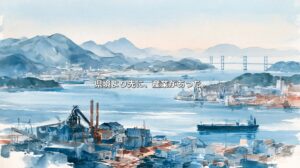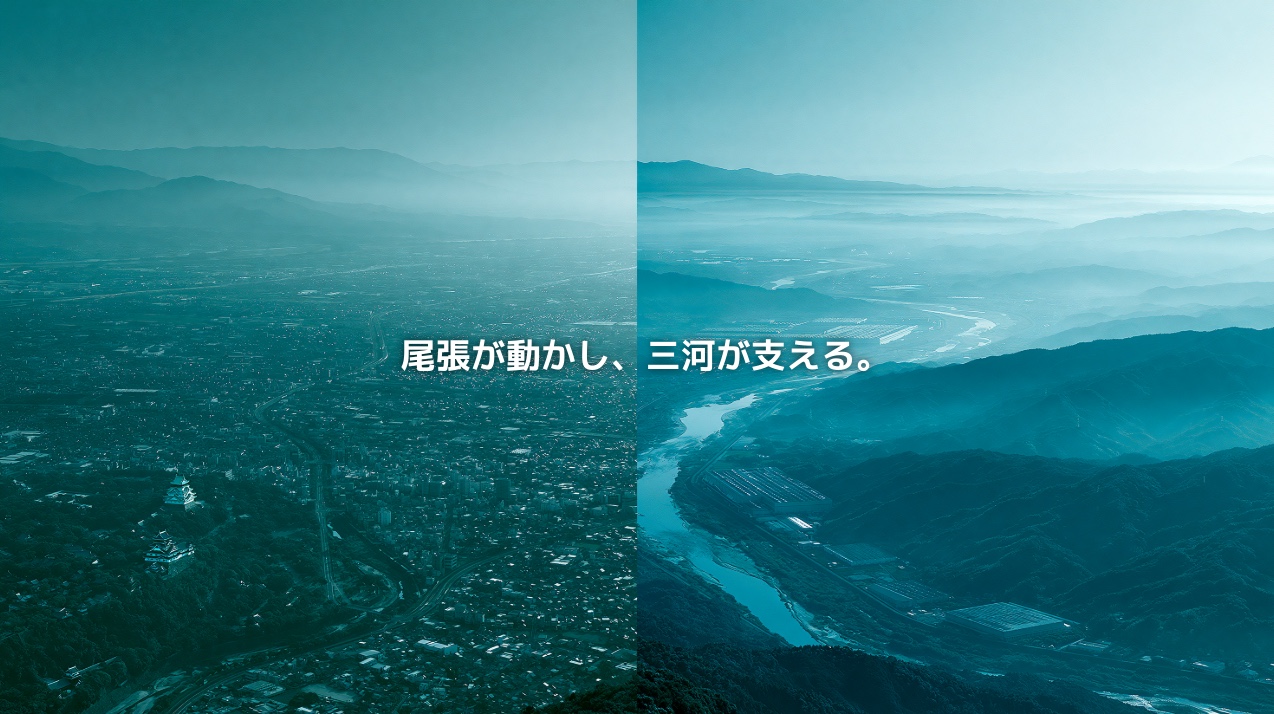
Aichi is one prefecture, yet it contains two regions with distinctly different identities.
Owari lies in the west.
Mikawa extends across the central and eastern parts of the prefecture.
Owari developed around Nagoya as a center of commerce, logistics, culture, and administration.
Mikawa includes cities such as Toyota, Okazaki, Kariya, Anjo, and Toyohashi, and has grown into one of Japan’s most important manufacturing regions, particularly in the automobile industry.
Oda Nobunaga and Toyotomi Hideyoshi emerged from Owari.
Tokugawa Ieyasu emerged from Mikawa.
Today, Owari contains the largest metropolitan area in central Japan, while Mikawa supports a globally connected automobile-production network.
Why did such different regional identities develop within the same prefecture?
The answer cannot be explained simply by local personality or historical coincidence.
The shape of the plains, the flow of rivers, access to the sea, the position of highways, and relationships with surrounding powers all influenced how people lived and organized themselves.
To understand the geopolitics of Aichi, we must look beyond the modern administrative boundary called “Aichi” and examine the differences between Owari and Mikawa within it. (NEOTERRAIN Journal)
Aichi Became One Prefecture Only in Modern Times
Present-day Aichi was not historically a single region.
Before the ritsuryo administrative system was established, the area was divided among territories associated with the Kiso and Shonai river systems, the Yahagi River basin in western Mikawa, and the Toyo River basin in eastern Mikawa.
These areas were later reorganized into two provinces: Owari and Mikawa.
That division remained in place through the Edo period.
After the abolition of the domains and establishment of prefectures during the Meiji era, much of Owari became Nagoya Prefecture, while Mikawa and the Chita area of Owari became Nukata Prefecture.
Nagoya Prefecture was later renamed Aichi Prefecture and absorbed Nukata Prefecture, creating the framework of present-day Aichi.
In other words, Aichi is a modern administrative unit that brought together two historically distinct regions.
Roughly 150 years have passed since they were incorporated into one prefecture.
Even so, the names Owari and Mikawa remain embedded in company names, schools, administrative areas, transportation networks, and regional culture.
That is because the distinction between them is more than a historical label.
Owari Was an Open Plain Facing Outward
Owari occupies western Aichi and includes cities such as Nagoya, Ichinomiya, Tsushima, Inuyama, and Kasugai.
Its defining geographical feature is the broad Nobi Plain.
The plain was formed by river systems including the Kiso, Nagara, and Ibi—often called the Kiso Three Rivers—as well as the Shonai River.
It supported agriculture while also creating open space through which people and goods could move.
Roads could be built relatively easily across the flat terrain, allowing large numbers of people and supplies to travel.
Owari was also close to Ise Bay, making it possible to connect river transport, overland routes, and maritime trade.
It was not an inward-looking region isolated from its surroundings.
People, commodities, technology, and information could enter from outside.
Yet openness did not necessarily mean security.
Mino lay to the west and north, Ise to the southwest, Mikawa and Totomi to the east, and beyond them Kyoto, Suruga, and the Kanto region.
Because different powers could enter Owari from several directions, local rulers had to understand external developments quickly and adopt new talent and technologies in order to survive.
This geographical openness likely helped foster Owari’s commercial character and willingness to innovate.
Nobunaga Turned Owari’s Openness into Political Power
Oda Nobunaga was one of the figures who used Owari’s geography most effectively.
His father, Oda Nobuhide, strengthened his influence not only through territorial control but also through relationships with Tsushima and Atsuta, important centers of commerce and religion.
The power of a Sengoku-period lord was not determined only by the size of his territory or agricultural output.
Moving an army required money, weapons, food, horses, personnel, and information.
Controlling highways, ports, and commercial districts directly strengthened military power.
Nobunaga expanded his influence using Owari’s commercial wealth and transportation network.
He adopted new weapons and military methods.
He promoted people according to their ability rather than relying exclusively on birth or established status.
He often valued systems that worked over inherited customs and authority.
These characteristics reflect an environment in which people and information constantly moved across boundaries.
Owari could not be ruled simply by defending it.
Its leaders had to look outward and anticipate change.
Hideyoshi Demonstrated the Power of Mobility
Toyotomi Hideyoshi was also born in Owari.
Much about his early life remains uncertain, but he is widely known as a man who rose from a low social position, entered Nobunaga’s service, and eventually became the ruler who unified most of Japan.
One of Hideyoshi’s greatest strengths was that he did not depend entirely on inherited land or family status.
He understood people’s emotions, negotiated flexibly, adapted his role to different situations, and gathered the resources he needed.
On the battlefield, he emphasized logistics and castle construction.
In politics, he used rewards and appointments to organize people.
Such abilities are less likely to emerge within a completely fixed and closed community.
In Owari, highways brought merchants, craftspeople, warriors, pilgrims, and travelers into contact with one another.
The ability to build relationships with people from different backgrounds was valuable.
Hideyoshi’s rise can therefore be understood not only as a result of personal talent, but also within the mobile and highly connected environment of Owari.
Owari produced more than warriors who defended inherited territory.
It produced people capable of crossing boundaries, connecting others, and reorganizing existing systems.
Nagoya Was Not a Naturally Evolved City
Nagoya is now the center of Owari.
However, it was not always the region’s political center.
Before Nagoya Castle was built, Kiyosu served as the primary political base of Owari.
In 1610, Tokugawa Ieyasu began construction of Nagoya Castle on the northwestern edge of the Nagoya Plateau.
Samurai, merchants, craftspeople, temples, and shrines were moved from Kiyosu in a large-scale relocation known as the Kiyosu-goshi.
A grid-patterned castle town was developed around Nagoya Castle, forming the basis of the city’s present urban structure.
Nagoya was therefore not a settlement that expanded naturally over time.
It was a city designed for political and military purposes.
The Nagoya Plateau offered greater protection against flooding and attack than the surrounding lowlands.
It also allowed the Tokugawa regime to control the Tokaido corridor and position a powerful branch of the Tokugawa family between Edo and the western domains.
Merchants and craftspeople gathered in the castle town, concentrating political authority, commerce, and manufacturing expertise.
Owari’s openness was reorganized into a larger economic system through the planned city of Nagoya.
Owari’s Strength Lies in Gathering and Editing
Owari did not necessarily possess every resource it needed within the region.
Instead, it developed by gathering people, goods, technologies, and information from outside and reorganizing them within the city.
The castle town attracted not only samurai, but also merchants, craftspeople, performers, and religious figures.
Roads connected the region with Edo, Kyoto, Osaka, Hokuriku, and Ise.
Ise Bay provided access to maritime logistics.
Nagoya was not merely a place where locally produced goods were sold.
It functioned as an editorial hub: accepting materials and ideas from different regions, selecting and processing them, and sending them outward again.
This characteristic remains visible in modern Nagoya.
Corporate headquarters, trading companies, financial institutions, universities, broadcasters, department stores, and cultural institutions are concentrated there.
The city brings together information and capital from across the Tokai region.
Owari’s geopolitical strength does not lie only in creating something entirely from the beginning.
It lies in gathering different elements and making them function as one economic sphere.
Mikawa Is Not One Uniform Landscape
Mikawa has a different geography.
It is usually divided into western Mikawa and eastern Mikawa.
Western Mikawa includes cities such as Okazaki, Toyota, Kariya, Anjo, and Nishio.
Plains, hills, and mountains spread across the Yahagi River basin.
Eastern Mikawa includes Toyohashi, Toyokawa, Shinshiro, and Tahara.
Its landscape includes the Toyo River plain, the mountains of Oku-Mikawa, the Atsumi Peninsula, Mikawa Bay, and the Pacific coast facing the Enshu Sea.
Unlike Owari, Mikawa is not organized around one vast plain and one dominant city.
It contains several river basins, plains, valleys, mountain districts, and coastal areas.
These conditions encouraged each area to develop its own sphere of daily life.
At the same time, local communities had to organize themselves collectively when facing pressure from outside.
Rather than concentrating every function in one dominant center, Mikawa developed a structure in which multiple regional hubs shared different roles.
Mikawa as a Borderland Shaped Ieyasu
Tokugawa Ieyasu was born in Okazaki in Mikawa Province.
At the time, Mikawa was not controlled by a stable and fully independent power.
The Oda clan stood to the west.
The Imagawa clan stood to the east.
Other forces existed beyond the mountains to the north.
Ieyasu’s father, Matsudaira Hirotada, had to survive between larger neighboring powers.
As a child, Ieyasu himself was moved between Owari and Suruga as a political hostage.
Mikawa was a borderland between eastern and western powers.
A small regional force in such a position could not confront every larger power alone.
To survive, it had to form alliances according to circumstances, preserve internal cohesion, and wait for favorable opportunities.
Ieyasu’s political style often emphasized long-term stability over the immediate destruction of existing systems.
Where Nobunaga broke outward through obstacles, Ieyasu consolidated internally and waited for the right moment.
This difference can be interpreted not only as a contrast in personality, but also as a reflection of the different geopolitical environments of Owari and Mikawa.
Why Did the Mikawa Warriors Become So Cohesive?
The warriors who supported Tokugawa Ieyasu are often described as exceptionally loyal.
However, it is not enough to say that people from Mikawa were naturally loyal.
Mikawa’s warriors did not always exist within a stable relationship between lord and vassal.
The Matsudaira family contained several branches.
There were conflicts with religious organizations and local landholders.
During the Mikawa Ikkō-ikki uprising, even Ieyasu’s retainers were divided between opposing sides.
The cohesion of the Mikawa warrior group was therefore not complete from the beginning.
It developed gradually through experiences of division, confrontation, and reconciliation.
For a small regional power surrounded by larger forces, survival required clearly defined roles and accumulated trust among retainers.
No single hero could manage everything.
Different retainers had to protect their own positions and responsibilities.
Victory depended not only on dramatic battles, but also on supply, castle construction, negotiation, and governance.
This kind of organizational culture can be compared—carefully—with the later manufacturing culture of Mikawa.
The Mikawa warriors and modern corporations should not be treated as directly equivalent.
Yet both reveal a regional structure in which multiple participants with different roles cooperate over a long period, rather than relying entirely on one exceptional individual.
Mikawa Manufacturing Is a Network of Specialized Roles
Modern western Mikawa contains one of Japan’s largest manufacturing clusters, centered on the automobile industry.
A major final-assembly automaker is based in Toyota City.
Kariya, Anjo, Okazaki, Nishio, Hekinan, and surrounding cities contain component makers, material suppliers, machine-tool companies, and logistics facilities.
This industrial structure does not mean that one enormous factory manufactures every part of a vehicle.
Numerous companies are connected around final automobile production.
They specialize in engines, motors, brakes, seats, electronic components, molds, machine tools, logistics, and other fields.
Each company has its own technical expertise, while sharing information about quality, delivery schedules, and improvement.
Mikawa manufacturing is therefore more than a collection of separate companies.
It is a region-wide network of specialized roles.
Geography supports this structure.
Multiple cities and industrial centers are located within relatively short distances of one another and are connected by road networks.
Rather than being concentrated in one city, different locations perform different functions.
Each city contains distinct technologies and companies, yet all operate within one production system.
Mikawa’s strength does not come from having one enormous central city.
It comes from close connections between multiple centers and the continuous improvement carried out across production sites.
Why Mikawa Could Shift from Textiles to Automobiles
Mikawa’s automobile industry did not appear suddenly.
Before automobiles, the region had accumulated knowledge through cotton cultivation, textiles, weaving, and textile machinery.
Sakichi Toyoda worked on improving and automating looms.
He applied for a patent for a wooden hand loom in 1890 and continued to develop powered and automated machinery.
In 1924, he completed the Type G automatic loom.
Producing the Type G loom required foundry equipment and machine tools.
Systems were developed to ensure dimensional accuracy and interchangeability among components.
The first machine was completed in 1925, and Toyoda Automatic Loom Works was established in 1926.
Building looms required woodworking, metalworking, power transmission, quality control, and parts supply.
These capabilities could later be adapted to automobile production.
Textiles and automobiles are different products.
Yet both require machine design, component processing, process improvement, and stable mass production.
Mikawa’s industrial transformation became possible because the region had accumulated knowledge not only about what to produce, but about how to produce it.
Kaizen Emerges from Regional Proximity
The automobile industry depends on close coordination between design and manufacturing, as well as between automakers and component suppliers.
When a problem occurs in a part, people must identify the cause, modify the process, and prevent the same problem from happening again.
Physical and relational proximity between companies becomes a major advantage.
Engineers can visit a factory and inspect the actual product.
Designers and production workers can exchange opinions directly.
A problem can be treated not as the isolated responsibility of one company, but as an issue affecting the entire production process.
Many related companies are located near one another in western Mikawa.
This proximity increases the speed of both information exchange and improvement.
Kaizen is not merely an internal management technique used within one company.
It is also a regional system in which neighboring companies and production sites share knowledge through long-term relationships.
Owari can be understood as a region that gathers and edits diverse information from outside.
Mikawa can be understood as a region that accumulates small improvements within production sites.
Ports Connected Both Owari and Mikawa to the World
The industries of Owari and Mikawa do not operate entirely within the region.
Ports on Ise Bay and Mikawa Bay connect them to global markets.
Since opening in 1907, the Port of Nagoya has supported central Japan’s manufacturing industries through logistics.
In 2024, it handled approximately 156.71 million tonnes of cargo, ranking first in Japan for the twenty-third consecutive year.
Completed automobiles and automobile components accounted for about 63 percent of its export cargo.
Shinpo Pier at the Port of Nagoya serves as one of the locations from which completed vehicles are shipped overseas.
Owari provides urban functions and port logistics.
Mikawa provides manufacturing centers and component-supply networks.
Roads, railways, and ports connect them, allowing the entire prefecture to operate as a vast export-oriented industrial region.
Neither Owari nor Mikawa alone could sustain the industrial strength of present-day Aichi.
Owari often supports information, commerce, administration, and logistics.
Mikawa often supports production, technology, and continuous improvement.
Their roles are not always divided so neatly in practice.
Nevertheless, the complementary relationship between these different regional characteristics is one of Aichi’s defining strengths.
Owari and Mikawa Should Not Be Understood Only as Opposites
Differences between Owari and Mikawa are often described in terms of local personality.
Owari is sometimes portrayed as flamboyant and commercially skilled.
Mikawa is often described as practical, restrained, and reliable.
People also point to differences in language and culture between Nagoya and Mikawa.
Such descriptions may reflect real regional perceptions.
However, treating them as fixed personality traits obscures the deeper structure.
Regional identity is not an inborn character.
It is a pattern of behavior formed over time through interactions between geography and society.
In broad plains and cities where people and goods gather, negotiation with outsiders and the selection of information become important.
In manufacturing regions where several local centers cooperate, internal trust and the division of roles become more important.
The differences between Owari and Mikawa do not represent superiority or inferiority.
They are the results of adaptation to different environments.
The existence of both within one prefecture has become one of Aichi’s strengths.
Innovation May Not Take Root Without Mikawa—and Mikawa May Not Reach the World Without Owari
Owari has the capacity to accept new people and information and to change existing systems.
Mikawa has the capacity to embed technology in production sites, improve quality, and maintain systems over the long term.
With Owari’s strength alone, new ideas might emerge but fail to become established as a regional production system.
With Mikawa’s strength alone, advanced technology might remain disconnected from external markets and new values.
One force opens outward.
The other consolidates inward.
One creates change.
The other continues improvement.
Aichi developed because it possessed both.
Nobunaga and Hideyoshi changed the existing order.
Ieyasu established institutions that lasted over time.
In a similar way, Owari and Mikawa have transformed Japanese society through different methods.
Electrification Will Change the Relationship Between Owari and Mikawa
The automobile industry is now undergoing a major transformation through electrification, software, autonomous driving, and artificial intelligence.
Until recently, competitiveness depended heavily on mechanical component processing and assembly.
In the future, collaboration with battery makers, semiconductor companies, software developers, telecommunications firms, data businesses, and energy industries will become increasingly important.
Mikawa’s ability to improve quality at production sites will remain necessary.
However, relying only on existing business relationships and technologies may make it difficult to attract new companies and talent.
This is where Owari’s openness becomes important.
Universities, startups, IT companies, financial institutions, international businesses, and creators can bring knowledge that differs from the traditional automobile industry.
Networks and ideas developed in Owari can be connected with Mikawa’s production sites.
In the opposite direction, the manufacturing expertise and production data accumulated in Mikawa can be turned into new businesses through Nagoya’s urban functions.
Aichi’s next stage will require more than preserving the distinction between Owari and Mikawa.
The two regions must be reconnected more deeply than before.
Nagoya-Centered Thinking Does Not Reveal Aichi’s Full Strength
When Aichi is introduced to outsiders, Nagoya often dominates the discussion.
Tourism, media, culture, and government functions are concentrated in the city, leading many people outside the prefecture to equate Aichi with Nagoya.
However, many of the production sites supporting Aichi’s economy are located outside Nagoya.
Toyota, Kariya, Anjo, Okazaki, Nishio, Hekinan, Toyohashi, and Tahara each possess different technologies, factories, agricultural resources, ports, and cultural traditions.
Aichi is not simply a structure in which one enormous city dominates its surroundings.
It is a multi-centered region in which Nagoya’s urban functions connect with a network of manufacturing cities.
Looking only at Nagoya makes Aichi appear primarily commercial and urban.
Looking only at Mikawa makes it appear primarily industrial.
Only by seeing both can we understand Aichi as a region where urban functions and production systems operate together.
Conclusion: Aichi Is Driven by Two Different Forces
The history of Aichi cannot be understood without Owari and Mikawa.
Owari contains the Nobi Plain, Ise Bay, transportation routes, and the city of Nagoya.
It developed the ability to gather people and goods, edit information, and spread new systems outward.
Mikawa contains the Yahagi and Toyo river basins, mountainous areas, and multiple regional centers.
It developed the ability to strengthen internal cooperation, divide responsibilities, and continue improving technology.
Oda Nobunaga and Toyotomi Hideyoshi emerged from Owari.
Tokugawa Ieyasu emerged from Mikawa.
Nagoya developed as an urban center in Owari.
A production network centered on the automobile industry developed across Mikawa.
These are not accidental parallels.
Geography shaped human behavior.
The accumulation of that behavior created political systems, cities, and industries.
Owari moves outward.
Mikawa supports from within.
One creates change.
The other turns change into a functioning system.
Aichi’s strength does not belong exclusively to either side.
It comes from two different forces that complement one another while remaining in creative tension.
As electrification and artificial intelligence transform the foundations of manufacturing, Aichi is approaching another turning point.
Can Owari’s openness attract new industries and talent?
Can Mikawa’s organizational strength convert existing expertise into the technologies of the next era?
Can the two regions become more deeply connected?
Aichi’s future does not begin by eliminating the differences between Owari and Mikawa.
It begins by understanding those differences and combining them in new ways.
References
- Aichi Prefectural Government, “The Historical Formation of Aichi”
- Official Nagoya Castle Website, “Construction of the Castle Town and the Kiyosu Relocation”
- City of Nagoya, “The Excavation of the Horikawa Canal”
- Official Nagoya Castle Website, “Overview of Nagoya Castle”
- Toyota Motor Corporation, “Sakichi Toyoda” and “An Overview of Sakichi Toyoda’s Inventions”
- Toyota Industries Corporation, “Corporate History”
- Nagoya Port Authority, “The Strength of the Port of Nagoya” and “Shinpo Pier”
Those interested in the histories of Owari and Mikawa, or in the future of manufacturing in Aichi, are invited to bookmark this article.
NEOTERRAIN Journal explores the identities and futures of Japanese regions by connecting geography, history, industry, and culture.