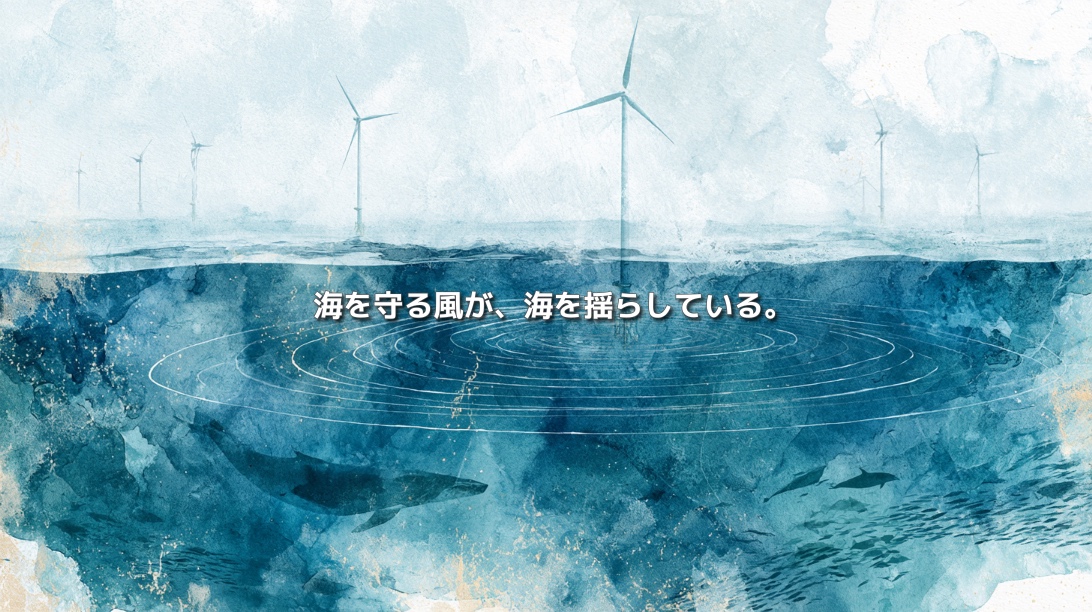
Offshore winds are generally stronger and more stable than winds on land. By harnessing them, wind turbines can generate electricity without burning fossil fuels.
Yet installing turbines at sea changes more than the seascape. It can affect the seabed, the movement of marine animals, fishing activities, and the underwater acoustic environment.
Renewable energy does not automatically mean zero ecological impact.
Offshore wind power therefore represents one of the central challenges of the energy transition: how can we address climate change while also protecting biodiversity and the livelihoods connected to the sea?
Why Offshore Wind Is Moving Out to Sea
Onshore wind power has expanded in many parts of the world, but finding suitable locations is becoming increasingly difficult.
This challenge is particularly pronounced in Japan. Much of the country is mountainous, with forests, settlements, agricultural land, and infrastructure competing for limited space. Wind farms also require access roads, transmission lines, and areas of graded land, all of which can create additional environmental impacts.
The ocean offers more space and often provides stronger, more consistent winds. Offshore locations can accommodate larger turbines and clusters of multiple turbines, allowing wind farms to generate electricity at a substantial scale.
However, Japan’s coastal waters become deep relatively quickly. Areas suitable for conventional fixed-bottom foundations are limited, which has accelerated interest in floating offshore wind technology.
The environmental effects of any offshore wind project depend on numerous factors, including:
- Water depth
- Seabed geology
- Wind and wave conditions
- Distance from ports and transmission infrastructure
- Existing fisheries
- Marine species and habitats
- Construction and maintenance methods
The question is therefore not simply whether offshore wind is environmentally friendly. The more meaningful question is how, where, and under what conditions it should be developed.
When Is Underwater Sound Generated?
Offshore wind farms generate underwater sound throughout their life cycle, from preliminary surveys to construction, operation, and eventual decommissioning.
| Project stage | Main sources of underwater sound | General characteristics |
|---|---|---|
| Preliminary surveys | Seabed geological surveys, survey vessels, acoustic equipment | Sound waves may be used to investigate seabed conditions |
| Construction | Pile driving, excavation, work vessels, cable installation | May include powerful impulsive sounds and continuous noise |
| Operation | Mechanical vibration, underwater structures, maintenance vessels | Usually quieter than construction noise but may continue for years |
| Decommissioning | Cutting or removing structures, component recovery, vessels | Noise levels vary depending on the removal method |
Pile driving for fixed-bottom turbines is one of the most significant concerns.
During pile installation, large steel foundations are repeatedly driven into the seabed using powerful hammers. Each strike generates sound that travels through both the water and seabed sediment.
The distance and intensity of sound propagation depend on factors such as:
- The size and shape of the pile
- Hammer energy
- Seabed composition
- Water depth
- Water temperature and salinity
- Underwater topography
This means that noise cannot be evaluated through a single universal standard alone. Measurements and modeling must reflect the conditions of each site.
What Does Construction Noise Do to Marine Life?
Sound travels much farther than light underwater. For many marine animals, it is an essential source of information.
Whales and dolphins rely on sound for communication, navigation, and feeding. Fish and invertebrates may also use sound to find mates, locate food, recognize habitats, and detect predators.
Powerful construction noise can affect these animals in several ways.
At close range, intense sound may cause temporary or permanent hearing damage. At greater distances, animals may avoid the area, interrupt feeding, change migration routes, or leave important breeding and nursery habitats.
Noise can also produce a phenomenon known as acoustic masking. This occurs when human-generated noise makes it more difficult for animals to hear biologically important sounds, such as mating calls, warning signals, or the presence of prey.
The effects vary considerably between species. Important factors include:
- Hearing sensitivity and frequency range
- Distance from the sound source
- Ability to move away
- Breeding and migration seasons
- Dependence on a particular habitat
- Duration and repetition of exposure
An environmental assessment must therefore examine not only how loud a sound is, but also which species are present, where they are located, and what they are doing at that time.
Construction and Operational Noise Require Different Assessments
Construction noise and operational noise have different characteristics and should not be treated as the same environmental issue.
Pile driving produces short but extremely powerful impulsive sounds. These sounds may be repeated thousands of times while a foundation is installed.
Operational noise is generally quieter. However, it may continue for the entire operating life of the wind farm. Mechanical vibration can travel from the turbine through the foundation and into the water. Maintenance vessels and other maritime activities also contribute to the local soundscape.
In a large wind farm, the combined sound of multiple turbines may be relevant. Noise from nearby shipping routes, fishing vessels, and industrial facilities can further increase the overall acoustic burden.
A short, loud disturbance and a quieter, long-term disturbance require different evaluation methods.
Monitoring should therefore continue after construction. Hydrophones can record underwater sound, while ecological surveys can examine changes in animal distribution, behavior, and habitat use.
Does Floating Offshore Wind Eliminate the Impact?
Floating offshore wind turbines are supported by floating structures secured to the seabed with anchors and mooring lines.
Because they do not necessarily require large foundations to be driven directly into the seabed, floating systems may reduce the intense pile-driving noise associated with some fixed-bottom projects.
However, floating offshore wind is not impact-free.
Potential sources of disturbance include:
- Anchor installation
- Mooring-line movement
- Subsea cable installation
- Construction and maintenance vessels
- Mechanical vibration transmitted through the floating structure
- Interactions with fishing vessels and fishing gear
- Changes to the movement of marine animals
The environmental performance of a project cannot be determined simply by labeling it “fixed-bottom” or “floating.” The entire system must be assessed in relation to the location where it will be installed.
Recording the Ocean Before Construction
One of the most important stages of environmental assessment occurs before construction begins.
A baseline survey should ask:
- What does the existing underwater soundscape sound like?
- How much vessel traffic already passes through the area?
- How does sound change between seasons?
- When are whales and dolphins present?
- Where are fish spawning and nursery grounds?
- At what times and in which areas do fishing activities take place?
Without reliable baseline data, it becomes difficult to determine whether later changes were caused by the wind farm or by other factors.
Japan’s Ministry of the Environment has proposed technical guidance that includes seasonal or continuous underwater sound observation and comparisons before, during, and after construction.
Acoustic data should also be combined with information about:
- Fish populations
- Marine mammals
- Seabirds
- Benthic organisms
- Ocean currents
- Water temperature
- Fisheries catches
An ecosystem is not a collection of isolated measurements. It is a network of relationships. Understanding how offshore wind affects the sea requires examining those relationships together.
How Can Underwater Noise Be Reduced?
Several measures can reduce underwater noise and its ecological effects.
1. Select quieter foundations and construction methods
Pile driving is not the only way to install offshore foundations.
Depending on seabed conditions and turbine design, alternatives may include vibratory installation, drilling, gravity-based structures, or suction-based foundations.
These options have different costs, engineering requirements, and environmental consequences. They should be compared during the earliest stages of project planning, before the design becomes difficult to change.
2. Avoid breeding and migration seasons
Construction schedules can be adjusted to avoid periods when sensitive species are breeding, spawning, migrating, or caring for young.
This requires sufficient ecological data. A measure based on incomplete information may merely shift construction into another important biological period.
3. Use soft-start procedures
During a soft start, the power of pile driving is increased gradually rather than beginning immediately at full intensity.
The aim is to give mobile animals time to move away from the area before the loudest construction begins.
However, displacement should not automatically be considered harmless. Animals may lose access to feeding or breeding habitat, and suitable alternative areas may not be available.
4. Install bubble curtains
A bubble curtain is created by releasing compressed air through pipes placed around a construction site. The rising bubbles form a barrier that can reduce sound transmission because sound is reflected and absorbed at the boundary between air and water.
Bubble curtains have been used in offshore wind projects in Europe and North America.
Their effectiveness depends on water depth, currents, seabed conditions, bubble distribution, and construction methods. On-site measurements are therefore necessary to confirm their actual performance.
5. Monitor sound in real time
Construction should not rely entirely on predictions made before work begins.
If real-time measurements show that underwater sound is louder than expected, or if unexpected ecological effects are observed, the project should be able to adjust its methods, hammer energy, timing, or mitigation measures.
Environmental impact assessment should guide operations throughout the project. It should not become paperwork completed only to obtain approval.
A Single Project Cannot Explain the Whole Ocean
Even if one wind farm meets environmental standards, the wider region may still experience substantial pressure.
Several offshore wind projects may be constructed in neighboring areas or in rapid succession. Animals displaced from one construction zone may encounter another nearby. Shipping, port development, fishing, seabed surveys, and other marine industries add further sources of underwater noise.
These combined pressures are known as cumulative impacts.
A project-by-project assessment may conclude that each development has an acceptable impact, while the total regional burden continues to grow.
The ocean does not contain boundaries corresponding to individual developers or administrative procedures. Marine animals move across large areas, and underwater sound can travel far beyond a project site.
Environmental assessments must therefore consider broader geographic areas and longer periods of time.
Turning Survey Data into a Shared Regional Asset
Marine surveys are expensive and time-consuming. Nevertheless, their results are often disclosed only in limited reports or for a short period.
Information collected during offshore wind development could provide long-term value if it were made accessible in a usable form.
Useful shared data might include:
- Where and when underwater sound was measured
- Which frequencies were detected
- How much construction increased sound levels
- How well bubble curtains or other measures performed
- Whether animals left the area
- How long it took for them to return
Such information could be used by fishers, researchers, government agencies, local communities, and future developers.
An offshore wind project should leave behind more than electricity infrastructure. It should also contribute knowledge that helps society understand and protect the ocean.
What Renewable Energy Demands of Us
Debates about offshore wind often become divided between supporters and opponents.
One side emphasizes the urgent need to reduce greenhouse gas emissions. Another raises concerns about fisheries, marine ecosystems, landscapes, and local livelihoods. Offshore wind may also be presented as a source of employment and regional economic development.
All of these perspectives involve legitimate questions.
The issue cannot be reduced to a simple choice between building and stopping. More specific questions are required:
- Where should turbines be installed?
- Which technologies should be used?
- When should construction take place?
- Which mitigation measures are necessary?
- Who will measure the effects?
- How will the results be shared?
- Can the project change course if unexpected impacts occur?
Renewable energy must itself be developed sustainably. Decarbonization cannot become a reason to overlook local ecosystems.
Protecting the Climate and Listening to the Sea
Offshore wind is one important response to climate change, but it is not a complete answer on its own.
Behind every turbine are a seabed, fishing grounds, migration routes, and an underwater acoustic world that humans rarely perceive.
Above the sea, wind is an energy resource. Beneath the surface, sound is information.
The challenge is to respect both realities.
We must understand the ocean before construction, measure it while work is underway, and continue observing it after the turbines begin operating.
The value of offshore wind should be judged not only by how much electricity it generates, but also by the future it leaves for the surrounding sea and the communities that depend on it.
Frequently Asked Questions
Does offshore wind power always generate underwater noise?
Yes. Underwater sound may be produced during seabed surveys, construction, operation, maintenance, and decommissioning. Its intensity and characteristics vary according to the foundation type, construction method, turbine design, and site conditions.
Which stage produces the loudest underwater noise?
For many fixed-bottom offshore wind projects, pile driving during foundation installation produces the most intense underwater sound.
Can bubble curtains eliminate construction noise?
No. Bubble curtains can reduce the propagation of underwater sound, but they do not eliminate it. Their effectiveness must be measured under actual site conditions.
Is floating offshore wind always less environmentally damaging?
Not necessarily. Floating systems may avoid some pile-driving impacts, but anchors, mooring lines, subsea cables, vessels, and operational vibration can create other effects. Each project must be assessed comprehensively.
Can offshore wind coexist with marine ecosystems?
Potentially, but coexistence requires careful site selection, appropriate technology, seasonal planning, effective noise reduction, transparent data sharing, and long-term monitoring. Projects must also be prepared to adapt when monitoring reveals unexpected effects.
References
- Ministry of the Environment, Japan: Draft Technical Guidance for Environmental Impact Assessment of Offshore Wind Power
- Ministry of the Environment, Japan: FY2023 Environmental Survey Report
- Bureau of Ocean Energy Management: Offshore Wind Pile-Driving Sound Modeling and Measurement Guidance
- Bureau of Ocean Energy Management: Underwater Noise Mitigation
- Joint Nature Conservation Committee: Quieter Piling and Noise-Abatement Technologies
- Joint Nature Conservation Committee: Marine Mammals and Noise Mitigation
- International Maritime Organization: Underwater Noise from Commercial Shipping