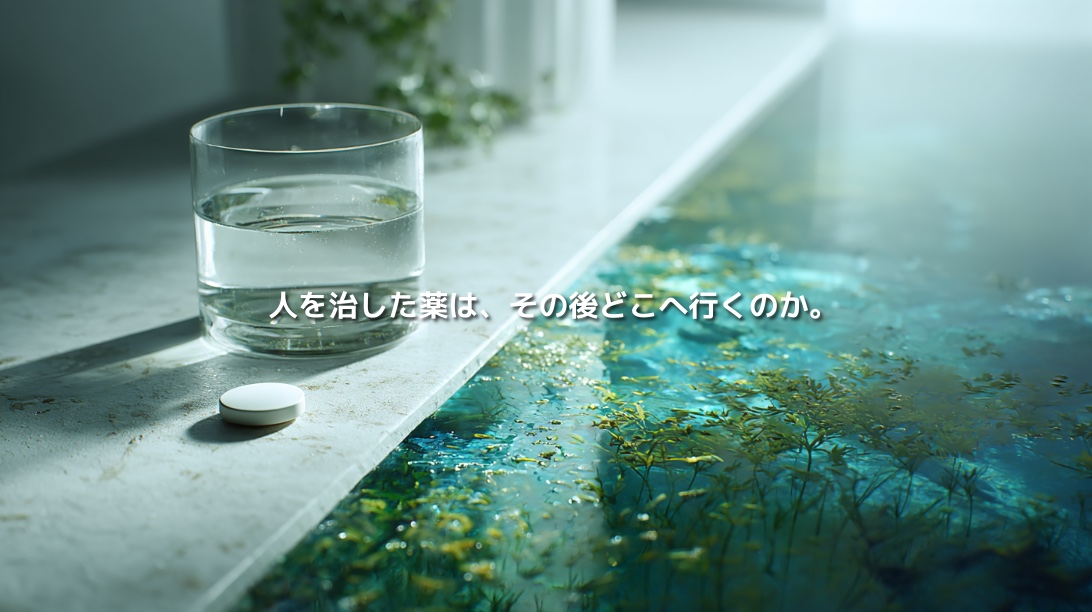
We swallow a tablet with a glass of water.
The medicine dissolves inside the body. It relieves pain, reduces fever, prevents bacteria from multiplying, and helps protect our health.
But after it has completed its task, where does it go?
Not all of it disappears inside the body.
Some active ingredients leave the body unchanged, while others are transformed into metabolites and excreted in urine or feces. They enter sewers from homes and hospitals, pass through wastewater treatment plants, and may eventually flow into rivers and seas.
Medicines are created to treat disease.
Yet even after leaving the human body, some of their ingredients may remain biologically active.
Antibiotics, painkillers, antiepileptic drugs, diabetes medicines, psychiatric medications, and other pharmaceutical substances have been detected in Japanese rivers.
The water may look clear.
But within it flow traces of the medicines used in our everyday lives.
Why Do Pharmaceuticals Enter Rivers?
There is more than one pathway through which medicines enter the environment.
The most familiar is human excretion after a medicine has been taken.
Pharmaceutical ingredients are absorbed and broken down inside the body, but they do not always disappear completely. Some are excreted unchanged, while others leave the body as metabolites.
They then travel to wastewater treatment plants. Substances that are not adequately removed may be discharged into rivers with treated wastewater.
Other sources include unused medicines poured into toilets or sinks, wastewater from hospitals and care facilities, emissions from pharmaceutical manufacturing, and veterinary medicines used in livestock or aquaculture.
The United Nations Environment Programme identifies pharmaceutical manufacturing, excretion by patients and animals, aquaculture, and the disposal of unused medicines as major pathways by which pharmaceutical residues enter the environment.
Source: United Nations Environment Programme—Pharmaceuticals in the Environment
However, this issue should not be framed as “people who take medicine are polluting rivers.”
Medicines are necessary to treat illness, relieve pain, and save lives.
The problem is not that we use them.
The problem is that the systems surrounding medicines still do not adequately consider what happens after their ingredients leave the human body.
Wastewater Treatment Plants Are Not Designed to Remove Every Medicine
Wastewater treatment plants use sedimentation, microbial decomposition, disinfection, and other processes to remove contaminants from household wastewater.
But conventional wastewater treatment was not designed to eliminate every type of chemical present at trace concentrations.
The removal rate varies greatly among pharmaceutical substances.
Some compounds are readily broken down by microorganisms. Others remain dissolved in water and pass through the treatment process. Some attach to sewage sludge, while others are transformed into metabolites or degradation products.
Research supported by Japan’s Ministry of Land, Infrastructure, Transport and Tourism examined several antiviral medicines at wastewater treatment plants using conventional biological treatment and chlorine disinfection.
Average removal rates for some of the antiviral substances studied were only 3 to 17 percent. By contrast, facilities using additional ozone treatment achieved removal rates ranging from 60 to 94 percent, depending on the compound.
Advanced treatment can increase the number of pharmaceutical compounds removed from wastewater.
However, ozone, activated carbon, and membrane treatment require additional infrastructure, energy, and maintenance expenditure. The possibility that treatment may generate other transformation products must also be considered.
The solution is therefore not as simple as installing identical advanced-treatment equipment at every wastewater plant.
Multiple Antibiotics Have Been Detected in the Tsurumi River
In July 2026, Japan’s Ministry of the Environment published a case study examining the ecological risks associated with combined exposure to macrolide antibiotics.
The study considered five substances:
- Erythromycin
- Roxithromycin
- Azithromycin
- Clarithromycin
- 14-(R)-hydroxyclarithromycin, a major metabolite of clarithromycin
Previous environmental monitoring had detected these substances together at several urban locations, including Kamenoko Bridge on the Tsurumi River in Yokohama, the Horikawa River in Nagoya, the Arakawa River estuary, Osaka Port, and the Sumida River estuary.
All five substances included in the study were detected at Kamenoko Bridge on the Tsurumi River.
One point requires care.
Although the report was released in 2026, the Ministry’s environmental measurements used in the study were collected mainly in fiscal years 2014 and 2019. They do not show the condition of the Tsurumi River in real time today.
Even so, the findings are important.
Medicines do not flow through rivers one substance at a time.
Different medicines used by many people enter wastewater systems, reach the same treatment plants, and mix within the same rivers.
Metabolism Does Not Always Eliminate Biological Activity
It may seem that once a medicine has been metabolized inside the body, it becomes environmentally harmless.
That is not always the case.
When clarithromycin is metabolized in the human body, it produces 14-(R)-hydroxyclarithromycin. This metabolite retains antibacterial activity comparable to, although somewhat weaker than, the original medicine.
In the Ministry of the Environment’s fiscal 2019 survey, clarithromycin was detected above the reporting limit at 19 of 30 locations. Its metabolite was found at 26 of the 30 locations.
At the 24 locations where both substances could be quantified, the concentration of the original medicine and that of its metabolite showed an approximately one-to-one relationship.
In other words, changing form inside the body does not necessarily eliminate the possibility that a pharmaceutical substance may continue affecting organisms.
Environmental analysis must therefore follow not only the medicine that was originally taken, but also the metabolites and transformation products produced inside the body and during wastewater treatment.
The Risks That Become Visible Only When Chemicals Mix
Chemical risk assessments have traditionally evaluated substances one at a time.
But real rivers contain mixtures of pharmaceuticals, detergents, cosmetics, pesticides, and industrial chemicals.
Even if each substance is present below its individual threshold, compounds with similar biological effects may become significant when their effects are combined.
The Ministry of the Environment’s 2026 case study used a hazard index to screen the risks of combined exposure. The measured concentration of each antibiotic was divided by its predicted no-effect concentration, and the resulting values were added together.
When measurements from the same locations were evaluated, three sites—Kamenoko Bridge on the Tsurumi River, Minato Shinbashi on the Horikawa River in Nagoya, and Osaka Port—exceeded the level at which more detailed assessment should be considered.
At Osaka Port, none of the individual substances exceeded the evaluation level when assessed alone. But when several antibiotics were considered together, the combined exposure raised ecological concerns.
This does not mean that ecological damage was confirmed at those locations.
The Ministry describes the study as a screening-level case study based on limited information, not as a formal risk-management determination.
Nevertheless, it demonstrates something important: assessing each chemical separately may overlook risks that appear only when substances are mixed.
A river does not divide itself according to individual chemicals.
Antibiotics Affect More Than Pathogenic Bacteria
Antibiotics are designed to inhibit the growth and biological activity of bacteria.
That function may not disappear completely after the substances enter a river.
The Ministry’s assessment found that algae and cyanobacteria tended to be more sensitive to the macrolide antibiotics studied than fish or crustaceans.
Algae may appear insignificant or nearly invisible in the water.
Yet through photosynthesis, they produce organic matter and oxygen. They support zooplankton and small fish and form the foundation of aquatic ecosystems.
If their growth is continuously inhibited, the effect may not end with the algae themselves.
Changes could extend through the food web—from plankton and small fish to larger fish and birds—and may also affect oxygen levels and nutrient cycles in the water.
Medicines are administered to people in controlled doses and for limited periods.
Aquatic organisms, however, cannot choose to move away from pharmaceutical residues.
Even at extremely low concentrations, they may be exposed continuously as the substances flow through their habitat.
Antimicrobial Resistance: Another Environmental Risk
The release of antibiotics into the environment is not only a matter of their direct effects on aquatic organisms.
In environments containing low concentrations of antibiotics, susceptible bacteria may be suppressed while resistant bacteria survive and multiply.
This process can contribute to antimicrobial resistance, or AMR.
Resistant bacteria and resistance genes can move among people, animals, wastewater, rivers, and soil.
Even when antibiotics are used appropriately in hospitals and households, resistance cannot be adequately controlled without addressing pharmaceutical manufacturing, livestock production, aquaculture, sewage, and waste management.
UNEP identifies pollution from pharmaceutical production, agriculture, and healthcare as an important environmental factor contributing to antimicrobial resistance.
This is why a One Health approach is necessary—one that does not treat human health, animal health, and environmental health as separate issues.
They are part of the same connected system.
Does Finding Medicines in Rivers Mean Tap Water Is Unsafe?
When people hear that pharmaceutical substances have been detected in rivers, a natural concern arises: is drinking water safe?
It is important to distinguish ecological effects from direct effects on human health.
The World Health Organization has stated that concentrations of pharmaceuticals detected in drinking water are generally several orders of magnitude below the lowest therapeutic doses.
Based on current evidence, clear effects on human health from individual pharmaceuticals in drinking water are considered unlikely. For this reason, WHO has not established drinking-water guideline values for individual pharmaceutical substances.
Source: World Health Organization—Guidelines for Drinking-Water Quality
The detection of medicines in a river therefore does not mean that tap water is immediately dangerous.
However, uncertainties remain concerning long-term exposure to extremely low concentrations, mixtures of multiple substances, and indirect effects related to antimicrobial resistance.
At present, the more immediate concern is not the direct pharmacological effect of drinking water on people. It is the continuous exposure of aquatic ecosystems and microbial communities in waters receiving treated wastewater.
The issue should be explained without creating unnecessary fear, while clearly distinguishing known risks from areas where scientific uncertainty remains.
Stopping Necessary Medication Is Not the Solution
People should not reduce or stop prescribed medication on their own because of environmental concerns.
Antibiotics in particular should be taken in the prescribed dose and for the instructed duration, following the advice of a doctor or pharmacist.
Stopping treatment prematurely can leave an infection inadequately treated and may also contribute to the development of resistant bacteria inside the body.
At the same time, unused medicines should not be poured into toilets or sinks, where they can enter the wastewater system directly.
Disposal methods differ according to the type of medicine and local regulations. The basic approach is to consult a pharmacy, medical institution, or local authority rather than disposing of medicines in water.
Improving household disposal alone, however, cannot prevent the excretion of pharmaceutical ingredients after medicines have been taken.
This is why the solution must connect medicine design, prescribing practices, collection systems, wastewater treatment, and environmental monitoring instead of relying only on individual behavior.
Designing the Entire Life Cycle of a Medicine
There are limits to removing pharmaceutical substances only after they have entered rivers.
The first step is to prescribe the necessary quantity to the people who need it, reducing excessive use and unused medicine.
Pharmaceutical companies can develop medicines that break down more readily in the environment and have lower ecological toxicity. Environmental release can also be evaluated during the development of new medicines rather than only after widespread use begins.
In 2016, Japan’s Ministry of Health, Labour and Welfare published guidance on environmental risk assessment in the development of new pharmaceutical products.
Wastewater can be treated closer to its source at hospitals, pharmaceutical factories, and other locations where higher concentrations may occur.
Wastewater treatment plants can examine local river flow, the proportion of treated effluent in receiving waters, and the pharmaceutical substances detected in the area. Advanced treatment can then be introduced first where the need is greatest.
Monitoring should examine not only individual compounds but also mixtures of pharmaceuticals and their metabolites.
The goal is not to treat every medicine as an enemy.
It is to redesign the system as a complete cycle—from manufacturing, prescribing, and use to excretion and the eventual return of pharmaceutical ingredients to water.
Ensuring That Medicines Which Heal People Do Not Harm Rivers
Medicines are among the most valuable technologies humanity has created.
They treat infections, reduce pain, and help people live with chronic illness.
There is no need to deny that value.
But the story of a medicine cannot end with the words, “I took it, and I recovered.”
After leaving the human body, pharmaceutical ingredients pass through wastewater treatment plants, enter rivers, and encounter algae, bacteria, and other organisms.
One tablet taken by one person is small.
But when the wastewater of tens of thousands—or millions—of urban residents comes together, many different medicines may overlap in the same water.
Where does a medicine go after it has helped a person?
Thinking about its destination as well as its therapeutic effect does not mean rejecting medical treatment.
It means redesigning the systems that protect human health so they also protect the health of rivers, seas, animals, and ecosystems.