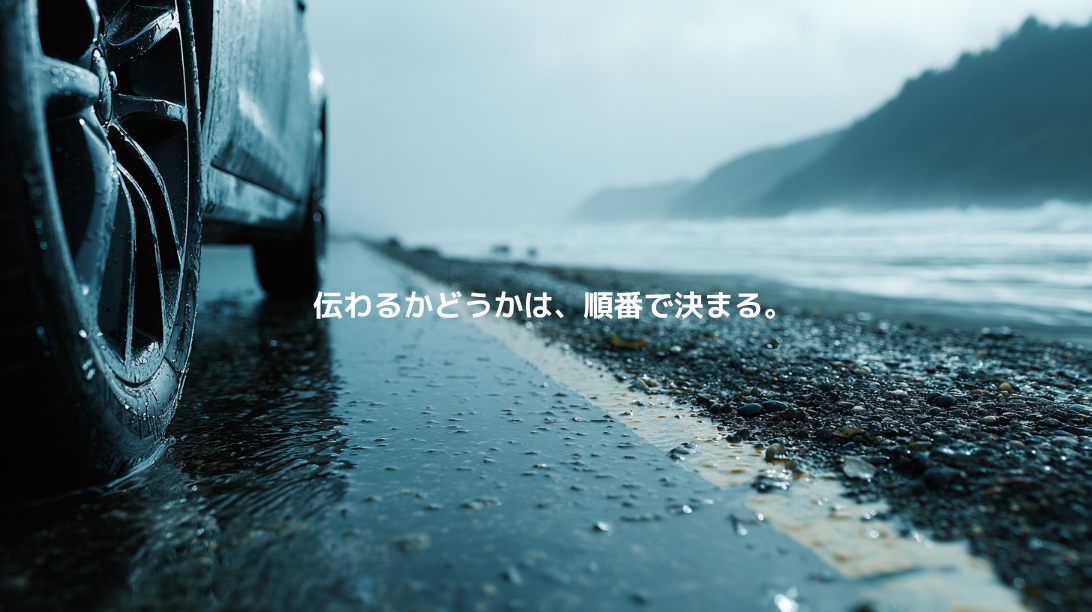
Dark water flows across a road after the rain.
Most people would hardly notice it. They might assume it is simply rainwater mixed with dirt from the asphalt or vehicle exhaust residue.
But that water may contain extremely small particles worn away from tires every time a vehicle travels along the road.
Particles left on the pavement are washed into gutters by rain. From there, they pass through storm drains, enter rivers, and, in some cases, eventually reach the sea.
When we think of plastic waste, we tend to picture bottles, shopping bags, and discarded fishing gear.
But not all plastic entering the ocean has been deliberately thrown away.
Some plastic is generated simply through the use of everyday products.
Tire-wear particles are one of the most significant examples.
Tires Are Gradually Disappearing as We Drive
Tires move, steer, and stop a vehicle through friction with the road.
That friction enables us to travel safely.
At the same time, however, the tire surface is gradually worn away with every journey.
The grooves visible on a new tire become shallower after several years of use. Much of the material that disappears during this process is released onto the road.
Tires are made not only from natural rubber but also from synthetic rubber, other polymer materials, and a variety of additives used to maintain safety and performance.
For this reason, tire-wear particles are often treated in environmental policy and research as a form of microplastic unintentionally released during the use of a product.
Japan’s National Institute for Environmental Studies states that tire-wear dust is estimated to account for nearly half of the microplastics released into the environment.
The institute is investigating its movement and ecological risks in road runoff, rivers, estuaries, and wastewater-treatment plants.
The problem of marine plastic does not begin only when waste falls outside a garbage bin.
It also begins with the ordinary act of moving through daily life.
Preliminary Estimates Suggest Thousands of Tons Reach the Sea from Japan Each Year
A fiscal 2024 assessment by Japan’s Ministry of the Environment provisionally estimated that approximately 13,000 to 31,000 metric tons of plastic waste flow from Japan into the ocean each year.
Within that total, the estimated annual marine release of tire-wear particles was approximately 5,700 metric tons when calculated from vehicle mileage.
A different calculation based on annual tire consumption and wear rates produced an estimate of approximately 9,400 metric tons.
These are not definitive figures.
Both the amount generated and the quantity entering the ocean vary according to tire type, vehicle type, road conditions, driving behavior, rainfall, street cleaning, and drainage infrastructure.
The Ministry of the Environment also notes that some of the tire-wear data used in its calculations are dated and that runoff rates more appropriate to Japanese road conditions require further examination.
The important point is not to allow one estimate to take on a life of its own.
It is that a potentially large volume of particles—previously difficult to see—may be moving from roads into aquatic environments.
A plastic bottle can be picked up.
Tire-wear particles are far more difficult to see. From the moment they are produced, they mix with road dust, sand, asphalt particles, and other materials, making both recovery and analysis difficult.
Their invisibility has allowed the problem itself to remain largely invisible.
On Rainy Days, Roads Become Connected to the Ocean
Not every tire-wear particle deposited on a road reaches the sea.
Some remain on the pavement. Others are carried by the wind, enter nearby soil, or are collected through street cleaning.
Some may also be removed by wastewater-treatment plants or stormwater-infiltration facilities.
In urban areas with separate sewer systems, however, rainwater from roads may travel through storm drains and be discharged directly into rivers or other public waters without passing through a wastewater-treatment plant.
The Ministry of the Environment’s preliminary estimate assumes that 24 percent of particles generated on roads—including material from tires, brakes, and road markings—eventually reach the ocean through stormwater runoff.
This figure is also likely to vary according to road conditions and urban structure, and further refinement is required.
Roads and oceans are not separate environments.
Rain falling on a road enters a gutter.
The gutter connects to a river.
The river flows toward the sea.
Water moving across the urban surface carries materials generated in the city all the way to the coast.
Looking inland from the Shonan coast, the roads may appear far removed from the ocean.
But if we trace the movement of water in the opposite direction, residential neighborhoods, parking lots, and major highways all lie upstream from the sea.
The Problem Is Not Limited to the Particles Themselves
Understanding tire wear also requires attention to the chemicals used in tires—not only the physical particles.
One substance receiving international attention is 6PPD.
6PPD is used to prevent tires from degrading when exposed to ozone and other environmental conditions. It helps preserve tire durability and safety.
When 6PPD reacts with ozone in the atmosphere, however, it forms another substance known as 6PPD-quinone.
The United States Environmental Protection Agency explains that tire-derived particles left on roads and parking lots can be washed into streams by stormwater, potentially exposing some fish species to 6PPD-quinone.
In North America, the substance has been found to be highly toxic to coho salmon.
Sensitivity differs among fish species, however, and many questions remain about the behavior of 6PPD-quinone in the environment and its possible effects on humans.
Effects observed overseas should not automatically be assumed to occur in every Japanese river or fish species.
Japan is still at the stage of investigating where tire-wear particles are generated, how much is released, where the particles travel, and which organisms may be affected.
A lack of knowledge does not prove that something is safe.
It means that we must measure, trace, and investigate it.
Will Electric Vehicles Solve the Problem?
Environmental discussions about automobiles have traditionally focused on exhaust gases and carbon dioxide emissions.
As electric vehicles become more widespread, tailpipe emissions during driving will disappear.
Regenerative braking may also reduce the generation of brake-wear particles.
Electric vehicles, however, still use tires.
Vehicle weight and high torque may affect tire wear, but actual wear rates depend on several factors, including tire performance, vehicle design, and driving behavior.
It would therefore be overly simplistic to conclude that electric vehicles always generate more tire-wear particles.
What is clear is that replacing gasoline with electricity does not eliminate tire wear.
The environmental impact of automobiles is not solely an engine problem.
The European Union has expanded its regulatory focus through Euro 7, which covers not only tailpipe emissions but also brake particles and tire abrasion.
For new passenger-car types, the rules are scheduled to begin applying in stages from November 2026.
Regulation is beginning to look beyond what a vehicle burns and toward what is worn away simply because the vehicle moves.
Making Cars the Villain Will Not Solve the Problem
For people living in rural areas, cars are essential infrastructure.
They enable older adults to reach hospitals, parents to transport children, families to buy groceries, tourists to visit regional destinations, and workers to support agriculture, forestry, fisheries, and delivery services.
Road transport also carries emergency supplies after disasters.
The answer is not simply to eliminate cars in the name of environmental protection.
The real question is how society can maintain the freedom and convenience of mobility while reducing the environmental burden it creates.
There is no single solution.
Tire manufacturers need to improve wear resistance without compromising safety and develop materials and additives with lower environmental impacts.
Automakers can reduce vehicle weight and design vehicles that place less stress on tires.
Road and urban infrastructure can use catch basins, street cleaning, stormwater-infiltration systems, and vegetated strips to capture particles before they enter rivers.
Japan’s National Institute for Environmental Studies is also examining the extent to which catch basins and wastewater-treatment plants can reduce releases.
Drivers can help by maintaining correct tire pressure, avoiding unnecessary rapid acceleration and hard braking, and reconsidering whether they need vehicles that are larger and heavier than their actual needs require.
Cities and regions must also consider public transport, cycling, walking, and shared delivery systems—not only to reduce the environmental impact of each vehicle but also to decrease the total amount of driving across society.
Tire manufacturers, automakers, road authorities, local governments, researchers, and drivers all have roles to play.
The burden must be reduced incrementally at every stage rather than placed on the efforts of one group alone.
What Flows from Beneath Our Prosperity
Tire-wear particles are not waste created through malicious intent.
No one produces them because they want to pollute the ocean.
We drive to work.
We pick up our families.
We deliver goods.
We set out on journeys.
The particles are generated as we live our daily lives and keep society moving.
That is precisely what makes this issue so difficult.
The answer is not simply to abandon convenience.
Nor will replacing one technology with another automatically solve everything.
Human prosperity creates movement.
That movement consumes not only energy but also physical materials—the road surface, the vehicle, and the tires—little by little.
We have long paid attention to what cars emit.
But perhaps we have not looked closely enough at what is worn away when they move.
On a rainy day, tiny particles left on the road flow into a gutter.
Beyond that gutter is a river.
Beyond the river is the sea.
Marine plastic pollution is not only a problem that begins at the coast.
It also begins on the roads we travel every day.
How can we preserve the freedom of movement while reducing what flows away beneath it?
This is not a question of giving up convenience.
It is a question of how to build a society capable of taking responsibility for the environmental burden that convenience leaves behind.
References
- National Institute for Environmental Studies, Japan: Research on Tire-Wear Dust and Microplastics
- Ministry of the Environment, Japan: Estimates of Plastic Waste Discharged from Japan into the Ocean
- United States Environmental Protection Agency: 6PPD-Quinone
- European Union: Euro 7 Emission Standards
Article Excerpt
Tires release tiny particles whenever vehicles move. Rain can carry these particles from roads into storm drains, rivers, and eventually the ocean. This article examines tire-wear microplastics, 6PPD-quinone, electric vehicles, and the shared responsibility for reducing pollution without sacrificing essential mobility.