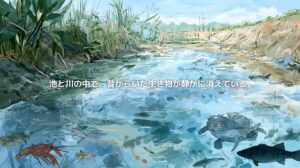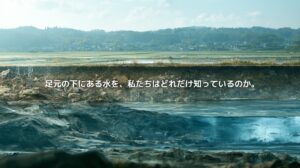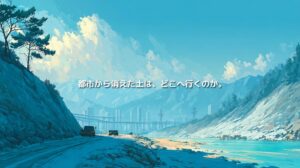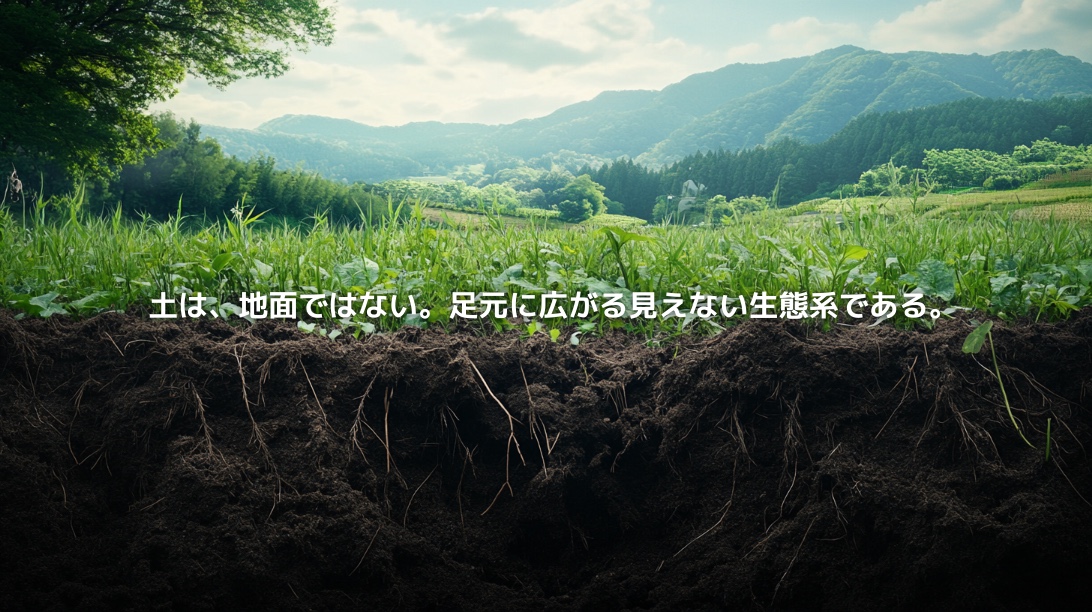
Soil appears silent.
Soil in farmland.
Soil in forests.
Soil beneath rice fields.
Soil in parks.
Soil beside roads.
Soil inside a flowerpot.
We walk across soil every day.
Yet we rarely consider what is happening beneath our feet.
Soil is not simply a collection of brown particles.
It contains microorganisms too small to see.
There are fungi.
Earthworms.
Mites.
Springtails.
Insect larvae.
Plant roots extending through the darkness.
Countless forms of life inhabit the soil.
The Food and Agriculture Organization of the United Nations explains that soil organisms are essential to many ecosystem services provided by soil, including food production, water filtration, carbon storage, and the breakdown of pollutants. FAO — The State of Knowledge of Soil Biodiversity
Soil is not merely the ground beneath us.
Soil is a living ecosystem.
Yet this ecosystem is quietly beginning to weaken.
The simplification of farmland.
Excessive dependence on pesticides and chemical fertilizers.
The loss of organic matter.
Urban paving.
Soil contamination.
Drought and extreme rainfall.
The decline of forests and grasslands.
What happens when the organisms living beneath the ground disappear?
This is not only a question about agricultural harvests.
It is connected to water cycles, carbon cycles, forest regeneration, food production, climate change, and everyday human life.
When the soil beneath our feet weakens, the foundations of nature also begin to tremble.
How Is Soil Formed?
Soil does not form quickly.
Rock is weathered.
Plants grow.
Leaves fall and accumulate.
Microorganisms and fungi break them down.
Earthworms and other small organisms mix the material.
Organic matter becomes part of the soil.
Water and air enter the spaces between particles.
Soil is created through these processes over long periods.
Japan’s Ministry of Agriculture, Forestry and Fisheries explains that soil forms when organic material from decomposed plants, microorganisms, and other organisms is added to mineral particles produced by the weathering of rock. Ministry of Agriculture, Forestry and Fisheries, Japan
Soil is an accumulation of past life.
Fallen leaves.
Dead grasses.
Roots.
The bodies of insects.
Microorganisms.
Fungi.
Animal waste.
These materials are broken down, mixed together, and transformed into soil.
Soil is where one generation of life ends.
It is also where the next generation begins.
When soil weakens, the cycle of life weakens with it.
Who Lives in the Soil?
Most soil organisms are almost invisible.
Even earthworms, which are large enough to see, spend most of their lives beneath the surface.
Microorganisms and fungal networks are smaller still, remaining largely beyond human sight.
Yet they are continually working.
They break down fallen leaves.
They transform organic matter into nutrients.
They create soil aggregates that allow water and air to move.
They form relationships with plant roots.
They help suppress some pathogens.
They store carbon in the soil.
They build and maintain soil structure.
FAO explains that soil organisms contribute to nutrient cycling, soil organic matter dynamics, soil carbon storage, and the regulation of greenhouse gas emissions. They are essential to the proper functioning of soil. FAO — Soil Biodiversity
Life beneath the ground is inconspicuous.
But without it, fallen leaves would not decompose in the same way.
Nutrients would not circulate as effectively.
Plants would struggle to grow.
Forests, farmland, and grasslands all depend on life within the soil.
Earthworms Are Craftspeople of the Soil
Earthworms are among the most recognizable soil organisms.
They sometimes appear on roads after rain.
They emerge when we dig into a field or garden.
Some people may remember holding them as children.
Earthworms consume soil and organic matter and release the processed material as castings.
Through this activity, they mix the soil and help create pathways for water and air.
Soil containing earthworms is often soft and porous.
Organic matter is broken down.
Plant roots can extend more easily.
This does not mean that every ecosystem requires the same species of earthworm.
Soil ecosystems differ from region to region.
Introduced earthworms can also create ecological problems in places where they did not previously occur.
Even so, earthworms remain powerful symbols of soil structure and organic matter cycling.
Human tractors are not the only things cultivating the land.
Beneath the surface, small organisms continue their invisible cultivation.
What Does It Mean for Soil to Weaken?
Weak soil does not simply mean that the amount of soil has declined.
Organic matter decreases.
The diversity of microorganisms and fungi declines.
The soil holds less water.
Air moves through it less easily.
It becomes compacted.
It becomes more vulnerable to erosion.
Nutrient cycling deteriorates.
Plant roots struggle to spread.
The health of soil is difficult to judge by appearance alone.
Dark soil may still be heavily compacted.
Farmland may remain productive even while its organic matter declines.
A lawn or public park may look carefully maintained while supporting little life beneath the surface.
Japan’s Ministry of Agriculture, Forestry and Fisheries describes soil improvement as enhancing the physical, chemical, and biological condition of soil to increase its productive capacity.
The word “biological” is essential.
Soil is not defined only by the nutrients contained in fertilizer.
Nor can its condition be understood only through hardness or drainage.
The strength of soil also depends on the diversity of life working within it.
Agricultural Soil Is Connected to Our Food
The decline of soil organisms can affect agriculture.
Crop roots become more difficult to establish.
The soil retains less water.
Nutrient cycling weakens.
Plants may become more vulnerable to disease.
Their resilience to drought and extreme rainfall declines.
When soil weakens, crops become more vulnerable.
Modern agriculture is supported by fertilizers, pesticides, irrigation, machinery, plant breeding, and many other technologies.
These innovations have contributed enormously to food production.
But when the underlying capacity of soil declines, more technology and external inputs may be required to compensate.
The natural cycles within soil.
Its ability to break down organic material and return nutrients.
Its capacity to store water.
Its structure, which allows roots to grow.
The diverse functions performed by microorganisms.
These are the invisible foundations of agriculture.
Our food is produced on farmland.
Farmland rests on soil.
Soil depends on countless organisms.
When we buy food, we rarely see the creatures beneath the field.
Yet invisible life supports the table above it.
Forest Soil Regulates Water
Forest soil receives rainfall like a sponge.
Rain falls.
Leaves soften the force of the droplets.
Water enters the soil.
It moves around roots and fungal networks.
It slowly travels underground and toward valleys.
When forest soil is healthy, water is less likely to flow away all at once.
But when soil is exposed, compacted, or deprived of organic matter, the movement of water changes.
Heavy rain runs rapidly across the surface.
Soil is washed away.
Rivers become muddy.
Sediment moves downstream.
Soil is also a pathway for water.
Forest problems.
Groundwater problems.
River problems.
Ocean problems.
All of them are connected through soil.
When forest soil weakens, rivers and seas cannot remain unaffected.
Urbanization Is Making Soil Disappear
Soil is increasingly difficult to see in cities.
Roads are paved.
Parking lots are covered with asphalt.
Buildings occupy the land.
Rainwater is directed into gutters and drains.
Even the soil in parks may become heavily compacted.
An area may appear to contain soil while allowing little water or air to penetrate it.
Urbanization fragments soil ecosystems.
There are fewer places for rain to enter the ground.
Less space remains for plant roots to spread.
Habitat for soil organisms disappears.
Surface temperatures rise.
Rainwater flows away more rapidly.
Soil is also essential within cities.
It absorbs rainwater.
It reduces heat.
It supports vegetation.
It provides habitat for microorganisms and insects.
It gives people places where they can experience seasonal change.
How we preserve and restore urban soil will become an increasingly important environmental question.
Soil Contamination: An Invisible Crisis
Soil can also become contaminated.
Former industrial sites.
Waste disposal.
Pesticides.
Heavy metals.
Oil.
Chemical substances.
The effects of historical land use.
Soil contamination is difficult to see.
It does not flow visibly like polluted water.
It may not produce an obvious smell like certain forms of air pollution.
Yet contaminated soil can affect groundwater, plants, ecosystems, and human health.
Japan’s Ministry of the Environment has established systems for investigating contaminated land and designating regulated areas under the Soil Contamination Countermeasures Act. Ministry of the Environment, Japan
Once soil is contaminated, it cannot easily be restored.
It may need to be removed.
Contained.
Treated.
Or managed over long periods.
Every option requires time and money.
Soil cannot simply be discarded and forgotten.
It retains the memory of what happened on the land.
Soil contamination is therefore a legacy that past industries and human activities can leave to the future.
Soil and Carbon
Soil is deeply connected to carbon.
Plants absorb carbon dioxide from the atmosphere through photosynthesis.
Some of that carbon enters roots and leaves, which eventually return to the ground.
Microorganisms and fungi break down this organic material.
Some carbon returns to the atmosphere.
Some remains stored as soil organic matter.
Soil is also a carbon reservoir.
Organisms living within it participate in this carbon cycle.
They decompose organic matter.
They influence how carbon is retained in soil.
They affect greenhouse gas emissions.
They create soil structures that support plant growth.
FAO explains that soil biodiversity contributes to soil carbon storage and the regulation of greenhouse gas emissions. FAO
This means that the soil crisis is also a climate crisis.
Forests.
Permafrost.
Oceans.
Farmland.
Carbon does not exist only in the atmosphere.
It also exists beneath our feet.
Protecting soil means protecting the carbon cycle.
Soil Biodiversity Is Easily Overlooked
When we think about biodiversity, we usually imagine animals and plants.
Birds in forests.
Fish in the sea.
Bees visiting flowers.
Frogs living beside rivers.
Dragonflies above wetlands.
Endangered species.
But the biodiversity beneath the soil receives far less attention.
Because we cannot easily see it.
Soil organisms are difficult to photograph.
They are difficult to observe.
Most people do not know their names.
They rarely become the familiar symbols of conservation campaigns.
Yet biodiversity below ground supports biodiversity above it.
Plants grow.
Flowers bloom.
Insects arrive.
Birds follow.
Animals find places to live.
Beneath all of them is soil.
When organisms disappear from the soil, visible landscapes also begin to change.
The decline of invisible life eventually becomes a visible transformation of nature.
Soil Carries the Memory of a Place
Soil contains the memory of the land.
A place that was once forest.
A place that was once a rice field.
A place that was once farmland.
A former factory site.
A former wetland.
Land repeatedly flooded by a river.
Land covered by volcanic ash.
Land cultivated by generations of people.
Soil receives and retains the effects of both nature and human activity.
That is why soils that appear similar may contain very different histories.
Volcanic ash soil.
Clay-rich soil.
Sandy soil.
Andosol.
Alluvial soil.
Forest humus.
Mud beneath rice fields.
Differences in soil shape regional agriculture, food culture, and landscapes.
The flavor of vegetables.
The growth of rice.
The roots of fruit trees.
Drainage conditions.
Wetland wildlife.
Forest vegetation.
Soil is one of the materials from which regional identity is formed.
Losing soil can also mean losing part of a place’s memory.
What Does It Mean to Protect Soil?
Protecting soil does not simply mean leaving it untouched.
Return organic matter.
Allow leaves and grasses to circulate.
Avoid excessive compaction.
Prevent erosion by rain.
Preserve vegetation.
Grow a diversity of plants.
Reconsider the use of pesticides and chemical fertilizers.
Prevent soil contamination.
Leave places in cities where soil can breathe.
On farmland, soil can be supported through compost, green manure, crop rotation, cover crops, reduced or no tillage, and appropriate water management.
In cities, permeable paving, rain gardens, green spaces, parks, areas around street trees, school gardens, and green roofs can all contribute.
In forests, understory vegetation, fallen leaves, roots, fungi, and animals work together to protect the soil.
Soil does not recover quickly.
That is why preventing its destruction is so important.
Looking at the Ecosystem Beneath Our Feet
Soil is so familiar that it is almost invisible to us.
We look toward the sky.
We admire mountains.
We watch rivers and seas.
We notice flowers and birds.
But we rarely look closely at the soil beneath our feet.
Yet much of nature begins there.
Plant roots enter the soil.
Water penetrates it.
Fallen leaves return to it.
Insects develop within it.
Fungi connect with roots.
Carbon is stored inside it.
Soil is the world below that supports the world above.
The day life beneath the soil disappears may not be a day we immediately recognize.
Flowers will not vanish at once.
A forest will not die overnight.
Farmland will not suddenly cease to exist.
But when cycles within the soil weaken, the world above will gradually change.
Harvests change.
Water changes.
Forests change.
Insects change.
Birds change.
Regional landscapes change.
Looking toward the invisible ecosystem beneath our feet is essential to understanding environmental change.
Soil Is Alive
Soil appears silent.
But countless lives are moving within it.
Life that decomposes.
Life that mixes.
Life that connects with roots.
Life that creates pathways for water.
Life that moves carbon.
Life that enables the next generation of plants to grow.
Soil is not simply a collection of dead matter.
It is a place where what has died is transformed into new life.
Caring for soil is therefore also an act of caring for future life.
To protect our food.
To protect forests.
To protect water.
To protect the climate.
To preserve the memory of a place.
We need to look again at the soil beneath our feet.
The day life disappears from the soil will be the day the foundations of nature quietly begin to collapse.
References
- FAO — The State of Knowledge of Soil Biodiversity
- FAO — Soil Biodiversity, Global Soil Partnership
- FAO — Soil Organisms, Sustainable Agrifood Systems and Climate Change
- Ministry of Agriculture, Forestry and Fisheries, Japan — Soil Improvement Information
- Ministry of the Environment, Japan — Conservation of the Soil Environment
Countless organisms live beneath the soil, including microorganisms, fungi, earthworms, mites, springtails, and insect larvae.
Their invisible work supports food production, water cycles, forests, carbon storage, and regional landscapes.
NEOTERRAIN Journal will continue exploring the environmental changes hidden beneath familiar and beautiful scenery.
If this article gave you a new perspective, please bookmark it and return as we continue examining the relationship between the nature beneath our feet and the future of our lives.