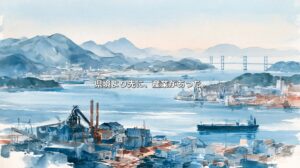
What comes to mind when you hear the name Aichi Prefecture?
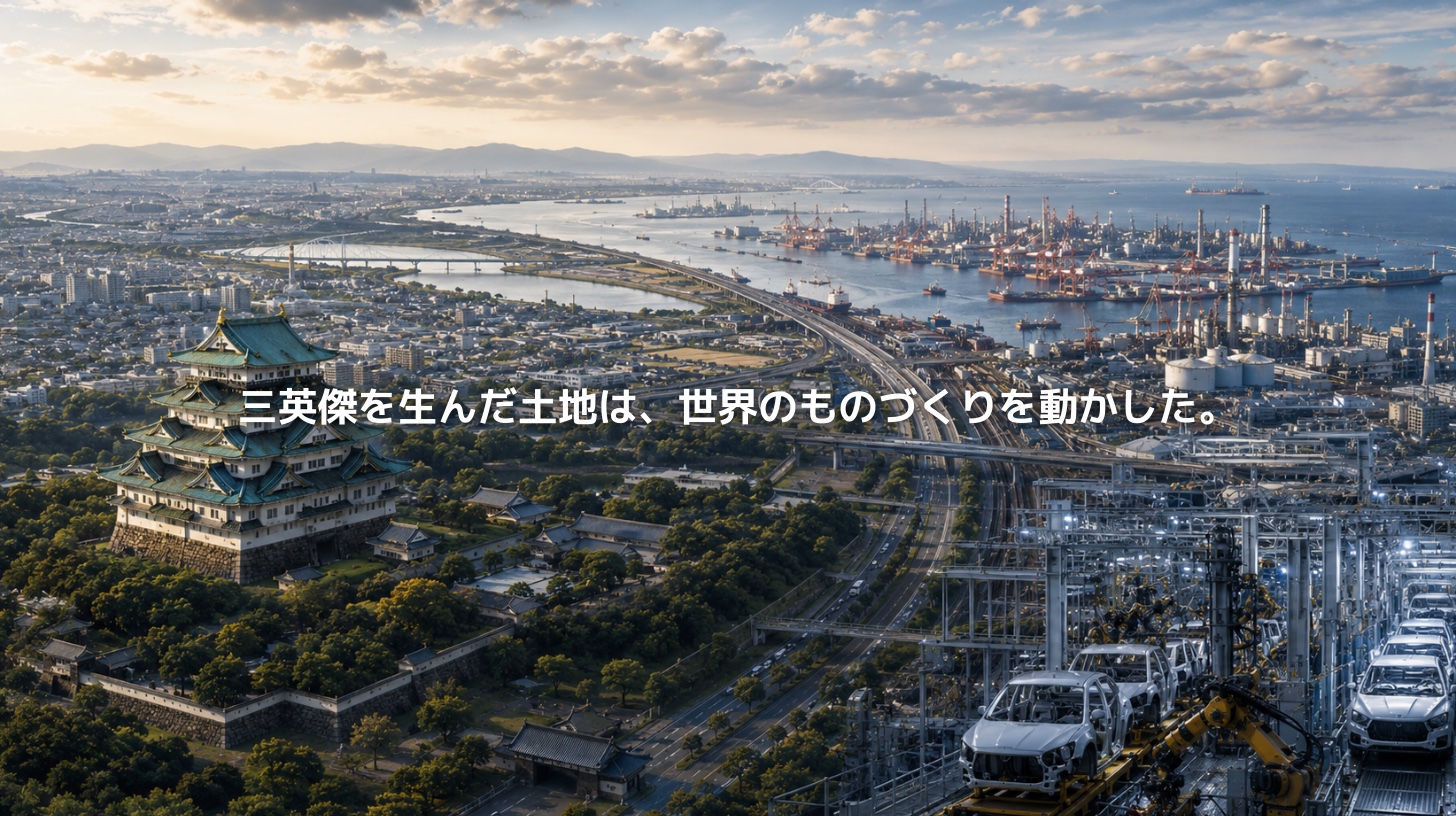
Nagoya Castle, Oda Nobunaga, Tokugawa Ieyasu, Toyota Motor Corporation, and the Port of Nagoya. Names associated with both Japanese history and modern industry quickly emerge.
At first glance, the warlords of the Sengoku period and today’s automobile industry may appear to have little in common.
Yet when Aichi is examined through the lens of geography, a clear line begins to connect them.
Aichi lies near the center of the Japanese archipelago. It links eastern and western Japan and possesses broad plains, rivers, historic highways, sheltered bays, and major ports through which people and goods have moved for centuries.
During the Sengoku period, rival powers crossed this region in their struggles for control of Japan.
During the Edo period, it became a strategic base from which the Tokugawa shogunate could guard against powerful domains in western Japan.
Today, it is Japan’s largest manufacturing region, exporting automobiles, machinery, and industrial technology to the world.
Aichi’s strength does not come simply from being located in the center of Japan.
It comes from its ability to use that central position—to gather people, accumulate skills, connect industries, and keep goods moving.
Through the histories of Owari and Mikawa, the Three Great Unifiers, Nagoya Castle, the old highways, the ports, and modern manufacturing, this article explores the geopolitics of Aichi Prefecture. (NEOTERRAIN Journal)
Aichi Is Where Eastern and Western Japan Meet
Aichi Prefecture lies on Japan’s Pacific coast, roughly between Tokyo and Osaka.
Through the historic Tokaido corridor, it connects the Kanto region in the east with Kyoto and Osaka in the west. To the north lie Mino and Shinano, while Ise Bay and Mikawa Bay open toward the south.
The Nobi Plain stretches across the western part of the prefecture. It was shaped by the Kiso Three Rivers—the Kiso, Nagara, and Ibi—and has long provided fertile land as well as routes for transportation and settlement.
The Yahagi River runs through central Aichi, while the Toyo River flows through the eastern region. Communities, farming areas, workshops, and industrial districts developed along these river basins.
Ise Bay and Mikawa Bay also provided access to maritime transport and trade.
Aichi therefore possessed the conditions needed to use both land and sea routes.
However, being a transportation crossroads does not bring prosperity alone.
Where people and goods gather, political power also gathers. Armies moving between eastern and western Japan passed through the region, and surrounding powers repeatedly fought for control of its roads, plains, rivers, and ports.
Aichi was fertile and commercially valuable, but it was never completely secure.
This combination—a region rich in resources yet exposed to constant competition—helped shape its history.
Aichi Was Not Originally a Single Region
Historically, present-day Aichi Prefecture was divided primarily into two provinces: Owari in the west and Mikawa in the east.
Before the establishment of the ancient provincial system, the region was divided into areas including Owari, Mikawa, and Ho. Under the ritsuryo administrative system, these territories were reorganized into Owari Province and Mikawa Province. That division continued through the Edo period.
After the abolition of the domains and establishment of prefectures during the Meiji era, Owari and Mikawa were eventually integrated into modern Aichi Prefecture. (NEOTERRAIN Journal)
Although they now belong to the same prefecture, Owari and Mikawa developed different geographical, historical, and cultural characteristics.
Owari: An Open Land of Plains, Roads, and Commerce
Owari corresponds largely to western Aichi, including present-day Nagoya, Ichinomiya, Tsushima, and Inuyama.
The region lies across the broad Nobi Plain, crossed by the Kiso and Shonai rivers and facing Ise Bay.
Its flat land supported agricultural production and made it easier to move people and goods by river and road. Religious and commercial centers such as Atsuta and Tsushima also developed.
Because people, information, and commodities could enter relatively easily, Owari became an open region in which commerce and urban culture could flourish.
Oda Nobunaga and Toyotomi Hideyoshi both emerged from Owari.
Their willingness to bring in outside talent, adopt new technology, challenge established authority, and expand beyond their original territories reflects the character of a region shaped by transportation, exchange, and competition.
Mikawa: River Basins, Local Communities, and Organization
Mikawa stretches across central and eastern Aichi, including present-day Okazaki, Toyota, Anjo, Nishio, Toyohashi, and surrounding areas.
The Yahagi River runs through western Mikawa, while the Toyo River supports eastern Mikawa. Plains, hills, mountains, and river basins are interwoven throughout the region.
Unlike Owari, Mikawa was not formed around one vast, open plain. Distinct communities developed within separate valleys and river systems.
In such terrain, internal ties and the ability of local groups to protect their land became especially important.
The Mikawa warriors who supported Tokugawa Ieyasu later became known for their loyalty and organizational strength.
Geography alone cannot explain the character of an entire warrior group.
Yet a region pressured by stronger surrounding powers, where communities repeatedly had to protect themselves and maintain internal cohesion, may have contributed to Mikawa’s distinctive organizational culture.
Aichi contains both the openness of Owari and the organizational discipline of Mikawa.
These two regional forces continue to shape the prefecture.
Why Did Japan’s Three Great Unifiers Emerge from Aichi?
Oda Nobunaga, Toyotomi Hideyoshi, and Tokugawa Ieyasu are often called Japan’s Three Great Unifiers.
All three were closely connected to the territory of present-day Aichi Prefecture.
They helped bring the Sengoku period to an end and laid the foundations of early modern Japan.
Their emergence from the same general region was not simply a historical coincidence.
Aichi’s geopolitical position played an important role.
A Strategic Position Between Kyoto and the East
Kyoto remained Japan’s political and symbolic center during the Sengoku period.
For any warlord seeking national power, advancing toward Kyoto was a central objective. Yet to the east lay other major powers in Suruga, Kai, and the Kanto region.
Owari and Mikawa stood along the boundary where eastern and western political forces met.
To the west were Kyoto and Osaka.
To the east were Suruga and the Kanto region.
Mino lay to the north, while Ise Bay opened to the south.
Controlling the Aichi region meant more than governing a single province.
It meant controlling transportation routes between eastern and western Japan while retaining the ability to expand in multiple directions.
Competition Strengthened Military, Diplomatic, and Organizational Skills
Strategic crossroads attract competing powers.
Owari experienced conflict within the Oda clan, while the Imagawa clan exerted pressure from the east and the Saito clan from the north. Mikawa was repeatedly influenced by both the Imagawa and Oda forces.
Survival in such a region required more than battlefield strength.
Leaders needed alliances, negotiations, intelligence networks, logistics, financial resources, and the ability to recruit and retain talented people.
Nobunaga adopted new weapons and administrative systems.
Hideyoshi rose through social intelligence, negotiation, logistics, and an exceptional ability to organize people.
Ieyasu built power through patience, durable alliances, and long-term institutional control.
The three men possessed very different personalities.
Yet growing within a region of intense competition may have trained them to think not only about warfare, but also about supply lines, diplomacy, information, and organization.
Aichi did not produce great leaders because of some mysterious heroic spirit.
It produced them because its geography demanded constant adaptation.
Atsuta Was Both a Sacred Place and a Logistics Hub
Atsuta is another important location in the history of Aichi.
Atsuta Jingu has attracted worshippers since ancient times.
Yet Atsuta was not only a religious center.
Miya-juku, one of the post stations on the Tokaido, was located there. From Atsuta, travelers crossed Ise Bay by the maritime route known as the Shichiri no Watashi, or “Seven-Ri Crossing,” toward Kuwana in Ise Province.
People traveling overland changed to boats at Atsuta.
This made the area a meeting point of religion, highways, and maritime transportation.
Where many people gather, accommodation, commerce, markets, and information exchange follow.
A center of worship became an economic center, and the economic activity attracted still more people.
In Aichi, culture and religion were also built upon geography and mobility.
Nagoya Castle Was a Western Defense Base for Edo
After the Battle of Sekigahara in 1600, Tokugawa Ieyasu established the Tokugawa shogunate in Edo.
However, powerful outside lords still remained in western Japan.
Owari, located between Edo and the Kyoto–Osaka region along the Tokaido, was strategically vital to the new regime.
In 1609, Ieyasu ordered the construction of Nagoya Castle on the Nagoya Plateau. Lords from western and northern Japan were mobilized for the project. After its completion, the castle became the seat of the Owari Tokugawa family, founded by Ieyasu’s ninth son, Yoshinao, and remained the political center of the Owari Domain for roughly 260 years. (NEOTERRAIN Journal)
Kiyosu, the previous political center of Owari, was located in a low-lying area vulnerable to flooding.
The political and urban center was therefore moved to the higher and more stable Nagoya Plateau in a vast relocation known as the Kiyosu-goshi.
Not only the castle, but also samurai residences, temples, shrines, merchants, and artisans were moved.
Nagoya was created as a planned city.
Nagoya Castle was more than a base for governing the surrounding territory.
It was a massive political and military stronghold intended to restrain western lords, control the Tokaido, and protect Edo from the west.
The castle town also gathered merchants and craftspeople.
A city created for military reasons gradually became a center of commerce and manufacturing.
Here, again, the line connecting Aichi’s history and modern industry becomes visible.
Highways Carried People and Built Cities and Industries
During the Edo period, numerous roads crossed what is now Aichi Prefecture.
The Tokaido was the main artery connecting Edo and Kyoto.
Within present-day Aichi, post stations included Futagawa, Yoshida, Goyu, Akasaka, Fujikawa, Okazaki, Chiryu, Narumi, and Miya.
Other roads connected Nagoya with Mino, the Ina Valley, Shinano, and additional inland regions.
The highways did not carry only feudal lords and samurai traveling under the alternate-attendance system.
Merchants, artisans, pilgrims, monks, travelers, commodities, information, and cultural practices also moved along them.
Post towns and markets developed beside the roads, allowing local products to circulate.
Aichi did not merely receive people and goods at the center of Japan.
It also redistributed them outward.
The present concentration of expressways, railways, warehouses, and logistics centers did not suddenly appear in modern times.
Aichi’s role as a place where people and goods pass through, gather, and are redistributed has continued from the age of the highways to the present.
Pottery, Textiles, and Karakuri: A Technical Culture Before Automobiles
If Aichi’s manufacturing history is described as beginning with Toyota, its deeper foundations are missed.
Long before the rise of the automobile industry, the region possessed diverse craft traditions and production technologies.
Pottery developed in Seto and Tokoname, where suitable clay could be found.
Cotton textiles and weaving prospered throughout Owari and Mikawa.
In the Nagoya castle town, expertise accumulated in woodworking, metalworking, Buddhist fittings, folding fans, dyeing, and other crafts.
The karakuri mechanical dolls used on festival floats are also symbolic of Aichi’s technical heritage.
Making a doll perform complex movements requires combinations of gears, pulleys, cords, springs, and carefully balanced mechanisms.
It demands the ability to design a system within a confined space and manufacture precise components.
These traditions connected, directly and indirectly, with the later development of textile machinery, machine tools, and transportation equipment.
Aichi’s manufacturing culture was not created by one inventor or one corporation.
It grew from a regional accumulation of materials, craftspeople, mechanical knowledge, commerce, and logistics.
From Automatic Looms to Automobiles: Mikawa’s Industrial Transformation
During the modern period, Aichi developed a major textile industry centered on cotton fabrics.
As textile production expanded, looms were improved and manufacturing became increasingly mechanized.
The automatic loom developed by Sakichi Toyoda emerged within this industrial environment.
A loom incorporates many technologies that would later become essential to mechanical industry: power transmission, metalworking, component production, control systems, and the detection of malfunctions.
An automobile division eventually emerged from Toyoda Automatic Loom Works and developed into Toyota Motor Corporation.
The transition from textiles to automobiles was not a leap between completely unrelated industries.
The region already possessed:
The ability to design machinery.
The ability to manufacture precise components.
The discipline to improve production processes.
The networks needed to collaborate with local suppliers.
Technologies and organizational practices accumulated through textile machinery were adapted for automobile production.
Western Mikawa also offered land for factories and could be connected by road and rail to the ports of Nagoya and Mikawa.
Products could be manufactured inland and transported from the ports to global markets.
Aichi’s geography supported its industrial growth.
Aichi’s Strength Lies Not in One Company but in an Industrial Cluster
Aichi is sometimes described simply as “Toyota’s home prefecture.”
Yet the region’s industrial strength cannot be explained by a single corporation.
Aichi contains automakers, component manufacturers, material suppliers, machine-tool companies, mold producers, logistics firms, research institutions, universities, and vocational organizations.
Producing one automobile requires a vast number of parts and processes.
Engines, motors, semiconductors, tires, glass, seats, coatings, electronic components, molds, and production equipment all come from specialized suppliers.
These companies exchange information and technology within the region.
According to official Aichi Prefecture materials, the value of manufactured goods shipments has reached approximately ¥58.02 trillion, the highest among Japan’s prefectures. The industrial base includes not only automobiles but also aerospace, robotics, textiles, and ceramics. (NEOTERRAIN Journal)
One advantage of this cluster is proximity.
When a design changes, companies can consult suppliers quickly.
When a production problem occurs, people from different factories can examine and improve the process together.
When a new product is developed, materials, processing, assembly, and logistics can be coordinated within the same region.
This is not a capability possessed by one company alone.
The region functions as one enormous production system.
The Port of Nagoya Connects Aichi’s Factories to the World
Even the best products have little economic value if they cannot reach their markets.
The ports of Nagoya and Mikawa connect Aichi’s manufacturing sector to the world.
The Port of Nagoya opened in 1907 and has supported the manufacturing industries of central Japan through maritime logistics.
According to the Nagoya Port Authority, the port handled approximately 156.71 million tonnes of cargo in 2024, maintaining its position as Japan’s leading port by total cargo volume for the twenty-third consecutive year. Completed automobiles and automotive components accounted for approximately 63 percent of export cargo. (NEOTERRAIN Journal)
Finished vehicles, machinery, and components are exported through the port.
At the same time, iron ore, crude oil, liquefied natural gas, coal, and other resources needed for manufacturing and urban life are imported from overseas.
The Port of Nagoya is therefore both an exit for finished products and an entrance for the resources that keep industry operating.
Factories, roads, railways, and port facilities are located close together and form an integrated logistics network.
During the Sengoku period, warlords in this region used highways and rivers to move troops and supplies.
Today, the same territory uses roads, railways, airports, and ports to move products and resources on a global scale.
The era has changed, but the essence of Aichi remains the ability to control movement.
Aichi’s Geopolitical Vulnerabilities
Aichi’s position as a transportation hub and global manufacturing cluster gives it considerable strength.
Yet the same strengths can also become vulnerabilities.
Dependence on the Automobile Industry
Transportation equipment represents a particularly large share of Aichi’s manufacturing sector.
A global recession, changing automobile demand, semiconductor shortages, electrification, or international trade disputes could affect the entire regional economy.
Because the automobile cluster is so strong, the whole region must adapt when the industry’s structure changes.
Dependence on Overseas Resources and Markets
Aichi’s factories depend on energy and raw materials imported from abroad.
Many of the vehicles and machines produced in the region are also exported to overseas markets.
Changes in international politics, disruptions to maritime transport, and rising resource prices can therefore affect Aichi directly.
Having major ports creates a powerful connection to the world.
It also means accepting the instability of the world.
Disaster Risk
Aichi faces Ise Bay and Mikawa Bay and contains many rivers and low-lying areas.
The region has experienced floods and storm surges in the past.
A major Nankai Trough earthquake could simultaneously damage factories, ports, roads, railways, and logistics networks.
Aichi’s industries are highly interconnected.
If a single factory or transport route stops operating, the effects can spread through component supply chains to production sites across Japan and overseas.
Industrial concentration improves efficiency, but it can also transmit disruption during a disaster. (NEOTERRAIN Journal)
Can Aichi Transform Again in the Age of Electrification?
The automobile industry has entered what is often described as a once-in-a-century transformation.
Electric vehicles, autonomous driving, software, artificial intelligence, batteries, and renewable energy are changing the nature of mobility.
Conventional automobiles were built around internal-combustion engines and large numbers of mechanical components.
Electric vehicles require different parts and technologies.
Software is becoming increasingly important, while competition with foreign companies and businesses from outside the traditional automobile sector is intensifying.
Aichi may not be able to maintain its position by continuing to work exactly as it has in the past.
Yet the prefecture has already experienced major industrial transformations.
From pottery and woodworking to machinery.
From textiles to looms.
From looms to automobiles.
Aichi’s true strength is not that it continues to manufacture one particular product.
It is that it has repeatedly converted accumulated regional knowledge into the foundations of a new industry.
The current transformation is not the first in Aichi’s history.
The question is whether local companies, engineers, universities, and government institutions can collaborate once again.
Their ability to do so will shape Aichi’s future.
The Openness of Owari and the Organizational Strength of Mikawa
Looking back over Aichi’s history reveals two distinct forces.
The first is the openness of Owari.
It is the capacity to accept people and information, develop commerce, and carry new value beyond the region.
The second is the organizational strength of Mikawa.
It is the ability to connect people and technology within the region and accumulate improvements over the long term.
Nobunaga and Hideyoshi changed the existing order by expanding outward.
Ieyasu created organizations and institutions that established a durable political order.
Modern Aichi similarly combines the power to enter new markets with the ability to protect quality and continuously improve production.
Owari and Mikawa are not merely administrative or historical divisions within one prefecture.
They are two different energies that have driven Aichi.
Conclusion: Aichi Has Always Moved People and Goods
Aichi Prefecture lies near the center of the Japanese archipelago.
But location alone does not create prosperity.
Aichi developed roads, built castles, gathered artisans, created machinery, expanded factories, and sent products from its ports to the world.
The plains and commerce of Owari.
The river basins and communities of Mikawa.
The competitive environment that trained the Three Great Unifiers.
Nagoya Castle and its castle town, constructed by the Tokugawa shogunate.
The technical traditions accumulated through pottery, textiles, and karakuri mechanisms.
The industrial transformation from automatic looms to automobiles.
And the Port of Nagoya, connecting the region to global markets.
These are not separate historical episodes.
They all emerge from the geography of Aichi—a region positioned between eastern and western Japan that has repeatedly moved people, resources, technology, and power.
During the Sengoku period, warlords from Aichi changed Japanese politics by controlling roads and logistics.
Today, Aichi’s companies connect factories with ports and support industries around the world.
Aichi did not become central to Japan simply because it was located in the center of the country.
It became central because it connected east and west, gathered people, refined technology, and kept goods moving.
Now, as Japan enters an age of electrification and decarbonization, Aichi faces another question.
Can it convert its accumulated expertise into the foundations of the next generation of industries?
Can the openness of Owari and the organizational strength of Mikawa be reconnected through the manufacturing systems of the future?
The geopolitics of Aichi is not merely a way to explain the past.
It is also a story about where Japanese industry may go next.
References
- Aichi Prefectural Government, “The Historical Formation of Aichi”
- Aichi Prefectural Government, “The Strengths of Aichi: Industrial Structure and Business Environment”
- Aichi Prefectural Government, “A Concentration of Leading Manufacturing Companies”
- Official Nagoya Castle Website, “The History of Nagoya Castle in the Early Modern Period”
- Nagoya Port Authority, “The Strength of the Port of Nagoya” (NEOTERRAIN Journal)
Those interested in Aichi’s history, manufacturing culture, and regional future are invited to bookmark this article and return to NEOTERRAIN Journal.
Understanding the geography of a place is not only about understanding its past.
It is also about considering what kind of future that place may choose.