Stand on a beach, and what you hear is the sound of waves.
Wind brushing across the surface.
Water advancing and retreating over the sand.
Seabirds calling in the distance.
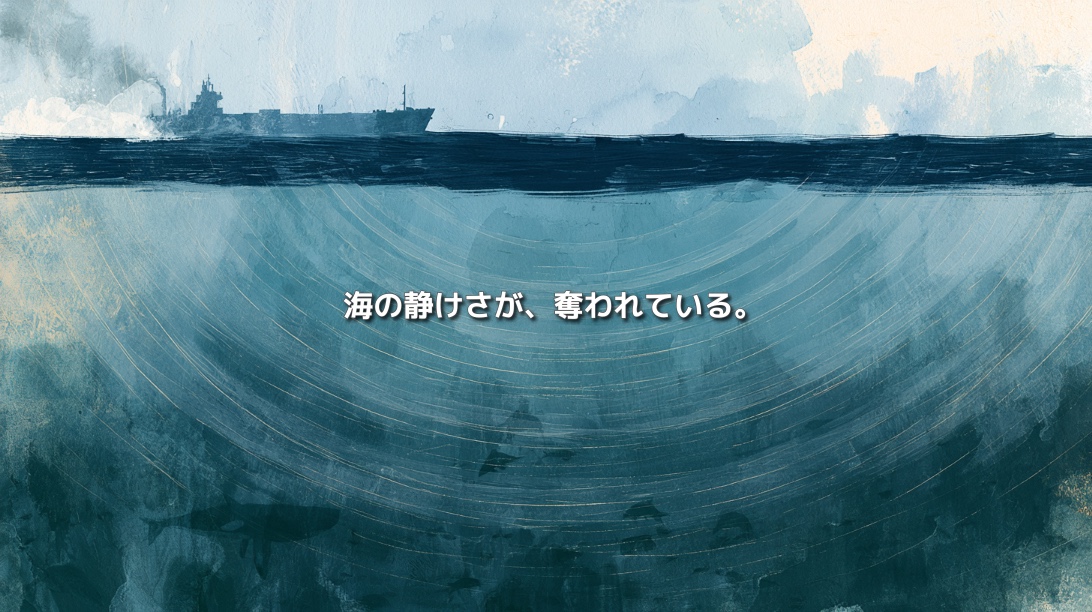
To us, the ocean may seem like a quiet place.
But beneath the surface lies another world of sound.
The calls of whales and dolphins.
The movements of fish.
The subtle sounds made by shrimp and other crustaceans.
Natural sounds created by waves, rain, and geological activity on the seafloor.
And entering this soundscape are ship engines, rotating propellers, seabed construction, pile driving, dredging, resource exploration, and military sonar.
The ocean is never truly silent.
The problem is that human-generated noise is being layered onto natural sounds, altering the acoustic environment that marine animals need to survive.
Underwater noise is invisible.
It does not float on the surface like plastic waste, nor does it change the colour of the water. Yet human-generated sound can travel great distances underwater, potentially affecting animal behaviour and communication.
Marine pollution is not limited to physical substances.
Sound, too, is an environmental burden released into the ocean.
The Ocean Has Its Own Soundscape
On land, humans rely heavily on sight to understand their surroundings.
We see roads, buildings, facial expressions, and distant landscapes. Visual information helps us understand where we are.
Underwater, however, light does not travel far.
The deeper the water, the darker it becomes. Suspended sediment and other forms of turbidity can reduce visibility even further.
Sound behaves differently. It travels faster and farther through water than through air. Low-frequency sound, in particular, can travel over very long distances under certain conditions.
For many marine organisms, sound is therefore far more than one source of information among many.
It helps them:
- Find members of their group
- Locate food
- Avoid predators
- Attract mates
- Maintain schools or social groups
- Navigate and determine direction
These activities, essential to survival, are supported by sound.
This is not limited to whales and dolphins. Fish and some invertebrates can also detect sound and use it for behaviour, feeding, reproduction, and predator avoidance.
Marine organisms live surrounded by sound.
Every marine region has its own distinctive soundscape.
What Kinds of Noise Do Humans Release into the Ocean?
Human-generated underwater sound can broadly be divided into two categories.
| Type of sound | Main sources | Characteristics |
|---|---|---|
| Continuous noise | Cargo ships, tankers, ferries, fishing vessels | Produces persistent, often low-frequency sound while vessels move through the ocean |
| Impulsive or intermittent noise | Pile driving, seismic surveys, explosions, sonar | Produces repeated bursts of intense sound, sometimes over short periods |
The vessels moving across the world’s oceans every day are among the most significant sources of continuous underwater noise.
Ships are designed to reduce the noise and vibration experienced by people onboard. But a quiet interior does not necessarily mean that little sound is being radiated into the surrounding water.
Vibrations from engines and onboard machinery can pass through the hull and into the ocean.
Another major source is the propeller.
When a propeller rotates at high speed, pressure changes around the blades can create small vapour bubbles that rapidly collapse. This phenomenon, known as cavitation, reduces propulsion efficiency and generates underwater noise.
The amount and character of sound vary according to vessel type, speed, hull design, propeller design, and maintenance condition.
Two ships of the same size do not necessarily produce the same acoustic footprint.
When Human Noise Masks the Voices of Marine Animals
The impact of underwater noise is not limited to hearing damage caused by extremely loud sounds.
Another important effect is known as acoustic masking.
Masking occurs when human-generated noise covers the sounds that animals are trying to detect.
In a crowded room, it becomes difficult to hear the person speaking beside you. Near a construction site, the voice of someone standing only a short distance away may disappear beneath the machinery.
Something similar can happen underwater.
A call to another member of the group may no longer reach its destination.
An animal may be unable to detect a potential mate.
The sounds produced by prey may become harder to locate.
An approaching predator may go unheard.
Acoustic cues used for migration and navigation may be obscured.
When important sounds become difficult to hear, animals may call more loudly, change the frequency or timing of their vocalisations, or leave noisy areas.
But not every animal can simply move elsewhere.
The noisy location may be a spawning ground.
It may be an especially productive feeding area.
It may lie along an essential migration route.
Underwater noise does not always kill marine animals directly.
Instead, it can gradually take away the information they need to live.
That is what makes the problem so difficult to see.
Impact Cannot Be Judged by Volume Alone
It is difficult to define a single decibel level at which underwater noise becomes dangerous.
Its effects depend on several interacting factors:
- Sound intensity
- Frequency
- Duration
- Number of repeated exposures
- Distance from the source
- Water depth and seabed topography
- Water temperature and salinity
- Species and stage of development
- Breeding, spawning, and migration seasons
- The ecological importance of the affected area
A single intense sound and a quieter sound repeated every day may produce different kinds of impact.
A frequency that humans can barely hear may also carry essential information for another species.
We cannot judge whether the ocean is quiet by using the human ear as the standard.
Shipping Creates the Ocean’s Background Noise
Global logistics depend on the sea.
Food, energy resources, vehicles, clothing, raw materials, and manufactured products are transported by ship every day.
For an island country such as Japan, maritime transportation is essential to trade and daily life. Simply stopping ships is not a realistic option.
The real question is how much underwater noise can be reduced while maintaining global logistics.
In 2023, the International Maritime Organization approved revised guidelines for reducing underwater radiated noise from commercial shipping. In 2024, the IMO also approved an action plan to address barriers to the wider adoption of noise-reduction measures.
Potential measures include:
- Designing quieter hulls and propellers
- Reducing vibrations from engines and onboard machinery
- Cleaning and maintaining propellers and hull surfaces
- Adjusting vessel speed according to local ecosystems and sea conditions
- Moving shipping routes away from important whale breeding and feeding areas
- Measuring the underwater noise of individual vessels
- Developing ship-specific underwater noise management plans
In Washington State’s Puget Sound, a voluntary slowdown by large commercial vessels was reported to reduce the underwater noise reaching endangered Southern Resident killer whales by approximately half.
This suggests that improvement may be possible even without immediately replacing an entire fleet.
Changes in speed, routes, maintenance, and operating practices can all make a difference.
Underwater noise is not only a technological problem.
It can also be reduced by changing how we use the ocean.
The Additional Challenge of Offshore Wind Power
Offshore wind energy is being developed around the world as part of the transition away from fossil fuels.
Using winds over the ocean to generate electricity is an important option for reducing greenhouse gas emissions.
But renewable energy does not automatically have zero impact on the natural environment.
For fixed-bottom offshore wind turbines, pile driving during the installation of foundations can generate powerful impulsive sounds. After the turbines begin operating, vibrations from machinery and noise from maintenance vessels may also enter the marine environment.
This creates a difficult relationship.
Infrastructure intended to mitigate climate change may place a different kind of pressure on the marine ecosystem where it is constructed.
The appropriate response is neither to reject offshore wind automatically nor to assume that it is harmless because it produces renewable energy.
Instead, projects should:
- Measure the existing soundscape before construction
- Identify the distribution of marine species and seasonal changes
- Monitor noise during construction
- Continue assessing changes after operations begin
- Modify mitigation measures when monitoring reveals unexpected effects
Draft environmental assessment guidance published by Japan’s Ministry of the Environment emphasises seasonal underwater sound surveys, comparisons before, during, and after construction, and the continued disclosure of results.
Unless we understand what the acoustic environment was like before development, we cannot determine what the project has changed.
A Wall of Bubbles That Blocks Sound
Technologies are also being developed to reduce noise from marine construction.
One example is the bubble curtain.
Compressed air is released through pipes installed on the seafloor, creating a wall of small bubbles around a pile-driving site.
Because sound travels differently through water and air, the bubble layer can reduce the amount of construction noise spreading into the surrounding ocean.
Other mitigation measures include:
- Noise-insulating structures placed around piles
- Sound-absorbing materials
- Construction techniques that reduce vibration
- Foundation systems that require less impulsive installation
Bubble curtains, however, are not a universal solution.
Their effectiveness varies with water depth, currents, seabed conditions, and sound frequency.
It is not enough to say that a mitigation system was installed. Projects must measure how much noise was actually reduced.
Environmental protection does not end when equipment is placed in the water.
Measure the result.
Confirm its effectiveness.
Change the method when necessary.
Adaptive management—adjusting a plan to actual conditions in the ocean—is essential.
Ocean Noise Crosses National Borders
Ships travel across national boundaries.
The sound they generate does not remain inside a single port or territorial sea.
A vessel built in one country may pass through the waters of several others before reaching a distant port. Even if one port or company introduces effective measures, it will be difficult to improve the acoustic environment of an entire ocean without broader cooperation.
Underwater noise therefore requires international action.
This may include:
- Common standards for ship design
- Comparable methods for measuring underwater noise
- Noise assessment systems in ports
- Incentives for quieter vessels
- Shipping routes that avoid important habitats
- Marine acoustic data that can be compared across countries
Like marine debris and greenhouse gas emissions, underwater noise is an environmental problem in which the source and the location of the impact may be far apart.
It raises a wider question:
Who has the right to use the ocean, and who is responsible for protecting it?
A Quieter Ship May Also Be a More Efficient Ship
Reducing ship noise does not necessarily have to be treated only as an environmental cost.
Cavitation around a propeller generates noise, but it can also waste energy and damage components.
Maintaining hulls and propellers, reducing resistance, and controlling unnecessary vibration may help reduce both fuel consumption and greenhouse gas emissions.
Efficiency is not simply the ability to travel faster.
It can also mean moving with less energy, producing less vibration and noise, and creating less pressure on marine ecosystems.
Future vessels may be evaluated not only by their cargo capacity and fuel efficiency but also by how quietly they can pass through the ocean.
Maritime industry and marine conservation do not always have to stand in opposition.
Better ship design, operation, and maintenance may create opportunities to support logistics and biodiversity at the same time.
Listening to a Problem We Cannot See
We cannot see underwater noise by looking at the surface.
When a ship passes, people on land cannot know what kind of sound is spreading beneath it.
That is why measurement matters.
Hydrophones can record the acoustic environment of a marine area. These recordings can be compared with vessel positions, operating speeds, and the distribution of marine species.
Changes over time—including breeding and migration seasons—can also be tracked.
The marine environment must be recorded not only through water quality and temperature but also through its soundscape.
Only then can we identify where quiet marine areas remain, where human noise is increasing, and which mitigation measures are working.
An invisible environmental problem cannot be protected while it remains unmeasured.
The first step is to listen.
To understand the acoustic world in which marine animals live.
That is where action on underwater noise must begin.
Conclusion
The ocean is not silent.
It has always contained a rich soundscape created by waves, rain, geological processes, and marine life.
The problem is not simply that humans add sound to the ocean. Shipping, fishing, ports, marine construction, and energy development are necessary parts of modern society.
The question is whether our noise is masking the sounds that marine animals need to survive.
Plastic waste can be collected.
Wastewater can be treated.
Greenhouse gas emissions can be calculated.
Sound, however, spreads the moment it is produced and then disappears.
Because it leaves no visible trace, it is difficult to recognise.
Because we cannot see it, it is easy to postpone action.
Protecting the ocean means more than keeping its water clean.
It also means preserving an acoustic environment in which marine animals can hear one another, find food, reproduce, avoid danger, and navigate.
Some ecosystems become visible only after we begin to consider what the ocean sounds like.
Frequently Asked Questions
Is underwater noise only a problem for whales and dolphins?
No. The effects on whales and dolphins have been studied extensively, but fish and some invertebrates can also detect and use sound for reproduction, feeding, navigation, and predator avoidance. Underwater noise should be considered an ecosystem-wide issue.
How can noise from ships be reduced?
Possible measures include improving hull and propeller design, reducing machinery vibration, regularly cleaning and maintaining hulls and propellers, adjusting vessel speed, and routing ships away from ecologically important habitats.
Is offshore wind power harmful to marine life?
It cannot be judged uniformly. Pile-driving noise during construction is a particular concern, but its impact varies according to location, construction method, season, species, and mitigation measures. Monitoring should continue from before construction through operation, with measures revised according to the results.
Does underwater noise affect humans?
If noise affects fish populations and marine ecosystems, the consequences may extend to fisheries, food supply, tourism, and local cultures. This is not an issue confined to marine animals.
References
- International Maritime Organization: Ship Noise
- NOAA Fisheries: Ocean Noise
- NOAA Fisheries: Understanding Sound in the Ocean
- Ministry of the Environment, Japan: Draft Technical Guide for the Environmental Impact Assessment of Offshore Wind Farms
- NOAA Fisheries: Voluntary Ship Slowdown Reduces Underwater Noise Reaching Killer Whales
- U.S. Bureau of Ocean Energy Management: Underwater Noise Mitigation