Skipping rope.
Repeating combinations during shadowboxing in front of a mirror.
Striking the mitts held by a trainer and driving punches into a heavy bag.
These familiar scenes inside boxing gyms have changed remarkably little since Ashita no Joe began serialization in Japan in 1968.
Training equipment has become more sophisticated. Coaches can now measure heart rate, fatigue, punching speed, and physical condition with data.
Yet boxers still skip rope, face the mirror, and hit the bag.
Why have training methods used more than half a century ago survived until today?
It is because the trainers and fighters of that era understood the human body through a method different from modern sports science.
They may not have been able to explain why a particular exercise worked using the language of physiology or biomechanics.
Through countless hours of practice, however, they understood what made a boxer stronger.
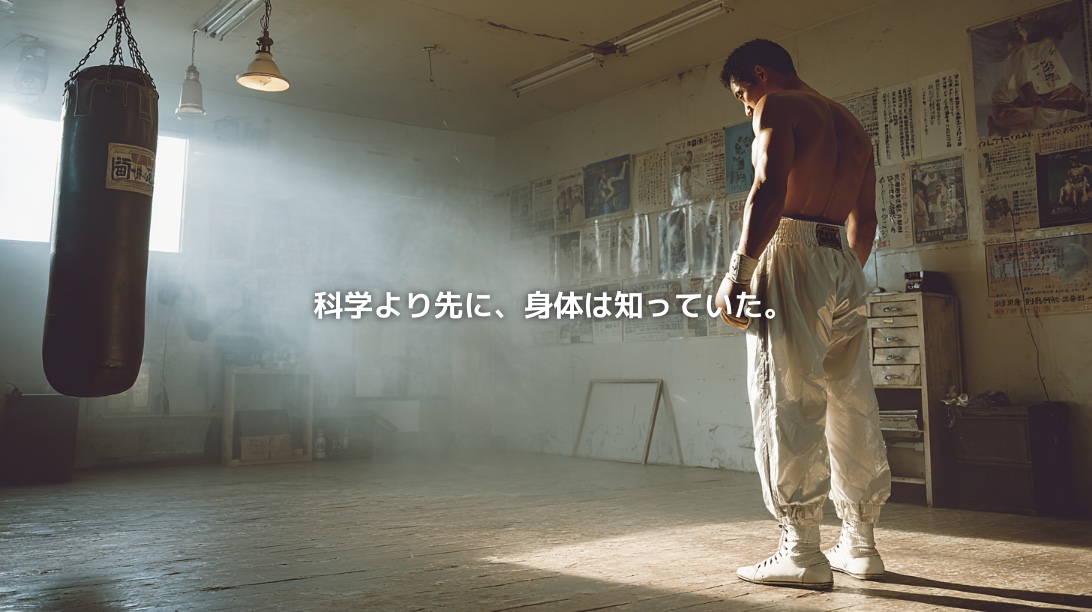
The body had found the answer before science gave it a name.
These Training Methods Existed Before Ashita no Joe
The boxing exercises depicted in Ashita no Joe were not invented during the 1960s.
Skipping rope, shadowboxing, heavy-bag training, and punching-ball exercises had already become established components of modern boxing training by at least the early twentieth century.
Jack Dempsey, who became world heavyweight champion in the 1920s, discussed rope skipping and bag training in detail in his book Championship Fighting.
Dempsey and the fighters of his era may not have known terms such as “stretch reflex” or “kinetic chain.”
Nevertheless, experience in the ring had taught them that light footwork supports both attack and defense, that punching power does not come from the arms alone, and that repeated practice refines the body’s movements.
Boxing training was not designed inside a laboratory.
It was tested in the ring. Methods were repeatedly selected and discarded, and those that produced results survived.
How Modern Science Explains Traditional Experience
| Training method | Traditional understanding | Modern interpretation |
|---|---|---|
| Rope skipping | Develops stamina, stronger legs, and lighter footwork | Improves cardiovascular fitness, lower-body reactivity, rhythm, ground contact, and whole-body coordination |
| Shadowboxing | Checks form and recreates a fight in the imagination | Repeats technical movements and refines movement patterns and decision-making against an imagined opponent |
| Focus-mitt training | Develops the instinct to strike a moving target and builds coordination with the trainer | Integrates visual information, distance, timing, tactical decisions, and striking movements |
| Heavy-bag training | Develops powerful punches and the stamina to continue striking | Repeats the kinetic chain that transfers force from the legs through the hips, torso, shoulders, and fist |
| Speed bag | Develops rhythm and hand speed | Improves repeated upper-limb movement, rhythm, endurance, and hand–eye coordination |
| Double-end bag | Sharpens reactions against a moving target | Trains distance perception, accuracy, defense, reaction speed, and transitions into the next attack |
It is important to note that the Japanese term often translated as “punching ball” can refer to more than one type of equipment.
A small speed bag suspended from above is mainly used to develop rhythm and continuous hand movement.
A double-end bag, secured by elastic cords at both the top and bottom, returns along less predictable paths. It is better suited to training distance, accuracy, reactions, evasive movement, and follow-up attacks.
The equipment may appear similar, but the abilities being developed are not entirely the same.
Rope Skipping Is More Than Stamina Training
Traditional trainers described rope skipping as a way to “make the feet lighter” or “put spring into the legs.”
These were not scientific terms.
As descriptions of bodily sensation, however, they captured something essential.
During rope skipping, the muscles and tendons are stretched when the feet contact the ground and then contract immediately afterward.
This sequence is now commonly described as the stretch-shortening cycle, or SSC.
A boxer does not continuously make large jumps around the ring.
Instead, the fighter repeatedly shifts their center of gravity, enters striking range, and moves away from an opponent’s punches.
Rope skipping teaches the body the rhythm and elastic response required for these small, continuous movements.
Some studies have suggested that training programs involving rope skipping may improve lower-body strength and striking-related performance.
The effects, however, depend on factors such as duration, intensity, and the athlete’s existing ability. It would therefore be misleading to claim that three three-minute rounds are sufficient for every boxer.
Modern science can now explain in greater detail what earlier trainers meant when they said that rope skipping made the feet feel lighter.
Shadowboxing Is a Dialogue with an Invisible Opponent
Shadowboxing is not simply the act of throwing punches into empty air.
An invisible opponent is present.
The opponent throws a jab. The boxer moves their head off the centerline, closes the distance, attacks the body, anticipates a counterpunch, and changes the angle.
Effective shadowboxing contains an imagined sequence of situations like these.
In Ashita no Joe, trainer Danpei Tange sends Joe—then being held in a juvenile detention center—the lesson known as “For Tomorrow, No. 1.”
The instruction is to master the left jab through relentless repetition.
By repeating the same movement, the boxer gradually becomes able to respond naturally when the moment arrives rather than first thinking and then moving.
In modern terms, this process increases the reproducibility and automaticity of a technical movement.
Repetition alone, however, does not guarantee improvement.
If a boxer repeatedly practices incorrect form, that incorrect movement may become deeply ingrained.
This is why correction through a mirror or an attentive trainer remains essential.
Even in the world of traditional experience, repetition and observation always worked together.
Punching Power Does Not Come from the Arms Alone
Watching a boxer strike a heavy bag may create the impression that punching power is produced by arm strength.
In reality, significant force reaches the target only when several parts of the body work together: the legs press against the floor, the hips rotate, and force travels through the torso, shoulders, arms, and fist.
Today, this coordinated transfer of force is described as a kinetic chain.
Traditional boxing trainers expressed the same idea differently:
“Put your hips into it.”
“Punch from the feet.”
“Do not punch with the fist alone.”
The words were different, but the physical phenomenon they observed was much the same.
The heavy bag shows the boxer whether force has traveled efficiently through the entire body. It communicates through impact, sound, and movement.
In other words, the bag itself functioned as a feedback device.
Was Danpei Tange an Unscientific Trainer?
From a modern perspective, Ashita no Joe depicts dangerous training practices, extreme weight loss, and forms of mental conditioning that would not be considered acceptable today.
Danpei Tange’s methods cannot simply be transferred into a modern training program.
That does not mean that everything he taught was irrational.
Break a technique into smaller elements.
Repeat a simple movement thoroughly.
Continue until the body can react without conscious hesitation.
Then transform that movement into a technique that works in an actual fight.
This fundamental approach remains relevant to modern skill acquisition.
Danpei did not have data collected through measurement equipment.
What he possessed was the ability to observe a fighter’s movement, breathing, gaze, fatigue, and fear at close range.
Perhaps this was not merely knowledge from an age before science.
It was embodied knowledge acquired through another method.
What Changed Was Not the Effectiveness, but the Way the Training Is Used
Rope skipping, shadowboxing, mitt work, and heavy-bag training all remain effective.
Modern coaches, however, no longer assume that doing more of an exercise will always make a fighter stronger.
They assess the athlete’s fatigue and adjust the intensity and volume according to a specific purpose.
They manage recovery through nutrition, hydration, and sleep while attempting to prevent injury and overtraining.
Video analysis and sensors can also measure punching speed, force transfer, left–right imbalances, and changes in heart rate.
The major difference between past and present lies less in the exercises themselves than in how they are distributed and managed.
Earlier training cultures often linked discipline closely with endurance and willpower. Excessive training and restrictions on drinking water could therefore be justified as tests of determination.
The greatest contribution of modern sports science has not been to reject traditional training.
It has enabled coaches to ask:
Which exercise should be performed?
By whom?
At what time?
At what intensity and volume?
Science Does Not Exist to Deny Experience
Practical knowledge often exists before science can explain it.
A craftsperson judges the condition of a material through touch.
A fisher senses changes in the sea through the air.
In the same way, boxers and trainers selected effective exercises by observing how the body responded.
Experience, of course, is not always correct.
Ineffective habits and practices that injured athletes have also survived under the name of tradition.
Science should therefore not accept experience unconditionally.
Its role is to test traditional knowledge and separate what is effective from what is dangerous.
The training methods that remain from the era of Ashita no Joe have not survived merely because they are old.
They have been tested by generations of boxers, and those with a degree of practical logic have been passed down to the present.
Engraving Tomorrow into the Body
“For Tomorrow, No. 1.”
What these words represent is not a secret technique.
Repeat a single movement again and again.
Continue the quiet, unglamorous practice today.
In doing so, the boxer builds tomorrow’s self into the body.
Fighters of the past could not explain muscular activity or the nervous system in the language available to sports scientists today.
Through their own bodies and the results they experienced in the ring, however, they continued searching for what worked.
Sports science has done more than simply prove traditional wisdom after the fact.
It has identified the logic contained within experience, removed errors and dangers, and updated old practices so they can be used more safely and effectively.
Science and experience are not opposites.
Science illuminates, through language and numbers, the answers that the body discovered first.
References
- Jack Dempsey, Championship Fighting: Explosive Punching and Aggressive Defense
- A Comparison of Plyometric and Jump Rope Training Programs on Health- and Sport-Related Physical Fitness in Male Youth Soccer Players
- Boxing Science: Strength Training for Boxing
- The Comics Journal: “Today’s Fight Starts Tomorrow—Ashita no Joe”
The rope-skipping study cited above examined male youth soccer players. Its results should not be directly generalized to boxers; it is included only as supporting material for understanding the physical characteristics of rope-skipping exercises.