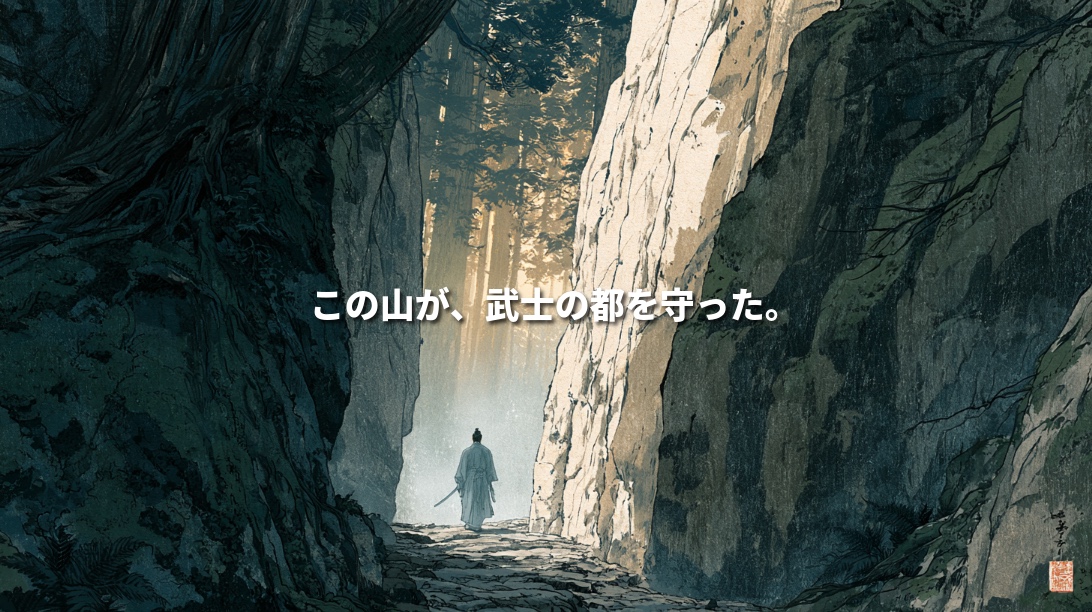
Mountains, sea, and the memory of power—reading a landscape shaped more than 800 years ago
NEOTERRAIN Journal | Intellectual Travel #02 | Kamakura, Kanagawa
Outside Kamakura Station, a stream of people makes its way toward the sea.
Souvenir shops line Komachi-dōri. The sweet scent of freshly baked treats drifts through the air. An old temple waits beyond a side street. Walk a little farther, and you can smell the ocean.
This is a city that draws travelers in.
Yet more than 800 years ago, the people studying this same landscape would have seen something different.
The mountains offered protection. The sea provided routes outward. Roads determined how people and supplies could enter the city.
Together, these features helped sustain a new center of power.
Why did Minamoto no Yoritomo choose Kamakura?
The answer begins with the shape of the land.
01 | Mountains on Three Sides, the Sea on the Fourth
Central Kamakura is enclosed by hills to the north, east, and west. To the south, it opens onto Sagami Bay.
On a map, the arrangement becomes clear: ridges curve around a small area of relatively flat ground.
Today, the hills provide a green backdrop, while the sea brings a sense of openness.
For the warriors who established their base here, these features also had strategic meaning.
Hills could impede an enemy’s approach. Narrow valleys restricted movement. Knowing and controlling the routes into the city could support its defense.
The terrain offered advantages that did not depend on constructing great stone walls.
Geography alone, however, cannot explain Yoritomo’s choice.
Kamakura also had strong associations with the Minamoto clan. Those connections mattered as he built a political base among the warriors of eastern Japan.
A new center of government emerged where the possibilities of the land met existing human relationships.
Kamakura’s location made sense through both geography and history.
02 | Establishing Power at a Distance from Kyoto
In 1180, Yoritomo entered Kamakura and began organizing his warrior following around this base.
Kyoto had long been the center of imperial government and court culture—a city of aristocratic households, established authority, and elaborate ceremony.
Making Kamakura his headquarters was a consequential political choice.
While maintaining relations with the imperial court, Yoritomo developed another center of government, grounded in the support of eastern warriors.
Kamakura grew into that role gradually.
People arrived. Roads were developed. Temples and shrines were built. Institutions took shape.
The city expanded alongside the government it housed.
Where Kyoto had accumulated centuries of courtly culture, Kamakura became a place where a rising warrior elite gave physical form to its authority.
These two historic cities tell different stories about how power takes root in a place.
03 | Wakamiya Ōji: An Avenue That Gave the City Its Axis
Wakamiya Ōji extends from Tsurugaoka Hachimangū toward the sea.
Visitors walk along it, admire the cherry blossoms, and stop outside shops.
But pause for a moment and ask: why does this avenue run here?
In 1180, Yoritomo relocated Tsurugaoka Hachimangū to its present site. The approach toward the sea subsequently developed as a central axis of the city.
The raised pedestrian approach known as the Dankazura is traditionally dated to 1182 and associated with prayers for the safe delivery of Hōjō Masako’s child.
A road can make a city’s priorities visible.
What occupies the center? Where does the main route lead? What does the arrangement ask people to recognize?
Kamakura’s organization around Tsurugaoka Hachimangū expressed the faith and authority of the warrior government.
That underlying structure remains legible today.
We still walk an urban axis established more than eight centuries ago.
Sometimes history continues into the present as a road beneath our feet.
04 | Kiridōshi: Gateways Cut Through the Hills
Along Kamakura’s hillside paths, there are places where exposed rock rises close on either side.
These are kiridōshi: passages excavated through the ridges.
Their narrowness can make a walker acutely aware of the surrounding terrain. Something of their tension is difficult to convey in a photograph.
The hills that offered defensive advantages also complicated access.
People, goods, and information needed routes through them. Cutting passages into the ridges connected Kamakura with surrounding areas while creating points where movement could be controlled.
Here lay a persistent challenge.
The city needed to limit access to protect itself. It also needed open routes to sustain its economy and cultural life.
Kamakura negotiated that relationship within the hills.
Walking through a kiridōshi, imagine the warriors, merchants, and travelers who once passed along these routes.
Between the quiet rock faces, the city’s history becomes a history of movement.
05 | Why Did Zen Appeal to the Warrior Elite?
Walk through Kamakura, and its temples become part of the rhythm of the journey.
Precincts sheltered by hillsides. Stone steps. Moss-covered gardens. Light filtering through trees.
During the Kamakura period, Zen Buddhism received substantial support from the warrior government. Its emphasis on seated meditation and disciplined practice is often understood as having appealed to warrior patrons.
It also arrived alongside influential cultural practices from China, including tea and the arts.
The city’s religious life belonged to a wider exchange of ideas, objects, and expertise.
Describing warrior culture simply as austere or rugged misses that richness.
What did powerful patrons consider beautiful? What did they value? What did they choose to support and pass on?
Over time, those choices found expression in buildings, gardens, vessels, and forms of conduct.
Perhaps some of the quiet we experience in Kamakura is cultural as well as natural—a quality cultivated through generations of practice.
06 | The Sea Connected a Sheltered City to the Wider World
An account centered on Kamakura’s hills can leave the sea at the edge of the story.
At Yuigahama Beach, it returns to view.
Waves approach the shore. Wind crosses the sand. The horizon opens.
Kamakura faced the sea even as hills enclosed its inland approaches.
Maritime routes offered ways for people and goods to move, connecting the city with places beyond its surrounding ridges.
Its sheltered position did not make it isolated.
The hills helped protect what lay within. The sea offered connections outward.
Both shaped the possibilities of this small stretch of land.
Stand on the beach and turn toward the hills. The space occupied by the city begins to make sense.
Looking inland from the shore becomes another way to read Kamakura.
07 | What Should a City of Visitors Protect?
Most people arriving in Kamakura today come to experience history, enjoy the scenery, or step briefly outside their usual routines.
A landscape once valued for sustaining political power now welcomes people seeking something different.
Yet welcoming visitors and sustaining everyday life can be difficult to balance.
Roads are narrow. Crowds enter residential streets. Transport becomes congested.
The qualities that draw people here can also come under pressure from their presence.
What, then, have we come to see?
A famous temple? A photogenic street? Or the accumulated lives and work that made these places meaningful?
If those lives matter to the journey, respecting the people who continue them must matter too.
Kamakura remains a place where people live, work, and shape the next chapter of the city.
Its history is still being made.
08 | Walking Kamakura Again
On your next visit, try a small change in perspective.
At Tsurugaoka Hachimangū, imagine the city’s axis extending toward the sea.
Along Wakamiya Ōji, consider why this straight avenue became so important to the city’s organization.
In a kiridōshi, notice how narrowness and steep terrain shaped movement. There is no need to touch the rock faces to sense the constraints they create.
At a temple, think about the ideas and cultural practices that warrior patrons welcomed.
And at Yuigahama, turn your back to the water and look toward the hills.
Another Kamakura begins to emerge.
A political experiment between mountains and sea.
A place where warriors sought to establish a new order.
A city where faith and culture took root, and where visitors still arrive more than 800 years later.
The depth of a journey can lie in how much more clearly we come to understand a place.
The view may look familiar.
What it means to us has changed.
EDITOR’S NOTE — NEOTERRAIN
Kyoto and Kamakura remind us that cities emerge through different combinations of circumstances and decisions.
Kyoto accumulated the authority and culture of the imperial court. Kamakura became a base from which warriors developed another center of government.
Both worked with their terrain, created routes, drew people together, and cultivated cultural life.
They arrived at different forms.
Geography offers possibilities and imposes limits. Human choices give those conditions historical meaning.
Somewhere in that relationship, a city acquires its character.
Looking at Kamakura’s hills, a question comes to mind.
What future did people imagine when they chose this place eight centuries ago?
And what might we leave for the Kamakura of eight centuries from now?
Understanding changes the view.
NEOTERRAIN — Intellectual Travel
Further Reading | Intellectual Travel
Kyoto and Kamakura are both historic centers, but their foundations differ.
Explore the geography, water, and cultural work behind Kyoto’s long history:
Why Does Kyoto Still Feel Like Japan’s Thousand-Year Capital? — Original Japanese Article
References and Sources
The following sources are in Japanese.
- Agency for Cultural Affairs, Japan Heritage — “Iza, Kamakura” — The warrior government, urban structure, and Zen culture.
- Kamakura City Tourist Association — The Seven Kiridōshi Passes — The passes and their transport and defensive functions.
- Kamakura City — Dankazura — The history of the raised approach.
- Kamakura City — Historic Character and Urban Structure (PDF) — The city’s organization around Wakamiya Ōji.
- Ministry of Land, Infrastructure, Transport and Tourism — Kamakura, Home of the Samurai: World Heritage Nomination Overview (PDF) — Background on the relationship between terrain and warrior government; a historical nomination document.